


Proof of accommodation without premature room payment
A visa application often asks a simple question with significant financial consequences: where will the applicant stay throughout the proposed journey? A traveller may need to show accommodation before the visa authority has decided the case, yet paying the entire cost of several hotel stays at that stage can create avoidable financial exposure. Cancellation deadlines, exchange-rate changes and non-refundable rates can make an early purchase particularly risky when the appointment is delayed or the application outcome remains uncertain.
A dummy hotel booking for visa purposes offers an application-stage way to present the intended stay. It organizes the guest name, property, address, destination, check-in date, check-out date and confirmation information into a structured hotel reservation without requiring the applicant to prepay the complete accommodation cost. The resulting document helps explain the lodging plan while leaving the final travel purchase until the appropriate stage.
The word dummy must not be confused with fabricated. A responsible dummy hotel reservation is not a hotel logo pasted onto an editable template, an invented confirmation number or an altered booking document. It is a temporary accommodation reservation prepared around the genuine details supplied by the traveller. Its purpose is to support a truthful proposed itinerary—not to create a false stay or guarantee a decision.
This guide explains how to book a dummy hotel for a visa application online, how validity works, how to review the reservation through CheckMyTrip, how to coordinate accommodation across a Schengen journey and how to recognize a service that provides meaningful value rather than a disposable PDF.
What is a dummy hotel booking for visa purposes?
A dummy hotel booking is a temporary accommodation reservation used to show where an applicant intends to stay during a proposed trip. It may be described as a hotel reservation for visa, hotel itinerary, accommodation confirmation, proof of lodging, temporary hotel booking or proof of accommodation for a visa application. These expressions overlap, although the wording used by a particular embassy, consulate or visa application centre should guide the applicant.
A properly arranged hotel confirmation normally identifies:
- the lead guest or all relevant guests;
- the hotel or accommodation property;
- the complete property address;
- the destination city and country;
- the check-in and check-out dates;
- the number of rooms, guests or nights where applicable;
- a reservation or confirmation reference;
- the property contact information when available; and
- the applicable booking or stay information.
It is important to distinguish four different items:
- A hotel reservation for visa presents an intended stay during the application stage.
- A prepaid hotel voucher indicates that accommodation has been paid according to the issuer’s terms.
- A direct hotel confirmation may be issued by the property after a booking is made with it.
- An invitation or host declaration supports private accommodation and is not replaced by an unnecessary hotel booking.
Applicants staying with relatives, friends, employers, universities or event organizers should follow the evidence required for that arrangement. Ordering a hotel document when the application states that a private host will provide accommodation can create a contradiction instead of strengthening the file.
Why applicants book a temporary hotel reservation online
Online ordering makes it possible to coordinate accommodation without visiting a travel agency or contacting several hotels individually. More importantly, it allows the applicant to organize the stay after the visa form, route and appointment schedule have become sufficiently clear.
Applicants commonly use a temporary hotel reservation to:
- avoid paying the complete room cost before the visa decision;
- show accommodation for every relevant night;
- connect hotel dates with flight arrival and departure dates;
- present a single-city or multi-city stay clearly;
- include the correct guest name and property address;
- demonstrate the principal destination of a Schengen journey;
- replace an unclear or incomplete accommodation plan;
- prepare supporting documents for tourism, business, study, family visits or another eligible purpose; and
- retain correction support if an avoidable detail needs adjustment.
Convenience should never displace accuracy. A dummy hotel booking online is useful only when it reflects the journey described elsewhere in the application. A polished confirmation cannot repair an itinerary that assigns the applicant to two distant cities on the same night, leaves several nights uncovered or conflicts with the flight schedule.
Is a dummy hotel reservation suitable for a Schengen visa?
Proof of accommodation is a familiar part of Schengen visa preparation. The exact evidence varies according to the competent consulate, application location, visa purpose and applicant circumstances, so the current official checklist must always take priority. A hotel reservation can support the file when that checklist calls for accommodation bookings, proof of lodging or evidence showing where the traveller intends to stay.
The Schengen Area now contains 29 countries: Austria, Belgium, Bulgaria, Croatia, Czechia, Denmark, Estonia, Finland, France, Germany, Greece, Hungary, Iceland, Italy, Latvia, Liechtenstein, Lithuania, Luxembourg, Malta, the Netherlands, Norway, Poland, Portugal, Romania, Slovakia, Slovenia, Spain, Sweden and Switzerland.
A Schengen visa hotel booking should do more than mention a famous European city. It should help the assessing authority understand:
- where the applicant intends to sleep each night;
- which country is the principal destination;
- how long the traveller proposes to remain in every city;
- whether the accommodation dates correspond with the transport plan;
- whether movement between destinations is possible; and
- whether the stated stay supports the declared purpose of travel.
Consider an applicant proposing a twelve-night journey with five nights in Italy, three nights in Austria and four nights in Germany. The hotel confirmations should account for those periods without overlaps or unexplained gaps. The transport plan should also make movement from Italy to Austria and then Germany plausible. If the application is submitted to the Italian authorities because Italy is the principal destination, the overall file should genuinely support that conclusion.
The word perfect should be used carefully. No commercial reservation makes a visa application perfect and no provider can guarantee acceptance. A carefully arranged hotel itinerary is, however, well suited to a Schengen file when it is accurate, complete, current and consistent with the applicant’s genuine journey.
Who can order a visa hotel reservation online?
Visa Dummy Tickets serves applicants internationally. A customer can order from the United States, Canada, the United Kingdom, Australia, New Zealand, the UAE, Saudi Arabia, Qatar, Pakistan, India, Bangladesh, Sri Lanka, Nepal, China, the Philippines, Indonesia, Malaysia, Singapore, Nigeria, Ghana, Kenya, South Africa, Morocco, Egypt, Turkey, Brazil, Mexico, European countries and other locations.
The service can support intended stays for Schengen destinations and other visa markets, including the United Kingdom, Ireland, the United States, Canada, Australia, New Zealand, Japan, South Korea, China, Singapore, Malaysia and the UAE, whenever accommodation evidence is relevant to the responsible authority’s checklist.
The country from which an applicant orders does not create a special document category. A traveller in Canada applying for an Italian visa, an applicant in India preparing a French visa file and a customer in the UAE planning a German business trip all require the same foundation: correct identity, genuine proposed dates, appropriate destinations and accommodation that corresponds with the stated journey.
Information to prepare before placing the order
A smooth order begins before the checkout page. Collect the following information first.
Guest details
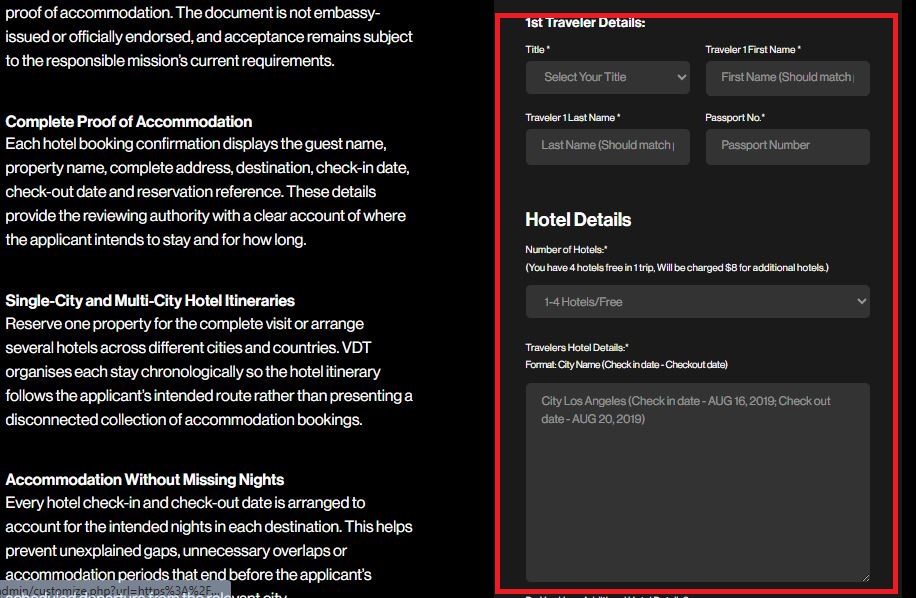
Enter the full name exactly as it appears in the passport. Preserve the spelling, order, spacing and any middle names required by the form. For family or group travel, confirm which guests must appear on each reservation and whether the rooms should be arranged together.
Travel dates
Use the intended arrival and departure dates from the visa application. Remember that a late-night flight, overnight sector or early-morning arrival can affect the first hotel night. Count nights rather than looking only at calendar dates.
Destination sequence
List every city in the order it will be visited. A multi-city application should not begin with isolated hotel requests. Establish the travel sequence first so that each stay fits naturally between the preceding arrival and following departure.
Property or area preference
Applicants may request a particular property, district or practical location. The final selection remains subject to availability and suitability. A famous hotel is not automatically the best choice if its location, dates or price level appear disconnected from the proposed plan.
Visa purpose
Tourism, business, study, conferences, medical visits and family travel can create different accommodation patterns. A business applicant may need a property close to a meeting venue, while a tourist may prefer access to the intended sightseeing area. The reservation should make sense in context.
Submission timetable
Know the visa appointment, online upload date or document-submission deadline. This allows the reservation to be prepared within a useful validity window rather than ordered so early that it becomes outdated.
How to book a dummy hotel for a visa application online
The following process keeps the booking efficient while reducing the risk of inconsistencies.
Step 1: Read the official accommodation requirement
Check the current instructions issued by the responsible embassy, consulate or authorized application centre. Determine whether the authority requests hotel reservations, proof of accommodation, a host declaration, an invitation, a campus residence letter or another form of lodging evidence.
Step 2: Finalize the journey before selecting hotels
Confirm the proposed countries, cities, arrival date, departure date and internal travel sequence. Hotel bookings should be built around the itinerary, not used to invent it afterward.
Step 3: Count every night
Create a simple night-by-night schedule. If the traveller arrives in Paris on 6 June and departs on 10 June, the stay normally covers the nights of 6, 7, 8 and 9 June, with checkout on 10 June. Apply the same method to every destination.
Step 4: Choose a single-city or multi-city arrangement
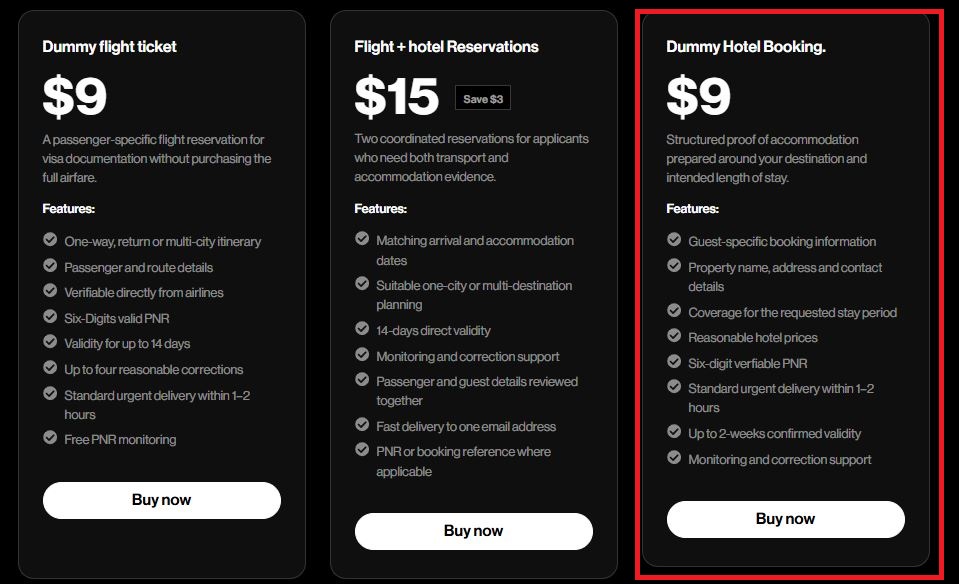
Select a single-city booking when the entire stay occurs in one destination. Choose a multi-city arrangement when the traveller will sleep in different locations. VDT pricing starts at $9 per traveller and includes up to four hotels within one trip; each additional hotel costs $8.
Step 5: Enter guest names exactly
Copy the details from the passport rather than typing from memory. An omitted surname, reversed name or informal spelling can disconnect the hotel reservation from the rest of the application.
Step 6: Add destination and property preferences
Provide the required cities and any preferred hotel or area. Preferences help shape the reservation, but the final property remains subject to availability and compatibility with the travel schedule.
Step 7: Review all dates before payment
Compare the order with the flight itinerary, visa form, insurance dates, invitation, leave approval and written travel plan. Correcting an error before processing is simpler than correcting it after delivery.
Step 8: Select the delivery timeframe
Choose the available processing option that fits the submission deadline. Urgent orders with complete information are commonly delivered within one to two hours, while ordinary processing should still leave enough time for careful review.
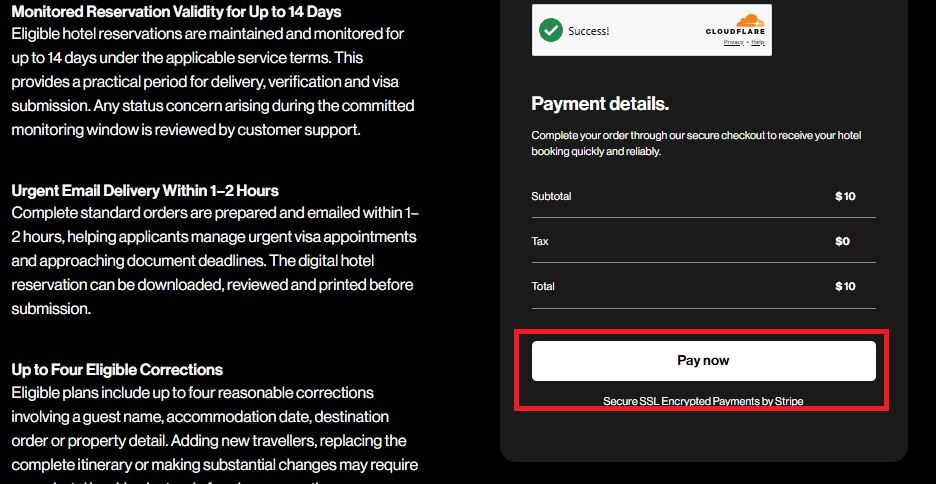
Step 9: Complete the payment
Pay only the stated reservation-service price through the available checkout method. This payment is for preparation and support; it is not the full room cost and does not transform the document into a prepaid hotel voucher.
Step 10: Receive the confirmation by email
Open the delivered file and inspect the guest, property, address, dates, destinations, number of nights and booking reference. Do not assume that an attractive layout means every entry is correct.
Step 11: Verify the reservation through CheckMyTrip
Use the supplied booking information to review the hotel reservation through CheckMyTrip. Compare the retrieved details with the delivered confirmation and report any discrepancy promptly.
Step 12: Request eligible corrections early
VDT allows up to four eligible corrections under the applicable terms. Submit correction requests as soon as an error or approved change is identified. Do not edit the PDF manually or create replacement details yourself.
Step 13: Recheck the document before submission
Inspect the reservation again close to the appointment or upload date. Confirm that the accommodation continues to match the final flight itinerary and application form.
How long is a dummy hotel booking valid?
Validity refers to the period during which the reservation is intended to remain useful and monitored under the provider’s terms. VDT offers monitored validity of up to 14 days. This extended window is designed to serve applicants who need time to receive the document, check it, request eligible corrections and submit it around a scheduled appointment.
Validity should not be treated as permanent ownership of a hotel room. Accommodation inventory and reservation systems remain subject to operational controls. The document is prepared for the visa-application stage and is not a promise that the room can be occupied without completing the hotel’s actual booking and payment requirements.
The timing strategy matters as much as the stated duration:
- Confirm the appointment or upload deadline.
- Stabilize the proposed route and stay dates.
- Order within the recommended service window.
- Review and verify the confirmation after delivery.
- Request corrections promptly.
- Recheck the reservation close to submission.
Some very cheap hotel reservations may last only a few hours or disappear before the applicant reaches the appointment. That apparent saving can become a false economy if the document must be replaced. Compare the monitored validity and support terms, not just the checkout price.
How to verify a dummy hotel booking
Verification enables the applicant to inspect the booking information rather than judging the document by appearance alone.
Use CheckMyTrip
The hotel reservation can be checked through CheckMyTrip using the booking information provided. Enter the required retrieval details carefully and compare the displayed record with the confirmation received by email.
Review the essential fields
Check the guest name, property, destination, check-in, check-out and reference information. A verification screen is useful only when the underlying entries correspond with the application.
Verify promptly and again before submission
Review the record soon after delivery so that any discrepancy can be raised during the correction period. Check it again near the appointment because a visa file should contain current and understandable accommodation information.
Understand the limit of verification
Verification confirms that the supplied booking information can be reviewed through the stated channel. It does not mean the complete room price has been paid, that check-in rights have been created or that the visa will be granted.
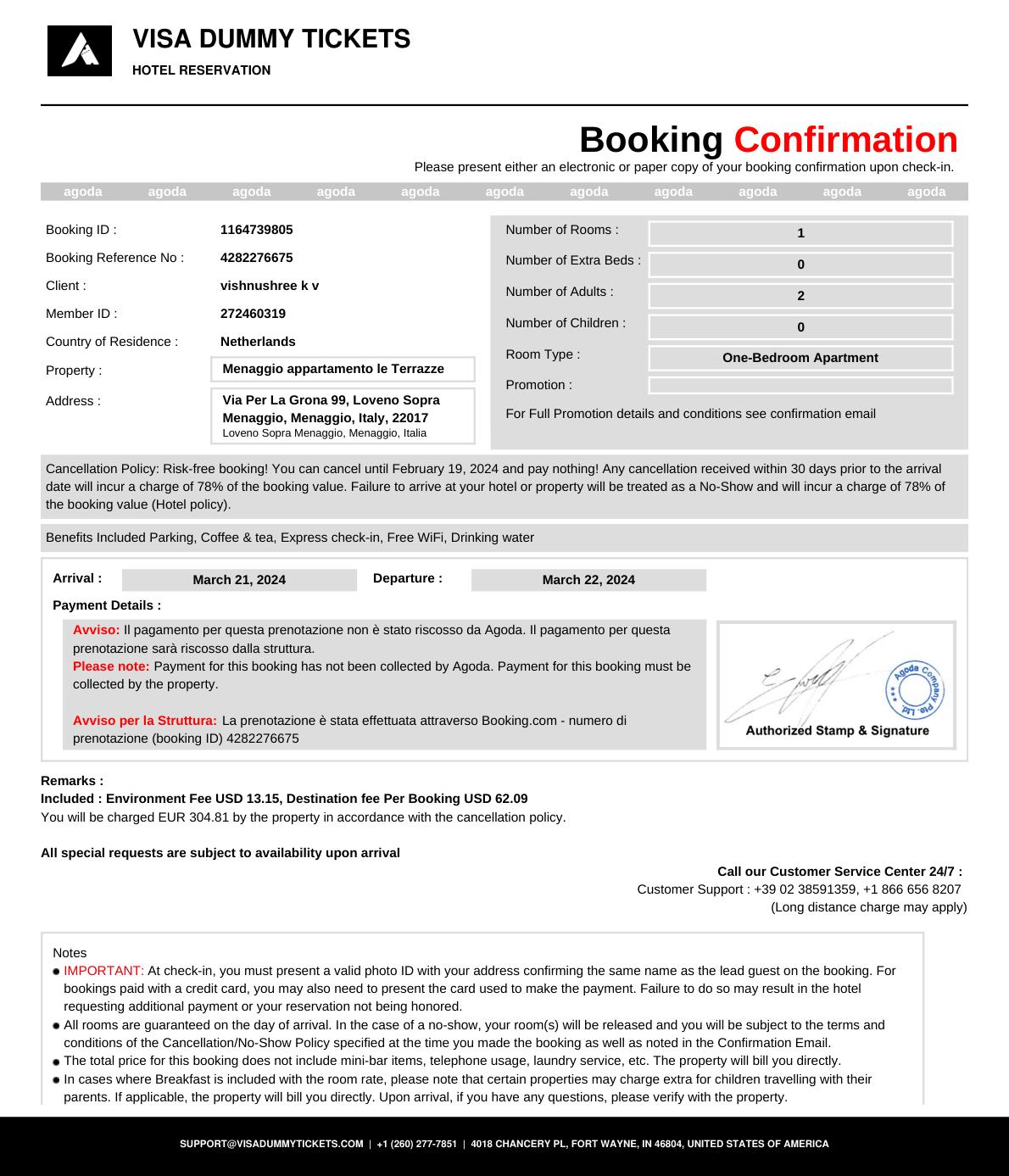
Sample dummy hotel bookings for visa application:
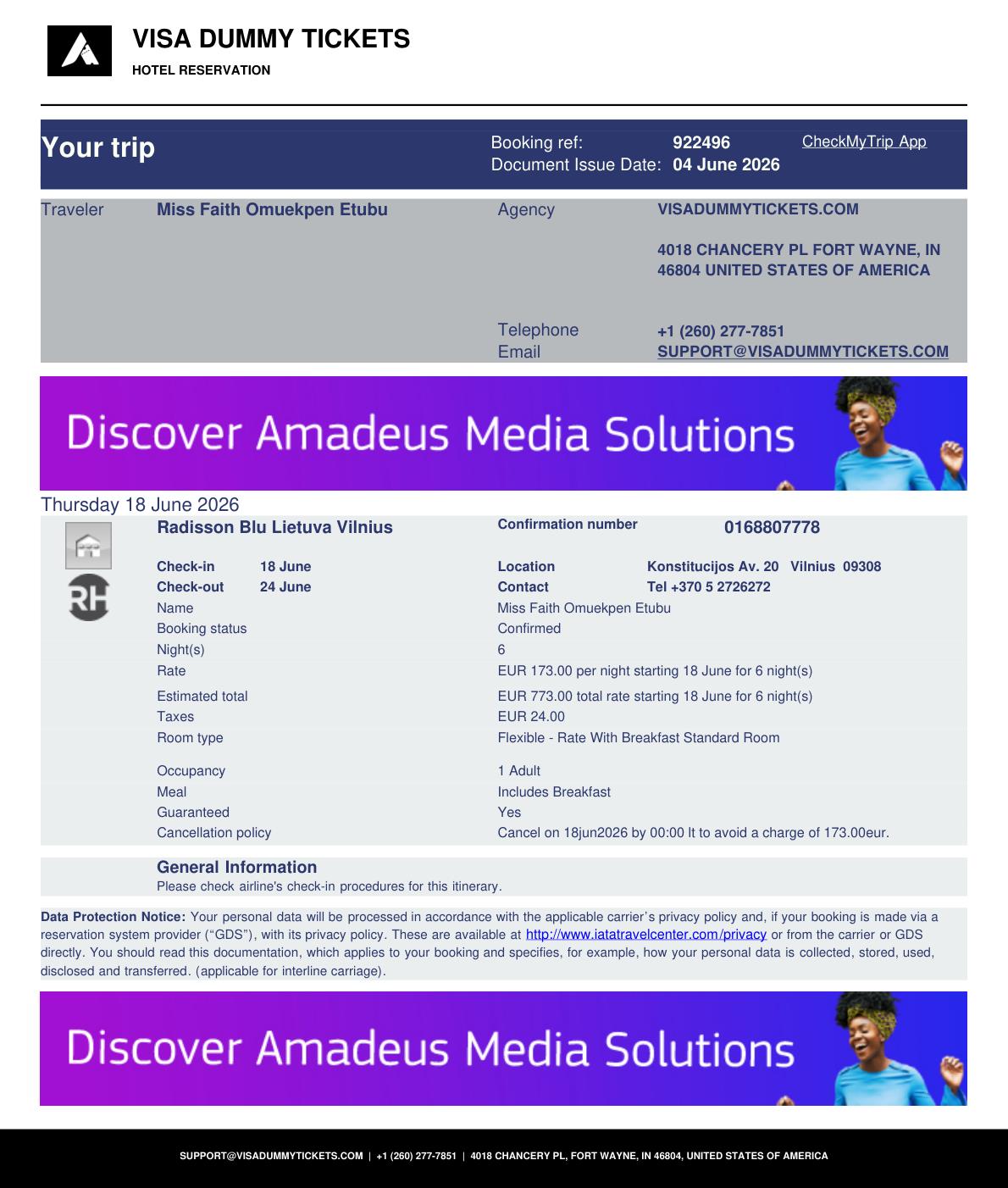
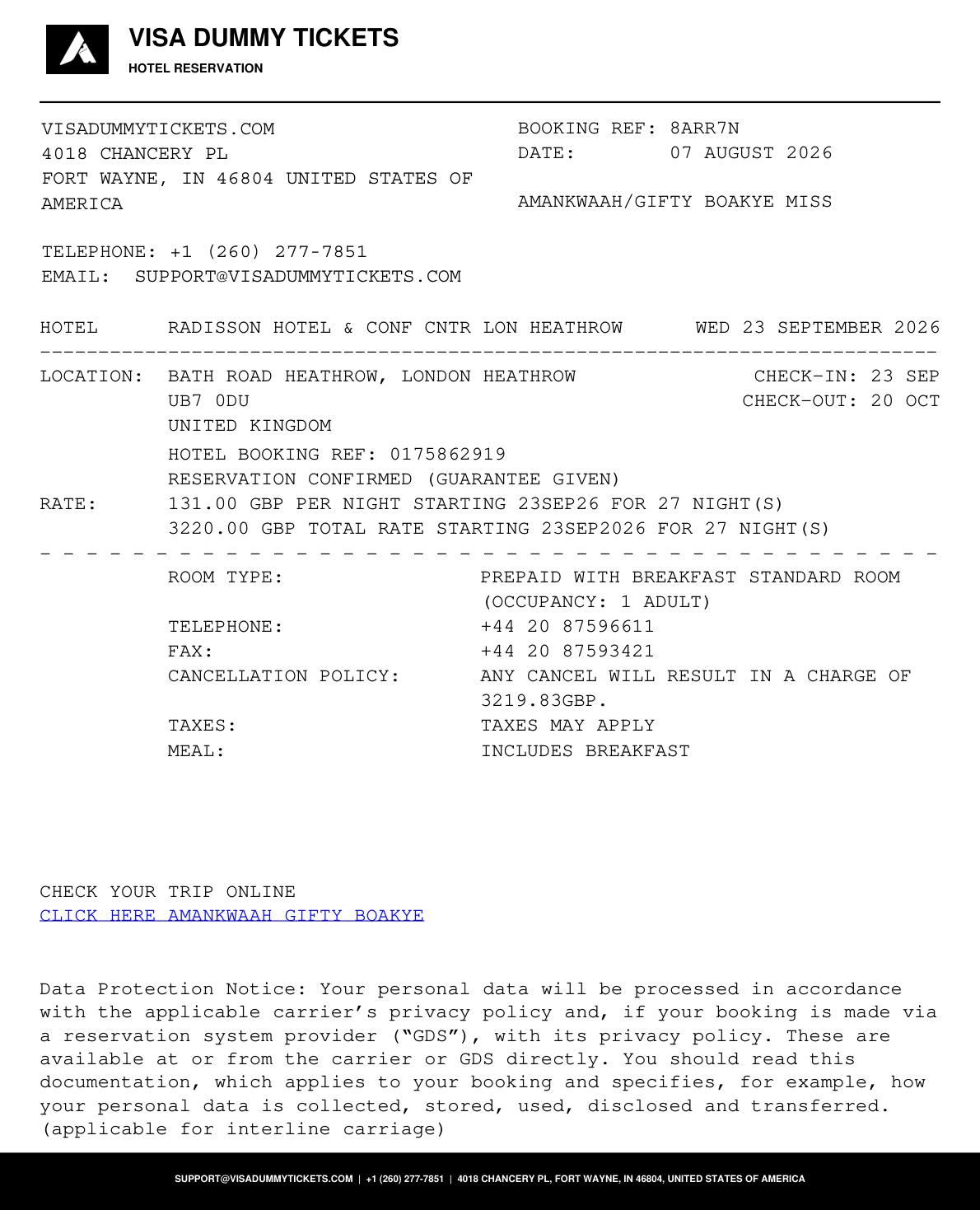
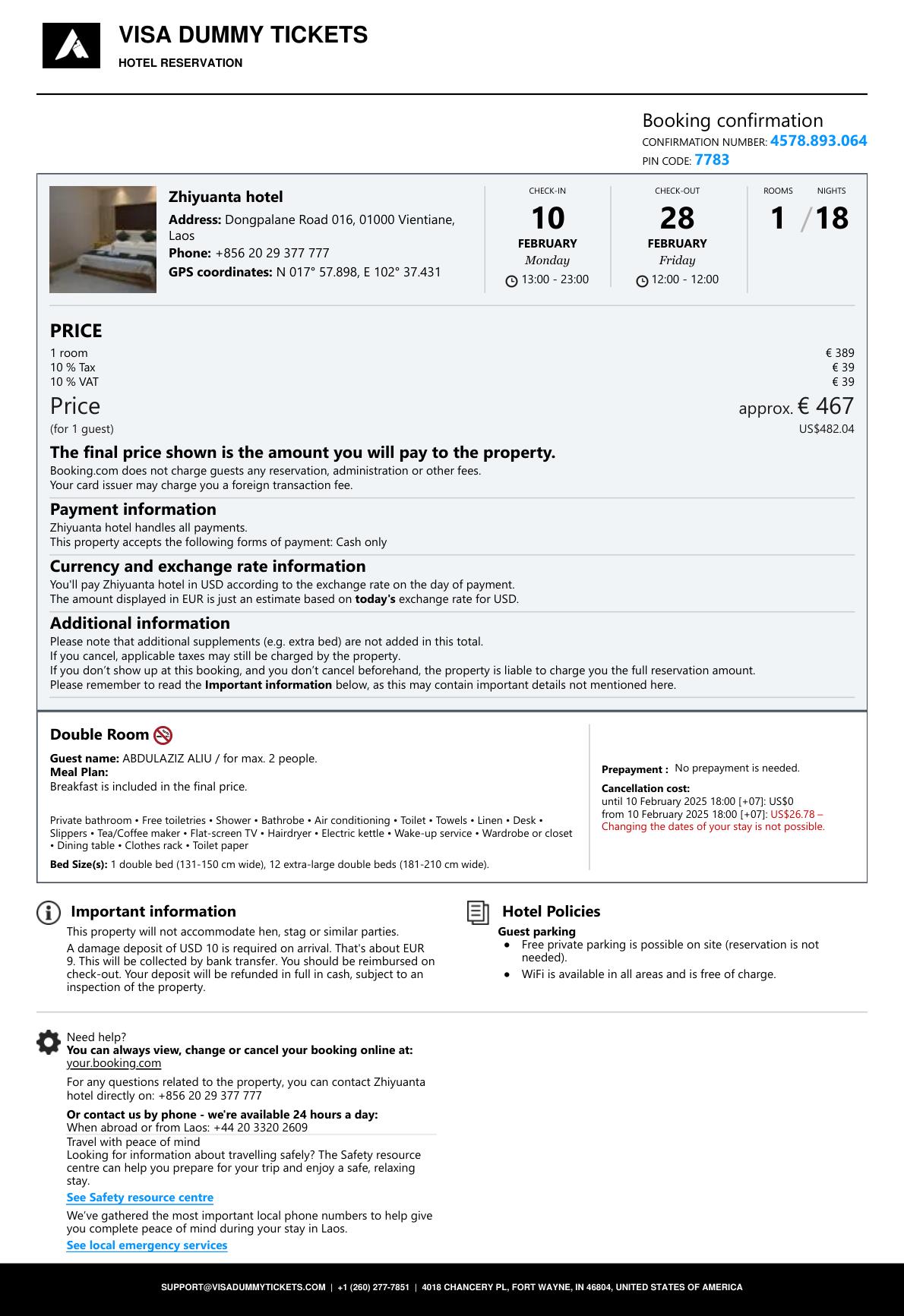
Matching hotel stays with the complete travel itinerary
An accommodation document does not operate in isolation. Its value depends on how well it supports the same journey presented by the surrounding evidence.
Match the first stay with arrival
The first hotel should be accessible after the traveller’s proposed arrival. If a flight lands late at night, account for airport transfer time and the hotel’s check-in conditions. An applicant should not appear to arrive after a reservation has already ended.
Match the final checkout with departure
The final checkout should connect logically with the return or onward flight. A departure several days after the last hotel checkout leaves an unexplained accommodation gap unless another form of lodging is documented.
Avoid overlapping cities
Two hotel bookings for the same applicant in distant cities on the same nights can suggest careless planning. An overlap may be legitimate in rare circumstances, but it should not appear accidentally.
Account for overnight transport
An overnight train, ferry or flight may explain why no hotel is required for a particular night. The itinerary should make that movement understandable rather than leaving an unexplained blank period.
Coordinate with travel insurance
Insurance dates should cover the intended travel period according to the official requirement. If the accommodation runs beyond the insured period—or vice versa—the application may appear internally inconsistent.
Keep the principal destination visible
For a Schengen application, the number of nights spent in each country can affect which authority is competent to assess the case. Do not distort the hotel schedule merely to obtain an appointment in a preferred location.
Single-city and multi-city hotel reservations
A single-city stay is usually straightforward: one property covers the accommodation period between arrival and departure. The main tasks are confirming the correct guest name, dates, address and number of nights.
A multi-city trip demands more judgment. Each property must fit into a sequence, and the time required to travel between cities must be considered. A sensible multi-city accommodation plan should answer three questions without forcing the reviewer to investigate:
- Where is the applicant staying on each night?
- How does the applicant move from one destination to the next?
- Why does the distribution of nights support the declared principal destination?
For example, an itinerary covering Madrid, Lisbon and Paris should not show a Barcelona property simply because it was inexpensive. The accommodation should reflect the actual destinations. Similarly, a hotel check-in in Paris on the same morning that the applicant remains booked in Lisbon may require explanation or correction.
How to compare cheap dummy hotel booking services
Searchers often look for a cheap dummy hotel booking, the lowest dummy hotel booking price or the best hotel reservation website for visa use. Affordability is reasonable, but price must be assessed against the complete service.
Confirm what the fee includes
VDT pricing begins at $9 per traveller and covers up to four hotels within one journey. Every additional hotel costs $8. This structure helps multi-city applicants understand the charge before processing.
Examine the validity period
A reservation that expires before submission has limited value. Look for a clearly stated period and an explanation of the support available during it. VDT provides monitored validity of up to 14 days under the applicable terms.
Require verification guidance
A provider should explain how the customer can review the reservation. VDT supplies booking information for CheckMyTrip verification instead of asking the applicant to rely on visual presentation alone.
Check the correction policy
Small mistakes can have serious consequences when names and dates must match several documents. VDT permits up to four eligible corrections under its terms, helping applicants resolve avoidable errors before submission.
Look for route-aware accommodation planning
A generic hotel template may fill a page without covering the journey. The provider should consider the arrival date, destination order, number of nights, onward movement and final departure.
Demand an honest service description
The provider should distinguish a reservation from a prepaid voucher and should never promise visa approval. Transparent limits are a sign of professional service, not a weakness.
Market terms and search synonyms explained
People use several phrases for accommodation evidence. Understanding them helps applicants find the relevant service without choosing an unsuitable document.
Dummy hotel booking for visa
This is the principal market phrase for a temporary hotel reservation prepared to support an application-stage travel plan.
Hotel reservation for visa application
This more formal phrase describes the same general purpose and may align more closely with embassy or application-centre wording.
Proof of accommodation for visa
This is a broader category. It may include hotel bookings, host invitations, rental agreements, campus housing or other lodging evidence, depending on the trip.
Hotel itinerary for visa
This often refers to one or several hotel stays organized in the order of travel. It is especially relevant to multi-city journeys.
Temporary hotel reservation
This phrase emphasizes the application-stage character of the booking. It should not be confused with a prepaid stay.
Verifiable hotel booking
Applicants using this phrase are usually looking for a confirmation they can review through a retrieval method such as CheckMyTrip.
Cheap hotel booking for visa
This search focuses on price, but the customer should still compare validity, correction support, verification and itinerary quality.
Confirmed hotel booking for visa
The word confirmed can be misunderstood. A reservation may carry confirmation information while remaining unpaid. Applicants should read the document and service terms instead of assuming it is a prepaid voucher.
Dummy hotel booking free PDF or hotel booking generator
These searches may lead to editable templates that do not represent reservation records. Applicants should never manufacture accommodation evidence or submit an invented property confirmation.
Natural use of these synonyms helps explain the service without repeating one keyword mechanically. Search visibility is strongest when the article answers the user’s real question rather than placing every phrase into every paragraph.
Common mistakes that weaken proof of accommodation
Leaving nights uncovered
Every night should be accounted for by a hotel, private host, overnight journey or another documented arrangement. A gap creates an obvious question about where the applicant intends to stay.
Using the wrong guest name
A shortened, reversed or misspelled name can make the reservation appear unrelated to the passport. Copy the identity carefully and inspect the delivered document.
Ignoring arrival and departure times
Hotel dates must be read together with flight times. Overnight sectors and early arrivals can change the required check-in date.
Showing contradictory accommodation types
Do not claim to stay with a relative while also presenting a hotel for the same period without explanation. The application form, invitation and accommodation evidence should communicate one plan.
Selecting unrealistic properties
A hotel should make sense for the destination and purpose. An impractical location or unexplained luxury property may not support the broader financial and travel narrative.
Creating impossible multi-city movement
Check travel time between destinations. A checkout and check-in on the same date may be reasonable between nearby cities but implausible across distant regions without a suitable transport connection.
Ordering too early
A temporary booking obtained weeks before it is needed may become outdated. Time the order around the actual appointment and monitored validity period.
Choosing only by price
The cheapest hotel reservation may lack sufficient validity, verification or support. Compare the practical value of the service rather than the headline fee alone.
Editing the delivered confirmation
Never change dates, guest names, references or property information manually. Request an eligible correction through the provider so the document and booking information remain aligned.
Treating the reservation as a check-in voucher
A visa hotel reservation is not proof that the room has been prepaid. Finalize the actual accommodation before travel and comply with the property’s payment and check-in requirements.
Frequently asked questions
What is a dummy hotel booking for a visa application?
It is a temporary accommodation reservation showing where an applicant intends to stay. It can contain the guest, property, address, dates and booking reference without requiring the complete room cost before the visa decision.
Is a dummy hotel reservation legal?
A genuine reservation based on accurate information is different from a forged document. Applicants must never submit an invented confirmation, edited template or false accommodation claim.
How do I book a dummy hotel for a visa online?
Confirm the official requirement, finalize the route, count every night, enter the passport name, provide destinations and dates, complete the order, review the emailed confirmation and verify it through CheckMyTrip.
How much does a VDT hotel reservation cost?
Pricing starts at $9 per traveller and includes up to four hotels within one trip. Each additional hotel costs $8.
How long does the hotel reservation remain valid?
VDT provides monitored validity of up to 14 days under the applicable terms. Order close enough to the appointment for that period to remain useful.
Can I verify the booking online?
Yes. Use the supplied booking information to review the reservation through CheckMyTrip and compare the retrieved details with the confirmation delivered by email.
Is CheckMyTrip verification proof that the hotel is prepaid?
No. Verification allows the reservation information to be reviewed. It does not prove that the full accommodation cost has been paid or create a right to check in without completing the property’s requirements.
Can I request a particular hotel?
Yes. You may provide a preferred property or area, but the final selection remains subject to availability and suitability for the itinerary.
Can one order cover several Schengen cities?
Yes. A multi-city order can include up to four hotels within the starting price, with an additional charge for each hotel beyond that number. Every stay should fit the journey logically.
Which Schengen countries can the reservation cover?
The service can support intended stays in Austria, Belgium, Bulgaria, Croatia, Czechia, Denmark, Estonia, Finland, France, Germany, Greece, Hungary, Iceland, Italy, Latvia, Liechtenstein, Lithuania, Luxembourg, Malta, the Netherlands, Norway, Poland, Portugal, Romania, Slovakia, Slovenia, Spain, Sweden and Switzerland.
Can applicants outside Europe order the service?
Yes. Customers can order internationally, including from the USA, Canada, UK, Australia, UAE, Saudi Arabia, Pakistan, India, China, Southeast Asia, Africa and Latin America.
Is the booking suitable only for tourist visas?
No. A hotel reservation may support tourism, business, study, conferences, medical visits, family travel and other purposes when accommodation evidence is appropriate. Follow the checklist for the exact visa category.
Do I need a hotel booking if I am staying with family or friends?
Not necessarily. If a host is providing accommodation, use the invitation, host declaration or other evidence required by the authority. Do not order an unnecessary hotel reservation that contradicts the application.
Should the hotel dates match the flight reservation?
Yes. Flight arrival, hotel check-in, onward travel, hotel checkout and departure should form one coherent timeline. Any legitimate difference should be understandable from the supporting documents.
What if my visa appointment changes?
Contact support as soon as the new date becomes known. The available solution depends on the reservation status, monitored validity and correction terms. Never alter the document manually.
How many corrections are included?
VDT allows up to four eligible corrections under the applicable service terms. Submit the requested changes promptly and provide accurate replacement information.
Is a dummy hotel booking the same as a prepaid voucher?
No. The reservation presents intended accommodation for the application stage. A prepaid voucher confirms payment according to its issuer’s terms and serves a different purpose.
Can a hotel reservation guarantee Schengen visa approval?
No. Only the competent authority decides the application. Accommodation is one part of a broader file that may include finances, purpose, insurance, employment, invitations and evidence of return.
When is the best time to order?
Order after the route and dates are stable and close enough to the visa appointment for the monitored validity period to overlap submission. Leave time for verification and eligible corrections.
What should I do after receiving the visa?
Finalize accommodation that suits the approved travel plan, confirm payment and cancellation terms, and obtain the documents required for actual check-in. Do not travel assuming that an application-stage reservation is a prepaid stay.
A well-planned stay strengthens the travel narrative
The best dummy hotel booking for visa purposes is not simply the cheapest PDF or the property with the most recognizable name. It is a carefully arranged reservation that identifies the correct guest, covers the intended nights, follows the destination sequence, corresponds with the flight itinerary and can be reviewed through a clear verification process.
For a Schengen visa, this coordination is especially valuable. The distribution of nights should support the principal destination, the properties should correspond with the cities in the written plan, and the first and final stays should connect naturally with arrival and departure. The accommodation record should reinforce the application rather than introduce a competing version of the journey.
VDT combines market-competitive pricing with up to 14 days of monitored validity, CheckMyTrip verification guidance, prompt email delivery and up to four eligible corrections under the applicable terms. Used responsibly, the service gives applicants an organized way to present proposed accommodation without committing to the entire room cost before the visa decision.
Begin with the official checklist, provide truthful traveller and itinerary information, inspect every night, verify the booking after delivery and recheck it before submission. A disciplined process turns a temporary hotel reservation into a clear and useful component of a professionally prepared visa file.