



Top 7 Schengen Countries with the Highest Visa Approval Rates in 2026
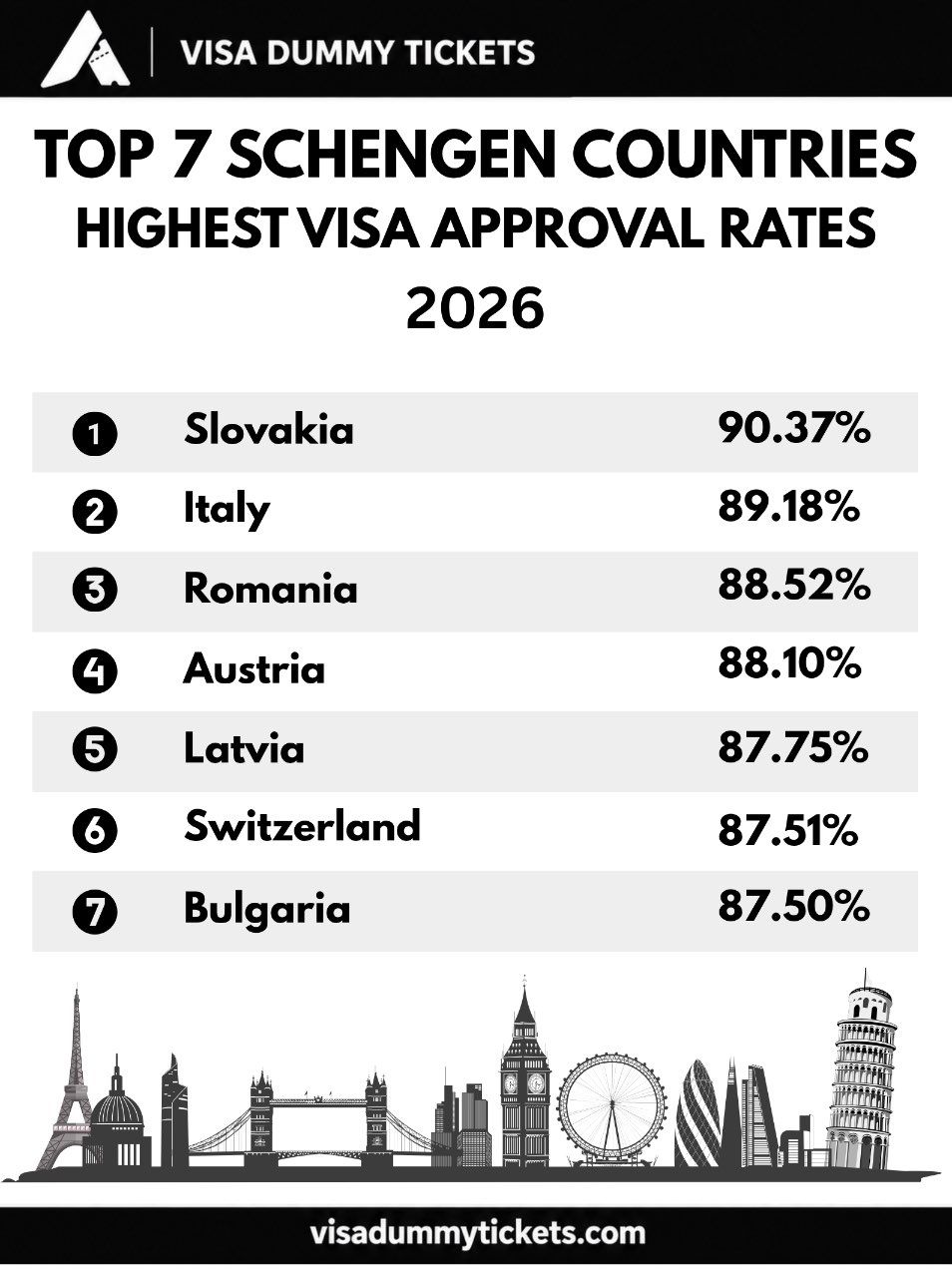
Planning a European trip often begins with one question: which Schengen countries have the highest visa approval rates? For travellers comparing destinations in 2026, the latest complete annual figures place Slovakia, Italy, Romania, Austria, Latvia, Switzerland, and Bulgaria in the top seven when approval is measured as the share of recorded short-stay visa decisions that resulted in a visa being issued.
Slovakia leads this decision-based ranking at 90.37%, followed by Italy at 89.18% and Romania at 88.52%. However, a strong national approval ratio is only part of the picture. It does not give every applicant the same chance, establish which embassy processes applications fastest, or allow travellers to apply through a country they do not genuinely intend to visit.
This guide explains the latest ranking, compares approval and refusal figures, examines what changed from the previous year, and shows how to prepare a clear application for each destination. It also briefly explains how to obtain a dummy ticket for Schengen visa applications through Visa Dummy Tickets when the relevant checklist accepts a flight reservation.
Top 7 Schengen visa approval rates at a glance
The seven countries below recorded the highest visa issuance shares among reported short-stay visa decisions in 2025. The same calculation is used for every country, and positions are determined before rounding.
| Rank | Schengen country | Applications received | Uniform visas issued | LTV visas issued | Approval rate | Refusal or nonissuance rate |
| 1 | Slovakia | 18,033 | 15,988 | 244 | 90.37% | 9.63% |
| 2 | Italy | 1,326,876 | 1,182,665 | 5,146 | 89.18% | 10.82% |
| 3 | Romania | 54,100 | 47,776 | 120 | 88.52% | 11.48% |
| 4 | Austria | 250,112 | 213,694 | 1,565 | 88.10% | 11.90% |
| 5 | Latvia | 19,222 | 16,677 | 364 | 87.75% | 12.25% |
| 6 | Switzerland | 619,323 | 538,341 | 3,611 | 87.51% | 12.49% |
| 7 | Bulgaria | 179,402 | 152,236 | 242 | 87.50% | 12.50% |
How to read the table: Uniform visas normally cover the Schengen area. LTV means limited territorial validity: these visas cover only the territory or territories specified on the visa. Both are successful issuance decisions in this approval calculation, but they do not provide identical travel rights.
The statistical non-issuance category includes refusals and certain applications for which examination was discontinued. Applications received and decisions recorded are separate annual counts, so the issued and non-issued totals do not necessarily add up to applications received.
Switzerland and Bulgaria are extremely close. Their unrounded approval rates differ by approximately 0.003 percentage points. Their sixth and seventh positions should therefore be understood as a statistical ordering, rather than a meaningful difference in an individual traveller’s prospects.
What the Schengen visa approval ratio actually measures
A Schengen visa approval rate is useful only when its calculation is clear. Some articles divide visas issued by applications received. Others subtract a published refusal rate from 100%. These approaches can produce different percentages and even different rankings.
For this article, approval means visa issuance among recorded decisions:
Approval rate = (uniform visas issued + LTV visas issued) ÷ (uniform visas issued + LTV visas issued + visas not issued) × 100.
Using Slovakia as an example, 15,988 uniform visas and 244 LTV visas were issued, while 1,729 visas were not issued. The calculation is 16,232 divided by 17,961 recorded outcomes, giving an approval rate of 90.37%.
If the 15,988 uniform visas were instead divided by the 18,033 applications received, the result would be 88.66%. That is a uniform-visa issuance-to-application ratio, which answers a different question. Neither percentage should be presented without explaining the denominator.
The ranking covers short stays rather than immigration outcomes
The country comparison concerns short-stay visa activity at consulates. It does not rank national long-stay work visas, residence permits, family reunification routes, or permanent immigration programmes. Airport transit visa figures and visas issued at external border crossing points are excluded from the ranking.
Tourist, business, family-visit, cultural, medical, and other eligible short-stay purposes can appear within the figures. The rates are therefore not a tourist-only success table or a separate approval estimate for first-time applicants.
A national average is not an individual prediction
An approval percentage summarises outcomes for a mixed group of applicants. That group may include experienced business travellers, organised tourists, family visitors, residents of different countries, and people with very different financial circumstances.
A national ratio does not isolate the effect of the destination itself. It also reflects where applications were submitted, the applicant population, travel purposes, and the records processed during that year. A small gap between countries can matter much less than whether an applicant has a credible purpose, sufficient funds, and a consistent travel plan.
The wider Schengen visa picture for 2026 applicants
The latest annual totals show substantial demand for European short stays. They also provide a useful baseline for understanding why the top seven stand out.
| Indicator | Complete 2025 annual figure |
| Uniform short-stay visa applications received | 12,201,026 |
| Uniform visas issued at consulates | 10,265,942 |
| LTV visas issued at consulates | 39,798 |
| Uniform and LTV visas issued together | 10,305,740 |
| Visas not issued | 1,768,605 |
| Visa issuance share of recorded decisions | 85.35% |
| Refusal or nonissuance share of recorded decisions | 14.65% |
| Multiple-entry uniform visas issued | 5,303,749 |
| Multiple-entry share of uniform visas issued | 51.66% |
Every country in the top seven sits above the overall decision-based approval rate of 85.35%. Slovakia exceeds that baseline by about 5.02 percentage points, while Italy exceeds it by about 3.82 percentage points.
Application volumes vary greatly. Italy received more than 1.32 million applications, compared with 18,033 for Slovakia and 19,222 for Latvia. Italy’s position therefore combines a high approval ratio with a much larger reported application volume. Smaller-volume leaders remain statistically relevant, but their figures describe narrower applicant populations.
The multiple-entry total also deserves careful interpretation. A multiple-entry visa can allow several journeys during its validity, subject to its conditions and the permitted stay. It does not automatically give the holder 90 days on every visit, and it does not mean a first-time applicant will receive a long-validity visa.
How the top seven changed from 2024 to 2025
Approval rates can change between reporting years. The following comparison recalculates approval consistently from recorded issuance and non-issuance outcomes in both years.
| Country | Approval rate in 2024 | Approval rate in 2025 | Change in percentage points |
| Slovakia | 90.06% | 90.37% | 0.32 |
| Italy | 89.11% | 89.18% | 0.07 |
| Romania | 90.63% | 88.52% | -2.10 |
| Austria | 86.33% | 88.10% | 1.77 |
| Latvia | 89.12% | 87.75% | -1.37 |
| Switzerland | 88.73% | 87.51% | -1.23 |
| Bulgaria | 90.60% | 87.50% | -3.09 |
Changes are calculated from unrounded rates, so subtracting the displayed two-decimal percentages may occasionally produce a slightly different rounded result. A percentage-point change is the difference between two rates; it is not a percentage increase in the number of visas issued.
Austria shows the largest improvement among these seven destinations. Italy remains comparatively stable, while Romania, Latvia, Switzerland, and Bulgaria record lower approval shares than in 2024. These movements describe outcomes; they do not, by themselves, prove that a country changed its legal requirements or became more or less welcoming.
Romania and Bulgaria also require historical context. Both began issuing Schengen visas following their integration into the common system in March 2024, and became full Schengen members on 1 January 2025. Their 2024 figures reflect a transition year, so comparisons with 2025 should not be treated as perfectly equivalent operating periods.
Why Iceland is outside this latest top seven
Iceland appears near the top of many older easy-visa lists. Its decision-based approval rate was 93.38% in 2024, but fell to 86.17% in 2025. Its uniform short-stay applications also rose from 35,413 to 67,380.
Iceland remains a legitimate destination for a genuine Iceland itinerary, but the latest figures place it below the seven countries ranked here. Reusing its older approval rate under a 2026 headline would give readers an outdated comparison.
Slovakia with a 90.37 percent approval rate
Slovakia ranks first in this comparison, with 18,033 applications received, 15,988 uniform visas issued, and 244 LTV visas issued in 2025. Its 1,729 non-issuance outcomes produce a refusal or non-issuance rate of 9.63%.
Its approval share rose from 90.06% in 2024 to 90.37% in 2025. This is a modest improvement, rather than evidence of a new guaranteed route to Europe. Slovakia processes substantially fewer applications than major destinations such as Italy, France, or Germany, so the composition of its applicant population matters when interpreting the figure.
Planning a genuine Slovakia trip
Slovakia suits travellers whose interests include Bratislava’s historic centre, regional towns, castles, and the High Tatras. An itinerary can combine a city stay with a separate mountain or countryside visit, provided the travel time and budget are realistic.
For example, a seven-night holiday could spend three nights in Bratislava and four nights in the High Tatras area. The application should show accommodation for both stops and explain how the traveller will move between them. A winter mountain trip also needs a sensible plan for the season, rather than a list of distant attractions copied into a cover letter.
Some travellers reach Slovakia through Vienna and continue overland to Bratislava. Entering through Austria does not automatically make Austria the correct country for the visa application. If Slovakia is the genuine main destination, the reservation and onward transport plan should make that clear.
How to get a dummy ticket for a Slovakia visa
Use the VDT flight reservation service to request the actual route you intend to follow, including your entry airport, return sector, and travel dates. If arriving through Vienna, explain the onward journey to Slovakia in your itinerary and include the transport evidence required by the checklist.
Slovakia’s visa guidance for applicants in India distinguishes a confirmed round-trip booking from the later purchase of the travel ticket. This supports using a reservation at the application stage where that checklist applies. Other filing locations should follow their own current instructions.
After receiving the dummy ticket, verify the booking reference and passenger details. Match the dates with hotel stays, approved leave, and travel insurance. Slovakia’s high approval rate is useful context, while the application still needs to establish why the proposed Slovak visit makes sense for that traveller.
Italy with an 89.18 percent approval rate
Italy combines the second-highest decision-based approval rate in this ranking with the largest application volume among the seven. It received 1,326,876 applications, issued 1,182,665 uniform visas and 5,146 LTV visas, and recorded 144,181 non-issuance outcomes in 2025.
The resulting approval share is 89.18%, with a refusal or non-issuance rate of 10.82%. Italy’s comparable approval rate in 2024 was 89.11%, showing relatively little movement between the two annual periods.
This is a useful distinction for travellers researching countries with high Schengen visa acceptance rates. Italy’s position rests on a large volume of reported activity, rather than a very small set of applications. It still does not establish an equal approval probability for every nationality, consulate, or travel purpose.
Planning a genuine Italy trip
Italy offers several coherent short-stay routes. A traveller could focus on Rome and Florence, visit Milan and nearby destinations, or plan a separate Venice-based holiday. A realistic itinerary gives each stop enough time and includes the train or other transport needed between cities.
For a nine-night trip, four nights in Rome, three in Florence, and two in Venice can create a clear domestic travel sequence. Arriving in Rome and departing from Venice is possible as an itinerary concept, subject to actual flight availability and connections.
The application should reflect the traveller’s purpose. A tourist file needs sightseeing and accommodation evidence, while a business visit needs the meeting or event documents that explain the journey. A flight reservation alone cannot turn a vague trip into a convincing one.
How to get a dummy ticket for an Italy visa
Request a return or multi-city flight reservation from VDT using the airports and dates in your Italian itinerary. Include all relevant sectors and check that the final departure date agrees with your last hotel checkout and approved leave.
Italian filing instructions vary. Some checklists request round-trip flight bookings with a reservation number. Others require transport documents printed directly from the operator and additional evidence for journeys between Schengen countries. Confirm the requirements for your filing location before deciding which booking documents to submit.
Where a reservation is accepted, verify the underlying airline record and keep the PDF legible. If your itinerary uses Italian trains between cities, obtain the separate rail evidence requested by the checklist; a flight dummy ticket does not document those domestic transfers.
Romania with an 88.52 percent approval rate
Romania ranks third, with 54,100 applications received, 47,776 uniform visas issued, and 120 LTV visas issued in 2025. It recorded 6,209 non-issuance outcomes, giving an approval share of 88.52% and a refusal or non-issuance rate of 11.48%.
Romania’s approval share was higher in the 2024 comparison at 90.63%. The latest figure therefore deserves attention on its own, particularly because the earlier period coincided with Romania’s transition into Schengen visa issuance.
Romania is fully within the Schengen area. A current uniform Romanian Schengen visa can support travel within the area under its conditions. An old national visa, a long-stay visa, and a limited-territorial-validity visa should not be assumed to provide the same rights as a uniform short-stay visa.
Planning a genuine Romania trip
A Romania-focused holiday might combine Bucharest with Brasov and surrounding destinations in Transylvania. Travellers interested in historic towns could choose a slower route that includes Sibiu, while others may prefer a shorter city visit.
For an eight-night example, four nights in Bucharest and four in Brasov keep the itinerary understandable. The file should explain the transfer between cities and show where the traveller stays each night. Adding several distant countries to a short Romanian trip makes the transport plan more complicated and can weaken the connection between the stated purpose and the supporting reservations.
Business applicants should document the Romanian organisation, event, or meetings that make Romania the main destination. Family visitors should provide the applicable host and accommodation evidence rather than describe their trip as tourism solely to use a simpler-looking checklist.
How to get a dummy ticket for a Romania visa
Request a flight reservation to and from the airport that suits your Romanian route, commonly Bucharest for a Bucharest-based itinerary. Enter the dates, passport names, destination, and consulate information accurately on VDT.
Romania’s supporting-document requirements depend on nationality, residence, and purpose. Follow the applicable short-stay checklist, including any invitation or additional approval requirement, and confirm whether a reservation or issued travel ticket is requested for your case.
Check the emailed itinerary against your accommodation and internal transport plan. If the return flight leaves Bucharest after a stay in Brasov, show how you will return to the departure airport. A clear final transfer is more useful than a booking that leaves an unexplained gap at the end of the trip
Austria with an 88.10 percent approval rate
Austria received 250,112 applications and issued 213,694 uniform visas plus 1,565 LTV visas in 2025. Its 29,079 non-issuance outcomes produce an approval share of 88.10% and a refusal or non-issuance rate of 11.90%.
Austria’s approval share increased from 86.33% in 2024, an improvement of approximately 1.77 percentage points. Among the seven countries in this article, that is the largest increase over the two-year comparison.
The improvement should be interpreted as a change in aggregate outcomes. It does not establish that Austria has relaxed documentation requirements or that an applicant can submit a weaker financial file.
Planning a genuine Austria trip
Austria works well for a focused city or cultural itinerary. Vienna and Salzburg can form a clear two-city holiday, while a separate mountain trip may include Innsbruck or another suitable base.
An eight-night example could allocate five nights to Vienna and three to Salzburg. Hotel reservations and rail plans should correspond to that sequence. A traveller attending a conference in Vienna could instead explain the event dates, any additional leisure days, and how the employer or applicant will meet the costs.
For a mixed-country journey, show Austria’s role accurately. If most of the stay is in Italy and only a brief stop is in Vienna, Austria’s approval rate does not make it the appropriate country through which to apply. The actual main destination determines the filing route.
How to get a dummy ticket for an Austria visa
Austria’s general visa guidance allows proof of transport through a reservation or booking and states that a paid ticket is not required for that purpose. Applicants should still check any additional instructions from the mission handling their case.
On VDT, request your planned arrival and departure route, including Vienna or another airport that genuinely suits the itinerary. Check local arrival times carefully, especially where an overnight connection shifts the arrival to the following date.
Review the reservation together with accommodation, travel insurance, funding evidence, and leave approval. If a sponsor is covering the trip, use the sponsorship format requested for your case. A transport reservation supports the journey; it does not replace evidence that the visit can be financed.
Latvia with an 87.75 percent approval rate
Latvia ranks fifth, recording 19,222 applications, 16,677 uniform visas issued, 364 LTV visas issued, and 2,379 non-issuance outcomes in 2025. Its decision-based approval rate is 87.75%, with a refusal or non-issuance rate of 12.25%.
The comparable 2024 approval share was 89.12%, so the latest year shows a decline of about 1.37 percentage points. Latvia nevertheless remains above the overall Schengen approval baseline in the latest completed annual figures.
Its relatively small application volume is relevant. A high national percentage should not be interpreted as evidence that Latvia accepts every type of applicant more readily than larger destinations.
Planning a genuine Latvia trip
Latvia suits travellers interested in Riga, Baltic architecture, coastal visits, and regional excursions. A short trip could use Riga as the main base, with day trips to Jurmala or another destination that fits the traveller’s interests.
A seven-night itinerary might allocate five nights to Riga and two to a separate regional stop. If all nights are spent in Riga, the application can explain day trips without inventing hotel stays in places where the traveller does not intend to sleep.
For a broader Baltic journey, calculate the actual time spent in Latvia, Lithuania, and Estonia. A Riga arrival does not make Latvia the main destination if the substantive visit is elsewhere. Equally, a journey that genuinely centres on Latvia should make that visible in the accommodation and transport documents.
How to get a dummy ticket for a Latvia visa
Request a return or multi-city flight reservation through VDT, using Riga if it is the relevant airport for your itinerary. Give the full route and any onward sectors rather than submitting a generic booking unrelated to your planned Baltic visit.
Latvia’s short-stay instructions for applicants handled in India include a flight reservation where applicable. Latvia is also represented by other Schengen countries in some locations, so the correct filing authority and its checklist must be established before submission.
Verify the reservation reference and check that hotel nights cover the proposed stay. If you plan to leave Latvia overland and fly home from another country, include that departure sector and explain the intervening transport. The finished documents should show one continuous journey.
Switzerland with an 87.51 percent approval rate
Switzerland received 619,323 applications in 2025 and issued 538,341 uniform visas plus 3,611 LTV visas. With 77,371 non-issuance outcomes, its approval share is 87.51% and its refusal or non-issuance rate is 12.49%.
The comparable 2024 approval share was 88.73%. Although the latest rate is lower, Switzerland remains one of the seven statistical leaders using the decision-based calculation in this article.
Switzerland belongs to the Schengen area despite being outside the European Union. Its uniform short-stay visas are subject to Schengen conditions, including the permitted stay and entry rules specified on the visa.
Planning a genuine Switzerland trip
A Swiss holiday can focus on Zurich and Lucerne, Geneva and surrounding destinations, or an itinerary that includes Interlaken and nearby mountain areas. The route should be affordable for the applicant and allow realistic time between stops.
For an eight-night example, three nights in Zurich, two in Lucerne, and three in Interlaken provide a clear sequence. Accommodation costs, rail travel, activities, meals, and the final return journey should all be reflected in the budget.
This is particularly relevant when a traveller selects Switzerland because of its approval percentage. A costly itinerary needs credible funding evidence. Merely showing a bank balance without explaining income, sponsorship, or recent large deposits may leave questions about how the holiday will actually be paid for.
How to get a dummy ticket for a Switzerland visa
Request a VDT flight reservation to Zurich, Geneva, or another airport that fits your route, with the actual return or onward sector included. Where the applicable Swiss checklist accepts a reservation or travel itinerary, use a verifiable record that agrees with your accommodation and insurance evidence.
Check the arrival airport against the first hotel location. If you land in Zurich but stay elsewhere that evening, explain the transfer. If you depart from Geneva after a mountain stay, allow enough time to reach the airport and document the final travel sequence.
Switzerland’s substantial application volume makes its national figures informative. The very small statistical gap between Switzerland and Bulgaria, however, should not determine a traveller’s destination when their interests, budget, or purpose point elsewhere.
Bulgaria with an 87.50 percent approval rate
Bulgaria completes the top seven with 179,402 applications received, 152,236 uniform visas issued, and 242 LTV visas issued in 2025. Its 21,775 non-issuance outcomes produce an approval share of 87.50% and a refusal or non-issuance rate of 12.50%.
The comparable 2024 approval share was 90.60%. The decline of about 3.09 percentage points should be read alongside Bulgaria’s transition into the Schengen system and its different application volumes across the two periods.
Bulgaria became a full Schengen member on 1 January 2025. Its uniform short-stay Schengen visas should be distinguished from older national visa documents and from visas carrying territorial restrictions.
Planning a genuine Bulgaria trip
Bulgaria offers several distinct holiday plans. Sofia and Plovdiv suit an urban and cultural route. Other travellers may prefer a mountain visit or a seasonal Black Sea holiday. The application should explain the actual purpose rather than combine unrelated destinations into an unrealistic short stay.
For an eight-night example, four nights in Sofia and four in Plovdiv can be documented with matching accommodation and an internal transport plan. If the trip is focused on the coast, choose an airport and route suitable for that region and confirm availability for the intended season.
Avoid assuming that a Bulgarian application follows every detail of another country’s process. Invitation documents, locally required supporting evidence, and the submission procedure can depend on the travel purpose and the applicant’s place of residence.
How to get a dummy ticket for a Bulgaria visa
Use VDT to request the planned flight route and dates, including Sofia or the relevant arrival airport. Bulgaria’s individual-tourism checklist for applicants in China includes a round-trip flight reservation, demonstrating an application-stage reservation requirement for that filing route.
For applications elsewhere, check the wording of the current checklist and whether additional ticket evidence is requested later. A reservation accepted with the initial application should not be assumed to satisfy every later instruction.
Verify the passenger name, booking reference, departure dates, and return sector. Align the flight plan with hotel stays and internal transfers. Bulgaria’s latest approval ratio supports its inclusion in this ranking, while a successful application still depends on the applicant’s own evidence.
Approval rates by filing country and why they matter
The destination ranking combines applications handled by a country’s consulates worldwide. Travellers also need to understand the separate dimension of where an application was submitted.
The following figures cover applications lodged in the listed countries across all Schengen destinations. They use the same decision-based approval calculation as the main ranking.
| Country where the application was lodged | Applications received in 2025 | Approval share of recorded decisions | Refusal or nonissuance share |
| China | 1,915,149 | 95.98% | 4.02% |
| India | 1,153,748 | 84.22% | 15.78% |
| Saudi Arabia | 553,967 | 94.83% | 5.17% |
| United Kingdom | 512,426 | 89.45% | 10.55% |
| United Arab Emirates | 298,064 | 75.83% | 24.17% |
| Philippines | 235,674 | 93.07% | 6.93% |
| United States | 187,033 | 95.09% | 4.91% |
| Nigeria | 113,359 | 52.06% | 47.94% |
| Pakistan | 89,270 | 54.12% | 45.88% |
| Canada | 43,982 | 91.03% | 8.97% |
These are filing-location figures, not passport-nationality statistics. A figure for applications lodged in the United Kingdom can include visa-required residents holding passports from many countries. It does not describe British citizens as a group. The same distinction applies to the United States, Canada, the UAE, and every other location.
For an applicant in Pakistan or Nigeria, a high worldwide destination approval rate should therefore be read alongside the relevant local context. The lower aggregate figures in some filing countries describe the whole applicant population; they are not a verdict on a particular traveller’s application.
The table also does not mean applicants can choose a different country of submission simply because its aggregate rate is higher. Territorial responsibility normally follows legal residence. A traveller should establish the correct consulate or authorised representation before arranging an appointment.
Applying from the United Kingdom United States or Canada
Ordinary British, US, and Canadian passport holders are generally visa-exempt for qualifying short Schengen visits. Visa-required nationals legally resident in those countries may still need to apply, depending on their passport, status, and circumstances.
A local residence permit does not automatically replace a Schengen visa requirement. Conversely, living in a visa-required country does not automatically make a visa-exempt passport holder require a Schengen visa. Check passport eligibility and residence requirements separately.
Which country should you apply through
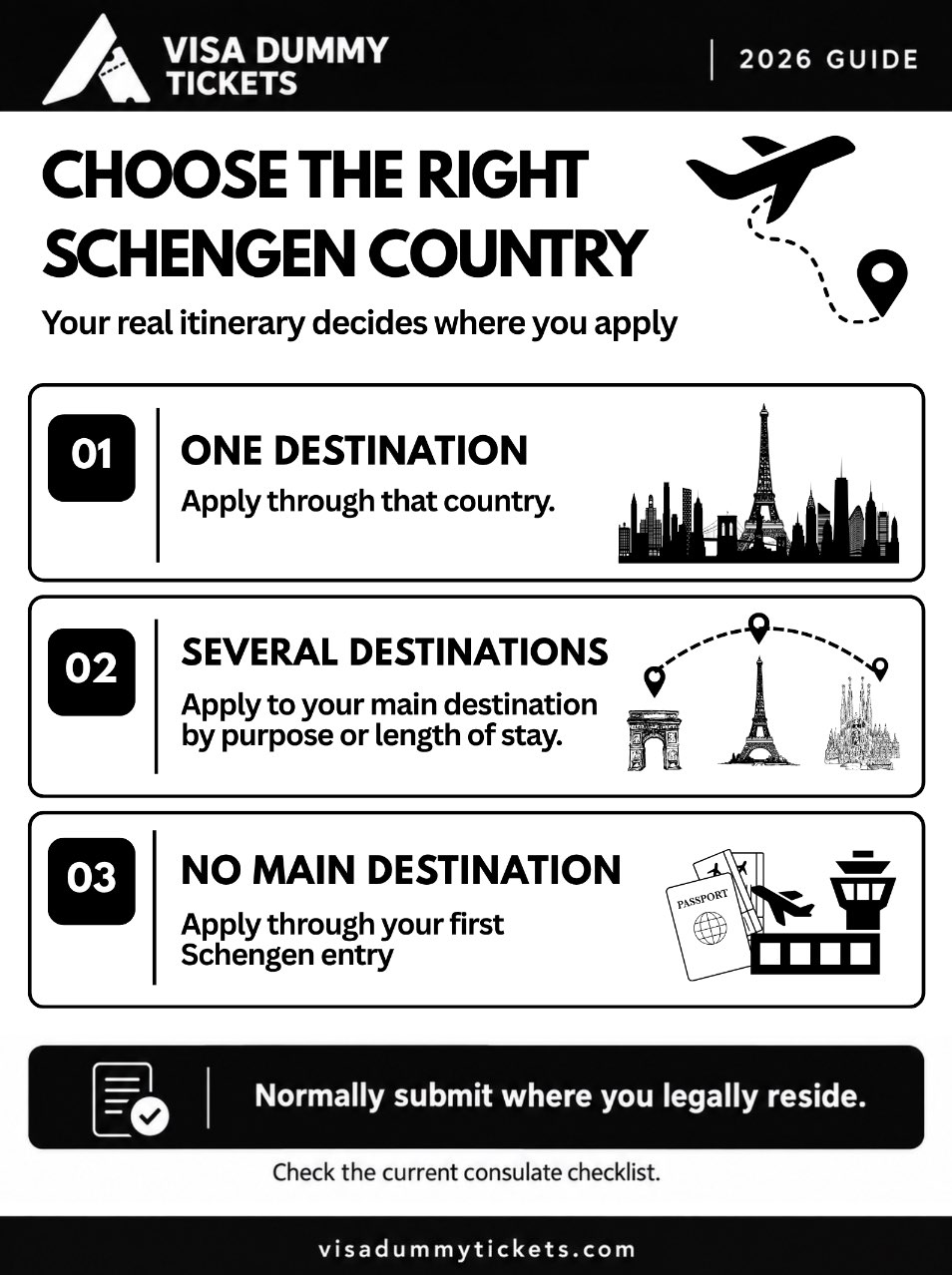
The correct Schengen country is determined by the real journey. A statistical approval ranking helps readers understand historical outcomes, but it does not replace the main-destination rules.
For a trip to one Schengen country, apply through that country. For a trip covering several countries, identify the main destination by the purpose or length of the stay. For a straightforward tourism itinerary, this will normally be the country where the traveller spends the longest time.
Where no main destination can be identified and the stays are equal, the first country of entry determines the appropriate application route. A substantive business or other principal purpose can affect the main-destination assessment, so mixed-purpose trips should be assessed on their actual circumstances.
| Illustrative itinerary | Normally appropriate country for the application |
| Seven nights in Slovakia with arrival through Vienna and onward travel to Bratislava | Slovakia, if it is the genuine main destination |
| Six nights in Italy and three nights in Switzerland for tourism | Italy |
| Five nights in Austria and five nights in Italy with equal-purpose tourism and first Schengen entry in Austria | Austria |
| A Romania-only holiday | Romania |
| Two nights in Latvia and six nights in Lithuania for tourism | Lithuania |
Do not book a token night in a high-approval country while intending to spend almost the entire trip elsewhere. The application form, cover letter, accommodation, and transport evidence should describe the same genuine journey.
Representation also matters. In some locations, another Schengen country handles applications on behalf of the destination. Visa application centres collect files and perform administrative tasks; the competent authority makes the visa decision. The provider’s brand or appointment availability does not determine the correct destination country.
Schengen visa types relevant to this ranking
A short-stay Type C visa generally supports stays of up to 90 days in any 180-day period, subject to the visa’s validity and authorised duration. It may be used for tourism, eligible business activities, visits to family or friends, medical travel, events, and other permitted short-stay purposes.
| Visa or entry arrangement | How it relates to this article |
| Uniform Type C visa | Main short-stay category in the country statistics; territory and stay conditions must still be checked |
| Single-entry visa | Permits one entry into the Schengen area within the visa’s conditions |
| Double-entry or multiple-entry visa | Permits the specified repeated entries; it does not remove the permitted-stay limit |
| Limited-territorial-validity visa | Counted as issuance in the approval formula, but valid only for the specified territory or territories |
| Type A airport transit visa | Separate category excluded from this ranking; does not permit a normal holiday in the Schengen area |
| National long-stay Type D visa | Outside this ranking; work, long-term study, and residence procedures require their own assessment |
Permission to visit and permission to work are separate matters. Applicants intending to take employment or live in a country long term need to follow the appropriate work or residence procedure. Choose the category and purpose that accurately reflect the intended activity.
What strengthens a Schengen visa application
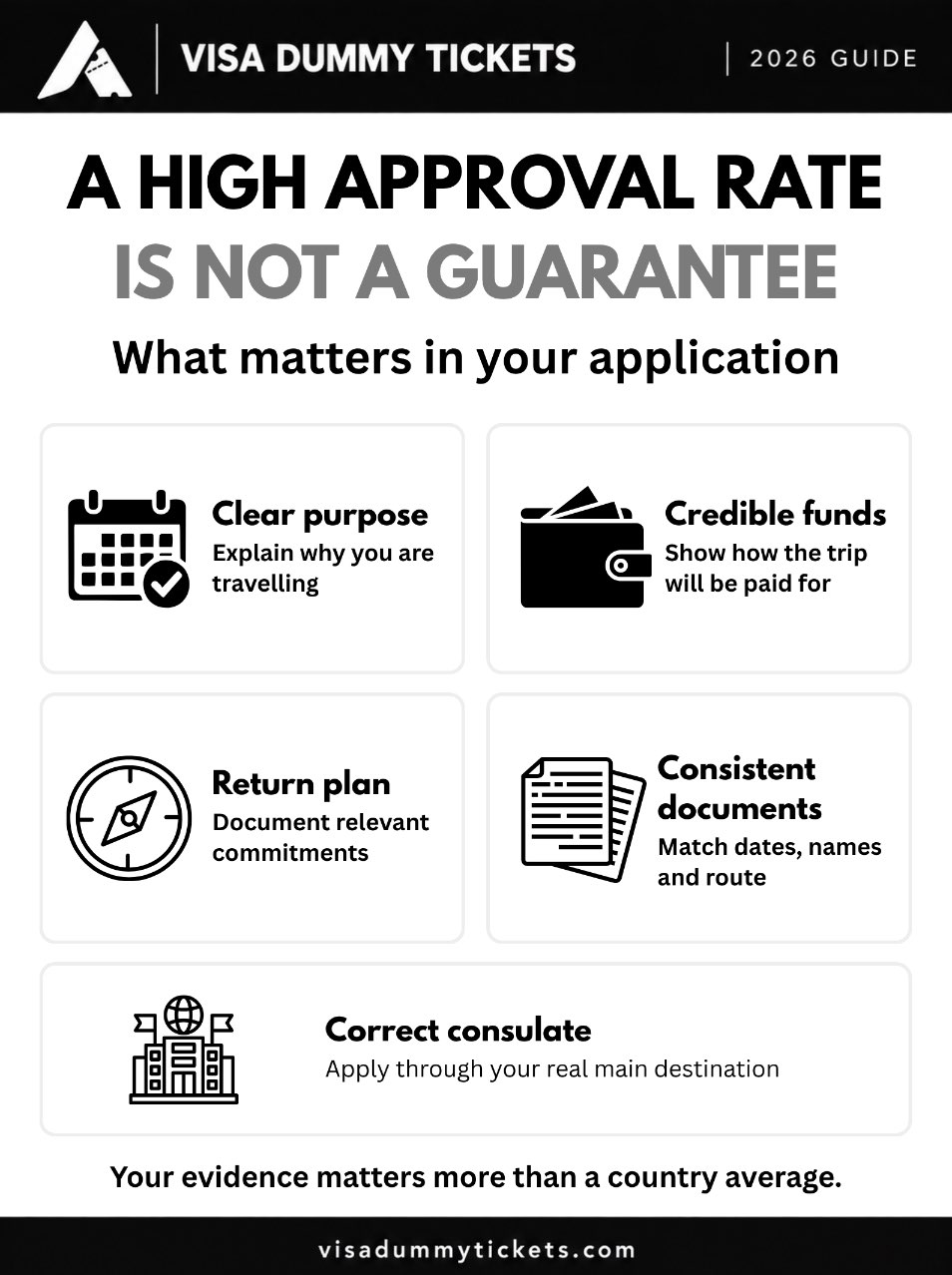
A high approval rate cannot compensate for unclear or contradictory evidence. The strongest practical approach is to make the purpose, funding, travel sequence, and return plan easy to understand.
Explain the purpose with documents that fit the visit
Tourism evidence should describe the destinations and stay dates. A business file should identify the organisation, meetings, or event involved. A family visit may need a host invitation, relationship evidence, and the accommodation or sponsorship documents required for that filing route.
A cover letter can connect these documents. It should explain the purpose, dates, funding, itinerary, and return arrangements concisely. It should not make promises unsupported by the bank statements, employment evidence, or reservations.
Show enough money and explain where it came from
The budget should cover transport, accommodation, meals, local travel, and relevant activities. Required financial evidence and daily subsistence rules vary by destination and circumstances, so there is no single bank-balance figure that guarantees approval across all seven countries.
Regular income, business records, savings history, or documented sponsorship can help explain how a trip will be financed. Where a recent large deposit is relevant, provide credible evidence of its origin. A balance that looks sufficient but cannot be explained may leave unresolved questions.
For a sponsored trip, establish who is paying, their relationship to the traveller, their ability to fund the visit, and the prescribed sponsorship format. A vague statement that someone will cover all expenses may not satisfy the applicable requirements.
Make the return plan consistent with real obligations
Employment confirmation, approved leave, ongoing studies, business commitments, and family circumstances can help explain why the traveller intends to return. Use the evidence that actually applies to the applicant; property ownership is not a universal requirement.
Leave dates should cover the journey, including travel days. A student travelling during term time should address any required absence permission. A self-employed applicant should explain both income and continuing business activity rather than substitute an employee-style letter that does not fit their circumstances.
Make every part of the itinerary agree
Check the arrival date shown on the flight itinerary, rather than relying only on the departure date from home. Overnight connections can change the calendar day of arrival. Hotel check-in, internal transfers, insurance, and the proposed visa dates should reflect the actual travel sequence.
Accommodation should cover the intended nights. A final hotel checkout before an evening flight can be reasonable, while a two-day unexplained gap requires clarification. Transfers between cities should also be feasible within the time available.
Meet the passport insurance and local document requirements
For standard short-stay applications, the passport generally must have been issued within the previous ten years, contain at least two blank pages, and remain valid for at least three months after the intended departure from the Schengen area.
Travel medical insurance generally requires at least EUR 30,000 coverage for the relevant medical, hospital, and repatriation risks, valid across the Schengen area and for the intended stay. Follow any applicable exemption or specific policy instruction for your case.
Local checklists may also require translations, legalisation, residence evidence, civil-status documents, or consent for minors. Use the requirements for the actual consulate and travel purpose, including any additional documents requested during examination.
How to get a dummy ticket for these top Schengen countries
A dummy ticket for visa use should be a genuine flight reservation documenting the proposed journey. It normally identifies the traveller, airline, route, dates, flights, and booking reference. It is application-stage travel evidence and does not permit boarding a flight.
Where the checklist accepts a reservation, Visa Dummy Tickets can prepare an itinerary around the actual journey. For each destination, the transport evidence should support the same travel plan as the accommodation, purpose, and funding documents.
Step 1 Confirm the checklist and actual travel plan
Establish the correct destination country, consulate, and visa category. Check whether the required evidence is a flight reservation, itinerary, issued ticket, or a particular operator-generated document. Decide the intended route and travel dates before ordering.
Step 2 Choose the flight reservation service on VDT
Visit visadummytickets.com and open the Dummy Flight Ticket service. Choose the trip format that fits your plan, such as a return or multi-city journey. A one-way reservation is appropriate only where the genuine circumstances and applicable requirements support it.
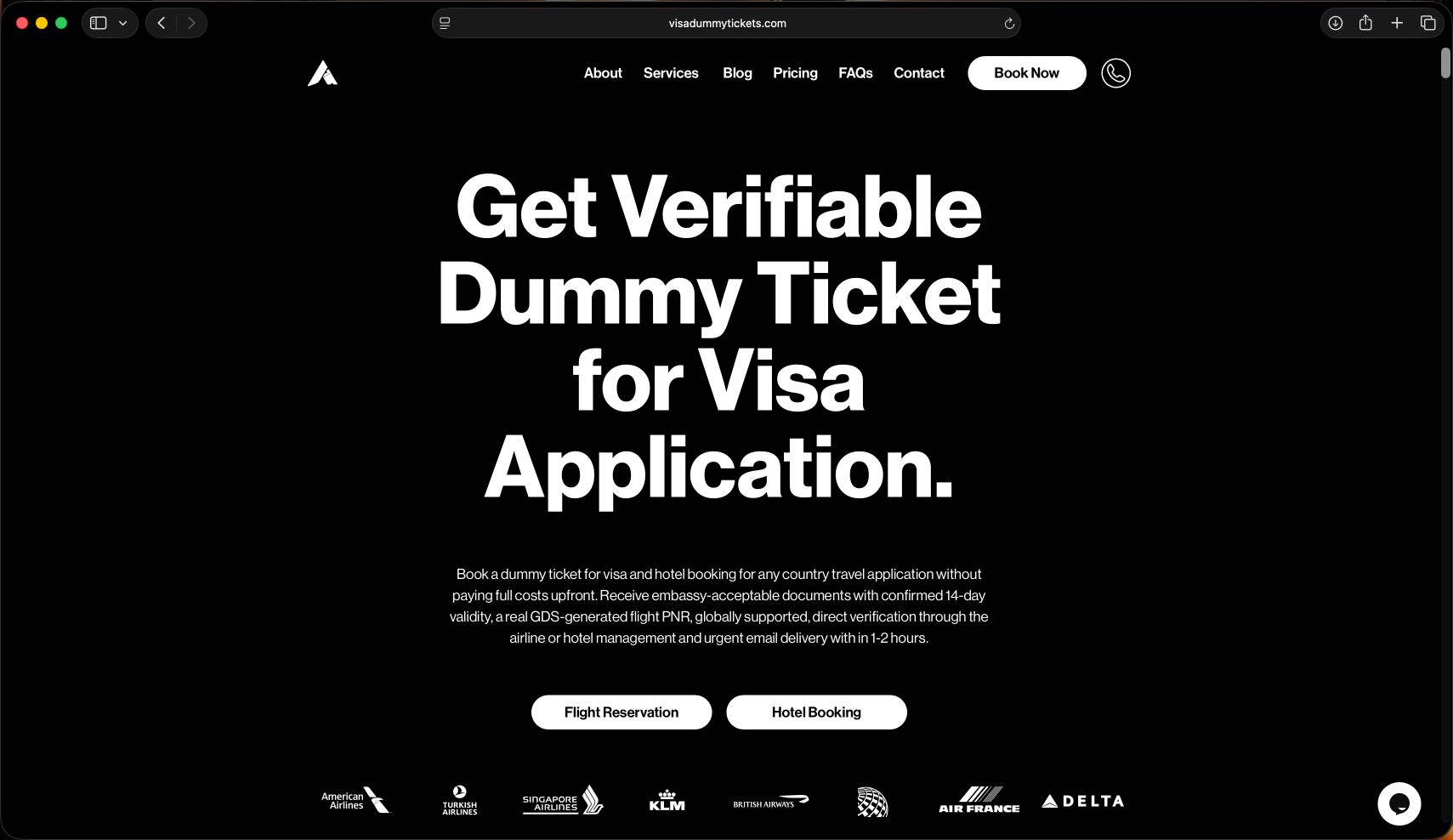
Step 3 Enter accurate traveller and journey details
The ordering form requests contact information and traveller details, including names and passport information. Enter names as shown in the passport, supply the actual flight route and dates, and add relevant extra sectors or booking preferences.
Provide the applying consulate and appointment details where requested. For family or group travel, check each passenger separately and ensure the requested travel dates agree across the applications.
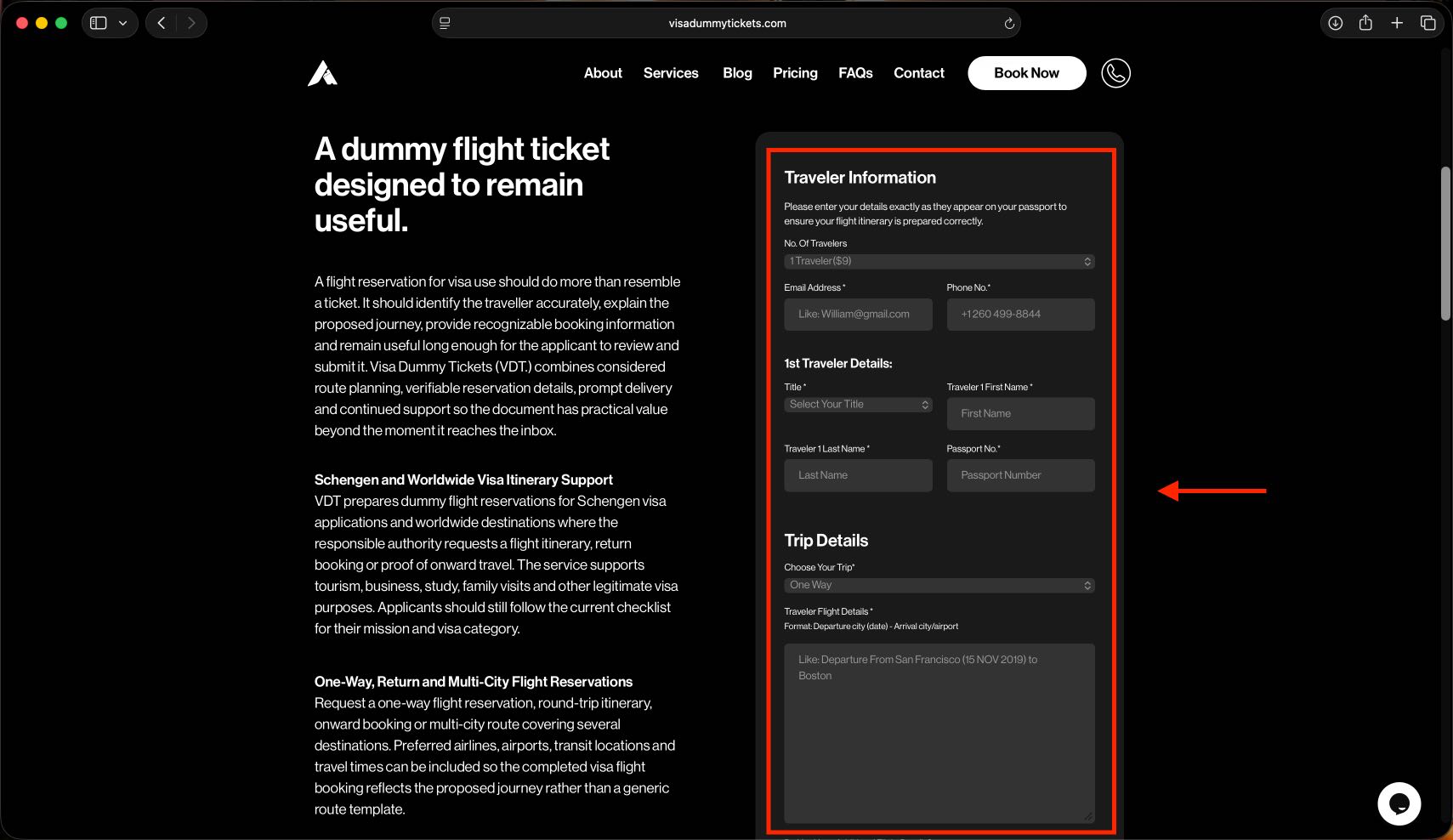
Step 4 Review the price and complete the order
Check the displayed total and service terms before payment. The standard flight reservation service is advertised from USD 9 per traveller; additional routes or order details may affect the checkout total.
The service advertises urgent email delivery within 1–2 hours for complete standard orders. Complex routes and incomplete information can require additional preparation time, so leave a practical margin before the appointment.
Step 5 Verify the reservation and review the PDF
Use the supplied booking reference and surname through the relevant airline’s supported Manage Booking facility or verification channel. Check the underlying record alongside the emailed document: names, airports, dates, and sectors should match.
If the booking cannot be retrieved through the expected channel, contact VDT for clarification before submission. A verifiable PNR printed on a PDF is useful only when it corresponds to the appropriate reservation record.
Step 6 Coordinate validity with the application
VDT advertises eligible embassy acceptable reservations with 14-day validity and separate free monitoring during that period. Confirm the validity committed for your order and schedule preparation around the submission date.
A 14-day reservation period is not the same as a visa-processing deadline. If the application or appointment is delayed, ask about the advertised extension facility before the reservation expires and confirm the arrangement for your specific booking.
Step 7 Request corrections and submit a consistent file
Check the itinerary against accommodation, insurance, leave approval, invitations, and the application form. Request any eligible correction promptly. VDT advertises up to four reasonable corrections under the applicable plan; substantial route changes may require different arrangements.
Submit the reservation in the format requested by the consulate. If the checklist requires an operator-generated printout, include that evidence rather than assuming an agency PDF alone is sufficient. For more route-planning detail, read our guide to booking dummy tickets for Schengen visa applications.
Flight reservation planning for each destination
The following examples show how an itinerary can be organised. They are planning concepts rather than live flight offers, and actual flights, connections, prices, and transport requirements must be confirmed.
| Destination | Suitable itinerary concept | Detail to explain in the application |
| Slovakia | Home city to Bratislava, or to Vienna with onward travel to Slovakia, then return | Slovakia must be visible as the genuine main destination; document the overland transfer where relevant |
| Italy | Arrival in Rome and departure from Venice after travel within Italy | Include the return sector and the internal transport required by the checklist |
| Romania | Arrival and departure through Bucharest with a stay in Brasov | Explain the transfer to Brasov and the return to the departure airport |
| Austria | Arrival in Vienna, a stay in Salzburg, and departure through a suitable airport | Match rail travel, accommodation, and final airport transfer |
| Latvia | Arrival in Riga with a Latvia-focused stay or a properly explained Baltic route | Include any overland onward journey and the actual airport used to leave Schengen |
| Switzerland | Arrival in Zurich and departure from Geneva after Swiss city and mountain stays | Show realistic transfer time and funding for the complete itinerary |
| Bulgaria | Sofia and Plovdiv, or a separate coastal itinerary with a suitable airport | Align the airport, season, hotel locations, and departure plan |
There is no need to invent a direct flight simply to keep a reservation short. A sensible connecting route is appropriate when it reflects actual availability and the traveller meets any transit requirements. Conversely, an unnecessary chain of connections can complicate an otherwise straightforward holiday.

When to apply and how reservation validity fits the timeline
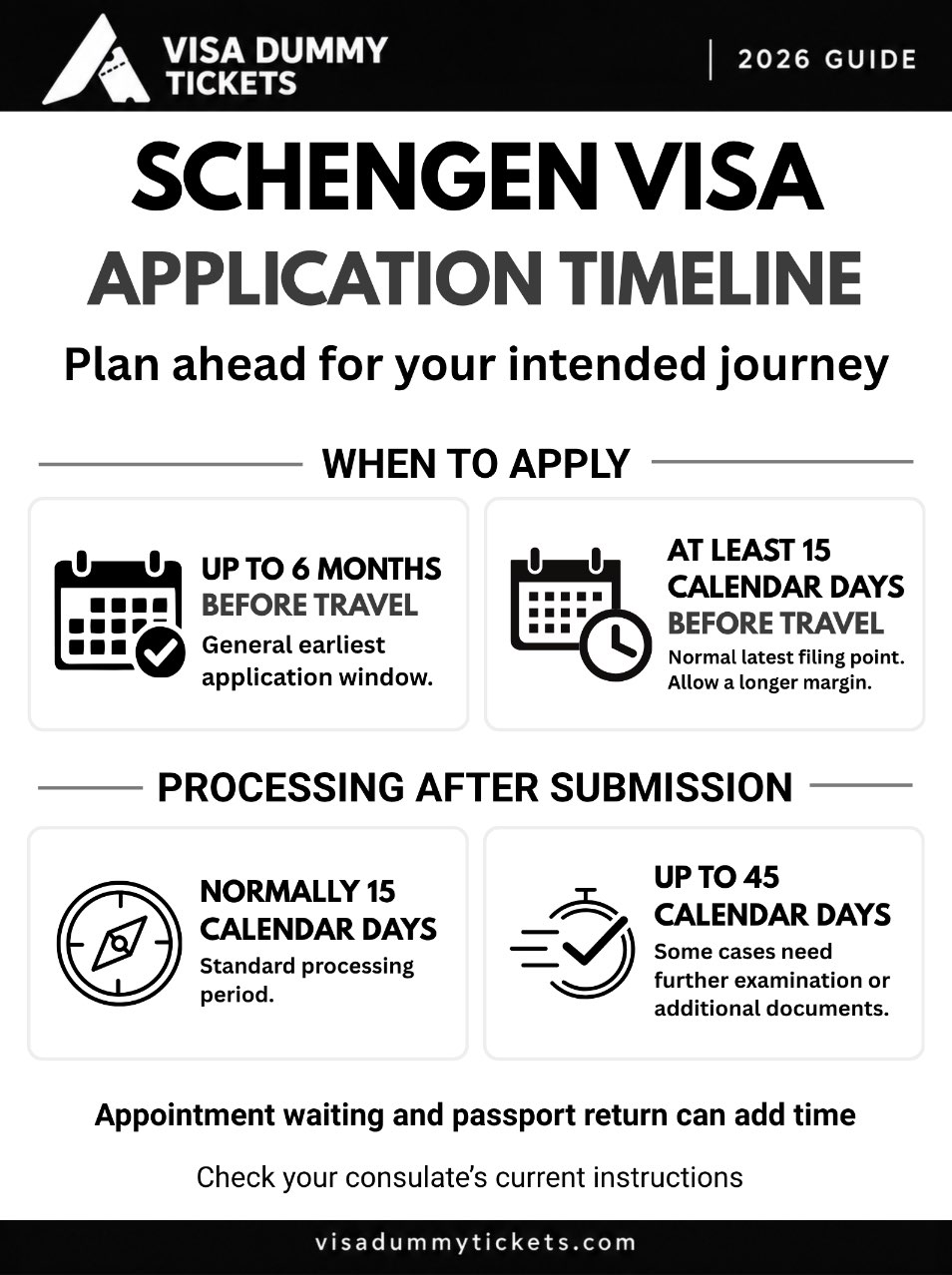
Standard Schengen visa applications can generally be lodged up to six months before the intended visit and should normally be submitted at least 15 calendar days before departure. Appointment availability and any applicable exceptions must also be considered.
The normal processing period is 15 calendar days, with extension to 45 calendar days in cases requiring further examination or additional documents. Appointment waiting time, document preparation, and passport return logistics should be considered separately.
| Timeline item | Practical meaning |
| Up to six months before travel | General earliest application window for standard cases |
| At least 15 calendar days before departure | Normal latest filing point; a longer margin is sensible where appointments or checks may cause delay |
| Normally 15 calendar days | Standard processing period, rather than a promise for every application |
| Up to 45 calendar days | Possible extended examination period |
| Advertised 14-day VDT reservation validity | Booking-service period, separate from the visa decision timeline |
Arrange reservations near enough to submission that the committed validity period is useful. If the consulate later requests updated evidence, provide a truthful update reflecting the current travel plan. Never assume that a national approval rate predicts processing speed or that an urgent flight reservation speeds up an embassy decision.
The standard short-stay visa fee is generally EUR 90 for adults and EUR 45 for children aged six to under twelve, with exemptions and reduced fees applying to some applicants. Visa-centre charges, insurance, transport reservations, and other preparation costs are separate from the visa fee.
Mistakes that can weaken an application despite a high approval rate
Choosing the consulate before deciding the real destination
Start with the purpose and itinerary. Applying through a statistical leader while presenting a journey centred elsewhere can create a jurisdiction problem and questions about the accuracy of the file.
Confusing a reservation with a paid ticket
A flight reservation records a proposed journey. A paid e-ticket is an issued travel document. Do not describe an unpaid reservation as a purchased ticket, or assume a reservation satisfies a checklist that explicitly requires an issued ticket.
Submitting a non-verifiable preview as travel evidence
A free sample or mockup may demonstrate the layout of a document without creating a booking. VDT’s free sample option is for preview purposes and does not provide a verifiable reservation for visa submission. Use the appropriate service when genuine booking evidence is required.
Ignoring document mismatches
An application can become difficult to assess when the form shows one arrival date, the flight shows another, and the hotel begins later. Check all documents together after each material change to the trip.
Relying on a bank balance without explaining the budget
Show how the complete visit will be funded. The cost of the itinerary should make sense alongside income, savings, sponsorship, and continuing obligations at home.
Final application checklist
Before submitting an application to Slovakia, Italy, Romania, Austria, Latvia, Switzerland, or Bulgaria, review the following points together.
| Check | What should be clear |
| Destination and filing authority | The application goes to the genuine main destination or its authorised representative |
| Purpose | The form, cover letter, invitation, and supporting evidence describe the same visit |
| Traveller identity | Passport details and names match every applicable reservation |
| Dates | Flights, hotel nights, insurance, leave, and event dates are consistent |
| Travel route | Arrival, internal transfers, and departure form a feasible journey |
| Accommodation | Every intended night is covered by the appropriate evidence |
| Funds | The budget is affordable and the origin of funding is documented |
| Return arrangements | The departure plan and relevant continuing obligations are explained |
| Reservation status | Booking evidence can be checked through the supported channel where required |
| Local requirements | Translations, sponsorship, minors’ documents, and any extra checklist items are included |
Frequently asked questions
Which Schengen country has the highest visa approval rate in 2026
Slovakia leads the latest completed annual comparison at 90.37% when approval is calculated as visa issuance among recorded short-stay decisions. This is a 2026 guide using 2025 annual figures, rather than a claim about completed 2026 outcomes.
What are the top seven countries with the highest Schengen visa approval rates
The seven leaders are Slovakia, Italy, Romania, Austria, Latvia, Switzerland, and Bulgaria. The calculation includes uniform and limited-territorial-validity visa issuance and excludes airport transit and national long-stay categories.
Is the country with the lowest rejection rate automatically the easiest for me
No. Aggregate figures describe different groups of applicants. Your purpose, finances, supporting evidence, residence, travel history, and circumstances still affect the assessment. You must also apply through the country responsible for your genuine journey.
Why does Slovakia have a 90.37 percent approval rate but an 88.66 percent issuance ratio
The denominators differ. The 90.37% figure compares successful uniform and LTV issuance with all recorded issuance and non-issuance outcomes. The 88.66% figure divides uniform visas issued by applications received. They measure different aspects of the annual data.
Are these approval rates only for tourist visas
No. The annual short-stay figures include eligible travel purposes such as tourism, business, family visits, and other categories. They do not provide a separate tourist-only or first-time-applicant approval rate in the table used here.
Why is Iceland not one of the top seven
Iceland’s decision-based approval share fell from 93.38% in 2024 to 86.17% in 2025. Older lists may continue to use its earlier figure, but it falls outside the latest top seven using the consistent calculation presented here.
Are Romania and Bulgaria Schengen countries
Yes. Both became full Schengen members on 1 January 2025 after beginning Schengen visa issuance in March 2024. Check the type, territorial validity, entry allowance, and authorised stay of the particular visa issued.
Is Switzerland included even though it is outside the European Union
Yes. Switzerland participates in the Schengen area and is included in the short-stay visa comparison. EU membership and Schengen participation are different arrangements.
Why are there 29 Schengen countries but only 28 destination rows in the statistics
Liechtenstein does not operate a separate short-stay visa issuance network and is represented by Switzerland. It should not be assigned an invented approval rate to create an additional statistical row. Ireland and Cyprus are outside the Schengen-area destination ranking used here.
Can I apply through Slovakia and spend most of my holiday in Italy
For a tourism trip mainly spent in Italy, Italy would normally be the appropriate country through which to apply. Slovakia’s higher national approval ratio does not override the main-destination rules.
Must I always apply to the first country where my flight lands
No. The main destination comes first. A traveller entering through Vienna but spending the substantive holiday in Slovakia may need to apply through Slovakia. First entry becomes decisive where no main destination can be established, such as an equal-purpose trip with equal stays.
Which country offers the fastest Schengen visa approval
This ranking does not measure processing speed. A high approval share does not establish shorter appointment queues or faster decisions. Standard processing is normally 15 calendar days and can extend to 45 calendar days in cases requiring further examination.
Can applicants from India Pakistan Nigeria China or the Philippines use this ranking
Yes, as a worldwide destination comparison. It is not a separate success estimate for those passports. The filing-country table describes where applications were lodged, while eligibility and individual assessment depend on the applicant’s own circumstances.
Do British American and Canadian citizens need a Schengen visa
Ordinary passport holders from these countries are generally visa-exempt for qualifying short visits. Visa-required nationals legally resident there may still need a Schengen visa. Passport eligibility and country of residence must be checked separately.
Can I use a dummy ticket for a Schengen visa application
A genuine flight reservation may be suitable where the applicable checklist accepts a reservation or itinerary. It must reflect the real proposed journey. Some filing locations request particular operator documents or additional evidence, so acceptance should not be assumed for every checklist.
Does a verifiable PNR guarantee visa approval
No. A verifiable booking reference helps establish the transport reservation. It does not prove the traveller’s finances, purpose, intention to return, or compliance with all other requirements, and it does not guarantee the visa decision.
Can I use a free VDT sample for my visa application
VDT’s free sample is a preview rather than a verifiable reservation. It is for understanding the document format and should not be submitted as evidence of an actual flight booking. Choose genuine reservation evidence when the checklist requires it.
How much does a VDT dummy flight ticket cost
The standard service is advertised from USD 9 per traveller. Check the current order total because additional sectors, route requirements, or other order details may affect the final amount.
How long does the VDT reservation remain valid
Eligible bookings are advertised with 14-day validity and free monitoring during that period. Confirm the commitment for the particular order. If more time is needed, ask about the extension facility and its applicable conditions before expiry.
Does a 14-day reservation cover the entire visa-processing period
It may not. Standard processing is normally 15 calendar days and may extend to 45 days, while a reservation has its own validity period. Coordinate submission timing, monitor the booking, and arrange any needed extension or updated evidence.
Can I submit a multi-city reservation for a Schengen visa
Yes, where it accurately describes the planned journey and meets the checklist. Include the actual arrival, onward, and departure sectors, with separate rail, bus, or other internal transport evidence where required.
Should I buy the full flight ticket before applying
Follow the wording of the checklist for your filing location. Where a reservation is sufficient, buying a nonrefundable ticket early may expose you to unnecessary loss if travel dates change or the visa is not issued. Where a ticket or operator-generated document is required, obtain the appropriate evidence.
What should I do if my Schengen visa is refused
Read the stated reasons and the instructions about appeal or review. If considering a new application, address the actual deficiencies and any changed circumstances. Switching to a country with a higher aggregate approval rate does not resolve an unexplained purpose, inadequate funding, or inconsistent evidence.
Can a visa refusal still happen in a country with a high approval rate
Yes. Every country in the top seven recorded non-issuance outcomes. A strong historical percentage provides context, while the competent authority decides whether the individual application meets the requirements.
Conclusion
For travellers researching Schengen visa approval rates in 2026, the latest complete annual decision-based figures identify Slovakia, Italy, Romania, Austria, Latvia, Switzerland, and Bulgaria as the top seven. Slovakia leads on the approval share, while Italy combines a high rate with more than 1.32 million reported applications.
Use the ranking to understand historical outcomes and compare them with a genuine travel plan. Then establish the correct filing country, document the purpose and funding, and make the transport and accommodation evidence consistent. The strongest application is one that explains the traveller’s actual circumstances clearly.
Need a flight reservation for your Schengen application? Request a verifiable dummy ticket from VDT around your real route and dates, then review it against the checklist before submission.