



Is Dummy Ticket Legal for Visa and Accepted by Embassies? [2026 Updated]
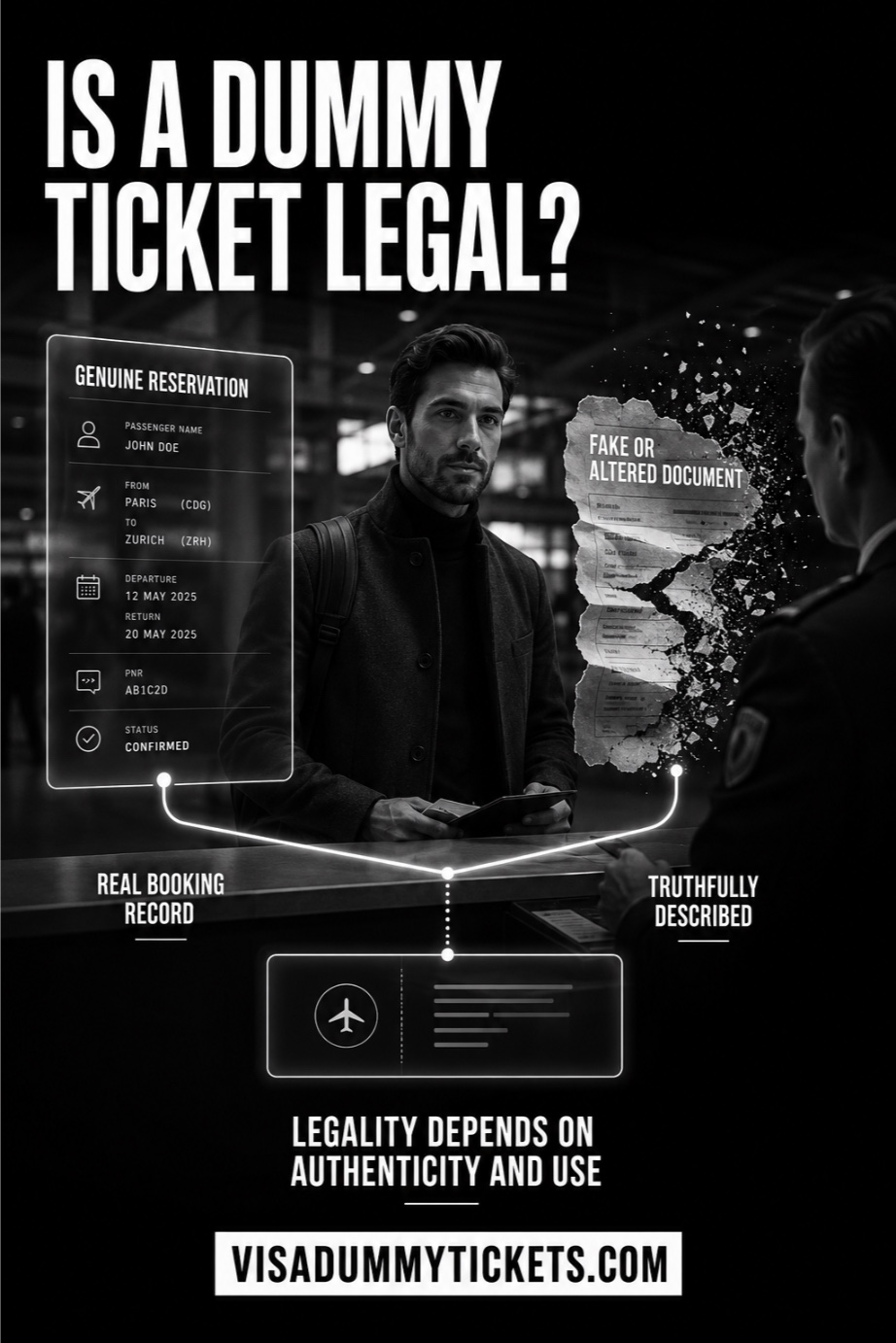
Yes – a genuine flight reservation is generally lawful to use for a visa application when it truthfully shows your proposed journey and the relevant embassy or visa-centre checklist allows a reservation. No – a fabricated PDF, invented booking reference, altered itinerary or document falsely presented as a paid ticket is not a legitimate “dummy ticket” and may be treated as false evidence.
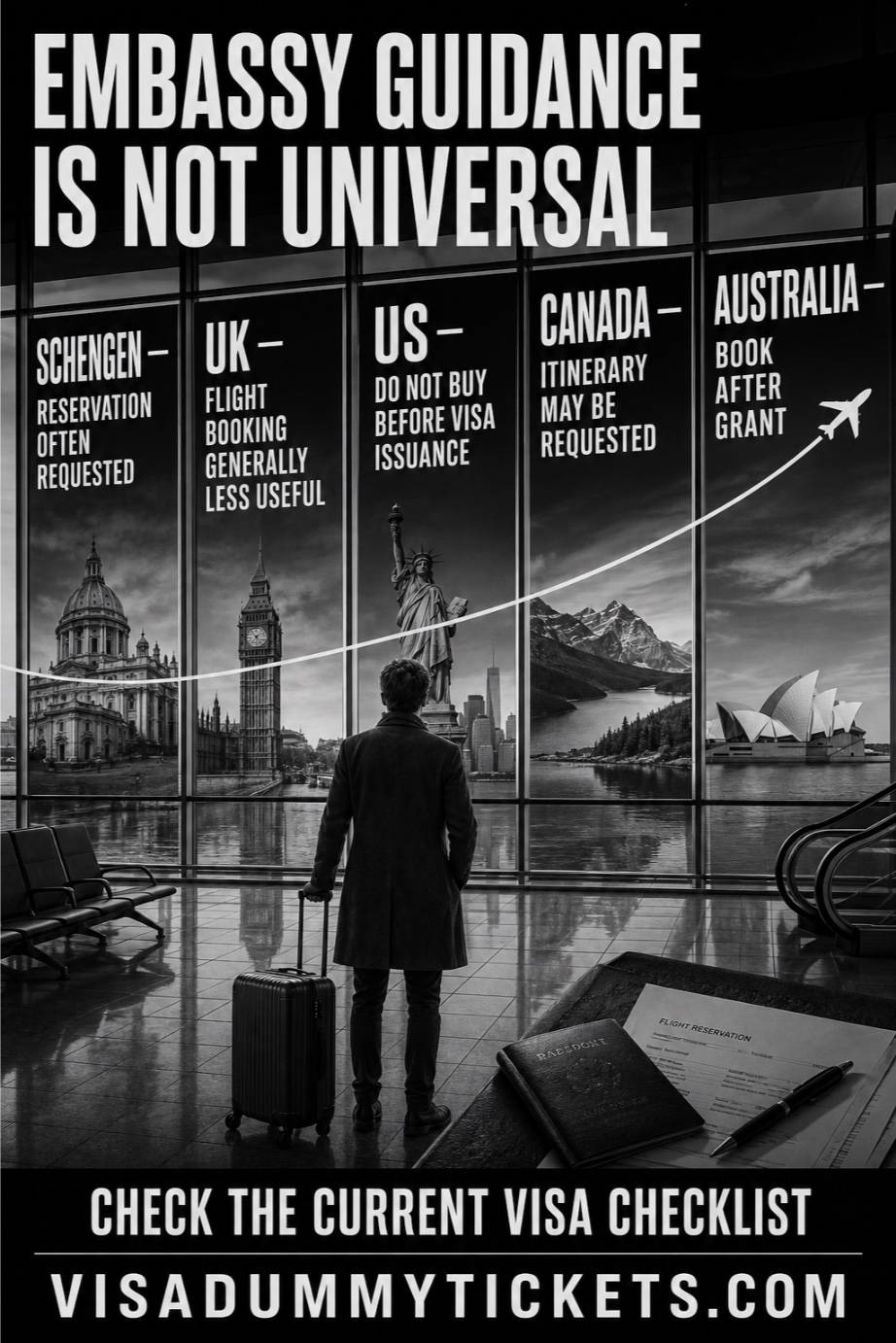
Embassy acceptance is a separate question from legality. There is no worldwide rule saying that every embassy must accept a dummy ticket. Schengen short-stay checklists often ask for a flight reservation or travel itinerary and may expressly say that a paid ticket is unnecessary. By contrast, the United Kingdom describes flight bookings as “less useful” evidence for most visitor applications, while the United States tells visitor-visa applicants not to make final travel plans or buy tickets until a visa is issued. Canada may request an itinerary or provisional arrangements, depending on the applicant’s personalized or local checklist.
That is the accurate 2026 answer. The informal label dummy ticket does not decide whether a document is safe. Its underlying facts do:
- Does a real reservation exist?
- Do the passenger name, route and dates match the application?
- Is the document described as a reservation rather than a paid or issued ticket?
- Is it active when submitted or checked?
- Does the current checklist for that visa category and application location ask for it?
If all five answers are sound, the document can be a legitimate way to evidence intended travel without risking the full price of a non-refundable flight before a visa decision. If any answer is false, the supposed shortcut can weaken the entire application.
Important: This guide provides general visa-document information, not legal advice or a visa guarantee. Requirements can change by country, consular post, visa class and applicant circumstances. The latest instructions from the deciding government authority and the applicant’s personalized checklist always take priority.
The 2026 answer at a glance
| Question | Accurate answer |
| Is a dummy ticket legal? | A genuine temporary reservation is not inherently unlawful. A forged, altered or deceptively presented document is not legitimate and may trigger fraud or misrepresentation rules. |
| Is a dummy ticket a real ticket? | Usually no. A reservation can be real without being ticketed. It does not confer a right to check in, board or fly. |
| Do embassies accept dummy tickets? | Some visa checklists accept or request a flight reservation or itinerary. Others do not require it or give it little evidential weight. There is no universal acceptance rule. |
| Is it accepted for a Schengen visa? | A genuine reservation commonly fits short-stay documentary requirements, but the competent consulate’s current checklist controls. Do not assume a paid ticket is required unless instructed. |
| Is a valid PNR enough? | No. It is useful evidence that a booking record exists, but the itinerary must also be current, accurate, consistent and appropriate for the application. |
| Can I fly with it? | No. A reservation that has not been ticketed and paid is not a travel document. Buy an issued ticket after approval or when the authority specifically instructs you. |
| Does it guarantee a visa? | Never. A flight reservation addresses only one possible part of a much larger eligibility and credibility assessment. |
What is a dummy ticket for a visa application?
In visa-document language, a dummy ticket should mean a temporary flight reservation or proposed flight itinerary prepared for the application stage. It normally displays the traveller’s name, airline, flight numbers, airports, travel dates, scheduled times and a booking reference or PNR. It is intended to show how the applicant proposes to enter and leave a destination.
The word dummy creates unnecessary confusion. In everyday English, it can suggest something artificial or fake. In travel discussions, however, people frequently use “dummy ticket” to describe a real booking record that has not yet become a fully paid, issued e-ticket. Government checklists usually prefer clearer terms such as:
- flight reservation;
- round-trip reservation;
- travel itinerary;
- booking confirmation;
- proof of intended transport;
- proof of onward or return travel; or
- provisional travel arrangements.
Those expressions are not always interchangeable. A consulate may want a reservation showing the intended route, while a transit authority may ask for a confirmed onward journey. An airline at check-in may require a paid ticket that permits travel. The exact words on the official checklist matter.
A legitimate reservation is not a creative imitation of an airline document. It is based on real passenger and journey details. Where a booking record is available through the carrier or reservation system, it can commonly be checked using the passenger’s surname and booking reference. It must still be presented honestly: reservation, not paid airfare; proposed journey, not proof that travel has already been purchased.
A reservation is real, but it is not an issued ticket
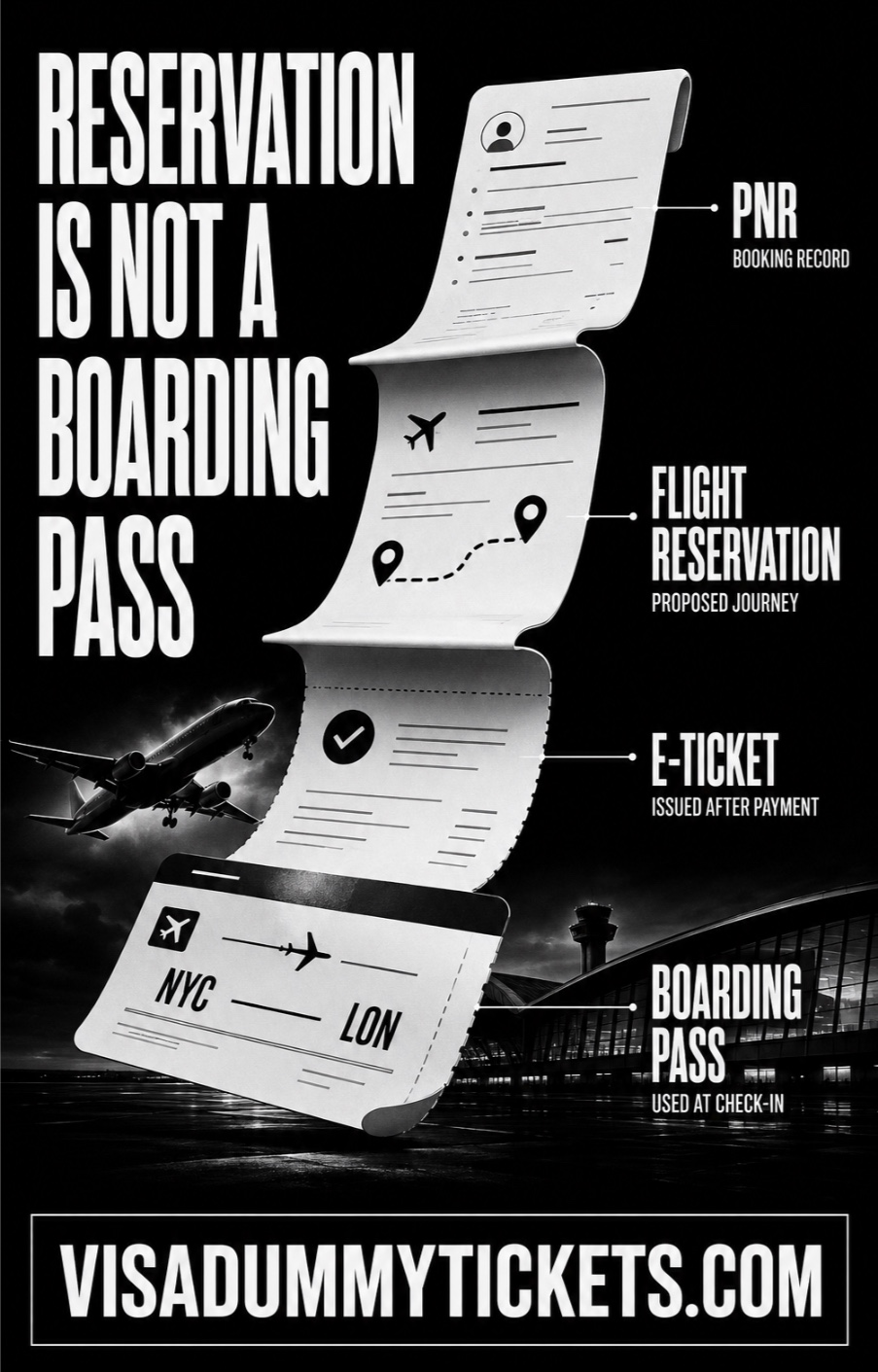
Air travel has several stages that readers often collapse into the word ticket:
- Itinerary selection: A route and fare are identified.
- Reservation creation: Passenger and flight details are placed in a booking record, commonly associated with a PNR.
- Ticketing: Payment and issuance produce an e-ticket number and the right to travel subject to fare and airline conditions.
- Check-in and boarding: The passenger satisfies travel-document requirements and receives a boarding pass.
A genuine dummy flight ticket normally sits at stage two. It can be an authentic reservation without being a paid ticket. It does not include the legal and commercial rights associated with an issued e-ticket, and it cannot be used as a boarding pass.
Is dummy ticket legal? The three-part test
The safest answer does not begin with a blanket “yes.” It applies three separate tests: authenticity, truthful use and procedural relevance.
- Authenticity: is there a real underlying reservation?
A document is fundamentally different from a forgery when the reservation it describes actually exists. The booking reference, traveller and itinerary should connect to a genuine reservation record. A made-up PNR, copied airline logo, invented e-ticket number or edited screenshot does not become lawful because someone labels it a dummy ticket.
Authenticity also has a time dimension. Reservations can be cancelled or expire. A confirmation may have been genuine when created but no longer active when submitted. That does not automatically mean the applicant committed fraud, but knowingly submitting a dead reservation as though it were current can create a credibility problem. Recheck the status shortly before the appointment or upload deadline.
- Truthful use: what are you claiming the document proves?
A real reservation can still be misused. If the application asks whether a flight has been purchased, do not call an unpaid reservation a purchased ticket. Do not add a fake ticket number, payment receipt, cancellation condition, embassy stamp or “confirmed and paid” label. Do not state that the reservation will remain active for a period the provider has not committed to.
Visa systems are built around declarations. The legal risk usually arises from deception, false representation or false documentation – not from responsibly reserving a possible flight before committing to the fare. Truthful labels and accurate supporting explanations therefore matter as much as the PNR.
- Procedural relevance: did the authority ask for this kind of proof?
A valid document can still be unnecessary. If a UK Standard Visitor application does not ask for a flight booking, uploading one may add little. If a US DS-160 asks for an itinerary only when travel arrangements already exist, an applicant should not invent arrangements merely to fill the field. If a Schengen checklist asks for a round-trip reservation, a one-way itinerary may be incomplete.
Use the document that answers the actual requirement. “More evidence” is not always stronger evidence, especially when extra attachments introduce inconsistencies.
The practical legal conclusion
Across these tests, a genuine and honestly described reservation is normally a legitimate planning and application document. Nevertheless, laws differ, and no article can declare every possible use legal in every jurisdiction. The legally responsible formulation is:
A genuine temporary flight reservation is generally permissible for visa-document purposes when it is accurate, relevant and not represented as something it is not. A fabricated, altered or misleading document may be treated as false evidence and can have consequences far beyond the loss of one application fee.
Dummy ticket vs flight reservation vs paid ticket vs fake ticket
| Document | What it is | Usually verifiable? | Right to fly? | Appropriate visa use |
| Genuine dummy ticket / flight reservation | A temporary passenger booking and itinerary without completed ticket issuance | Often, through an airline or booking system while active | No | Suitable where the checklist permits a reservation or itinerary |
| Airline fare hold | A time-limited airline option that preserves an itinerary or fare under stated conditions | Usually through the airline account or reference | No, until ticketed | Often suitable if it contains the required passenger and route details |
| Fully refundable paid ticket | An issued e-ticket purchased under a refundable fare rule | Yes | Yes, while valid | Suitable, but potentially costly; read refund and no-show rules carefully |
| Non-refundable paid ticket | An issued e-ticket with restrictive change or refund conditions | Yes | Yes, while valid | Usually unnecessary before a decision unless specifically required |
| Quote or screenshot of search results | A price or flight option with no passenger reservation | No | No | Frequently insufficient because it proves no booking in the applicant’s name |
| Fake or altered ticket | A fabricated PDF, changed booking, invented reference or counterfeit e-ticket | No, or details conflict | No | Never appropriate; may amount to false documentation or misrepresentation |
| Boarding pass | A check-in document associated with imminent or completed travel | Yes | Only for its specific flight and after checks | Not a substitute for an application-stage itinerary |
Is a dummy ticket the same as a fake ticket?
No. A credible provider uses dummy ticket as convenient shorthand for a genuine reservation. A fake ticket has no truthful underlying record or has been manipulated to communicate facts that are not true. Confusing those categories is the source of most fear—and much of the unsafe advice found online.
The difference is not visual polish. A counterfeit can look excellent, and a genuine reservation can look plain. The difference is whether the document accurately represents a real, current booking and whether the applicant describes its status honestly.
If you are deciding between paying the full airfare and using an application-stage reservation, see Paid Flight Ticket vs Dummy Ticket: Which Is Best for a Visa in 2026? for a separate cost, flexibility and risk comparison.
Is a PNR the same as an e-ticket number?
No. A Passenger Name Record (PNR) or booking reference identifies a reservation record. An e-ticket number is normally created when an itinerary is ticketed. Formats vary by airline and distribution channel, and codeshare journeys can create more than one reference. The presence of a six-character code is not, by itself, proof of ticket issuance or even conclusive proof of authenticity.
This is why “it has a PNR” should never be the whole quality test. The name, active status, route, dates, operating carrier and document description must all make sense.
Are dummy tickets accepted by embassies?
Many embassies accept a flight reservation when their checklist requests one. That does not establish a worldwide policy accepting every document sold as a dummy ticket. Embassy acceptance depends on five variables:
- the destination country;
- the precise visa category;
- the embassy, consulate or processing post responsible for the application;
- the applicant’s country of legal residence or application; and
- the wording and date of the current checklist.
Visa application centres such as VFS Global, TLScontact or BLS international may collect documents, but they generally do not make the sovereign visa decision. Their local checklists can be operationally important, yet the government authority remains decisive. Applicants should use the destination government’s website first and then follow the linked local submission instructions.
What the reservation can and cannot prove?
A coherent reservation can help show:
- proposed arrival and departure dates;
- a return or onward route;
- consistency with the requested visa period;
- the order of countries in a multi-destination trip;
- plausible transit points; and
- alignment with accommodation, insurance, leave and event dates.
It does not prove:
- that the applicant can afford the trip;
- that the applicant will return home;
- that the stated purpose is genuine;
- that accommodation is arranged;
- that travel medical insurance is adequate;
- that an invitation or employment claim is credible;
- that border admission is guaranteed; or
- that the visa will be approved.
An itinerary is one piece of a narrative. Officers usually assess the whole file: financial means, ties to the country of residence, purpose, previous travel, immigration history and internal consistency.
Worldwide comparison: what official guidance actually indicates
| Destination / route | 2026 position in official guidance | Sensible applicant response |
| Schengen short stay (Type C) | The EU Visa Code allows documents relating to continuation/return and lists a round-trip reservation among possible evidence. Local checklists often request a flight reservation. | Submit a genuine, current itinerary that follows the competent consulate’s checklist; do not buy a non-refundable fare merely to strengthen appearances. |
| UK Standard Visitor | UKVI says flight and hotel bookings are generally “less useful” evidence for visit applications, except flight evidence in transit cases. | Focus on purpose, funds, circumstances and intention to leave. Upload a booking only if requested or genuinely relevant. |
| UK Transit | Evidence of a confirmed onward journey may be requested. | Use proof matching the transit rules and timing; check whether a reservation or issued ticket is required in the individual case. |
| US B-1/B-2 visitor | There is no universal flight-booking requirement. The Department of State says not to make final travel plans or buy tickets before the visa is issued. | Provide an itinerary if the form or officer asks and arrangements exist, but do not treat a dummy ticket as a required shortcut to approval. |
| Canada visitor visa (TRV) | IRCC may ask for an itinerary; examples include flight details and accommodation. Some local checklists refer to provisional airline or hotel arrangements. | Follow the personalized document list and visa-office instructions. Make the proposed trip consistent with funds and purpose. |
| Australia visitor routes | Home Affairs suggests booking a flight after the visa is granted. | Do not purchase merely for the application. Provide travel plans only where relevant or requested. |
Is dummy ticket legal for a Schengen visa?
For a Schengen short-stay application, a genuine and accurately presented flight reservation is generally an appropriate form of travel evidence when the relevant checklist asks for it. The legal basis is more nuanced than the common claim that “all Schengen embassies approve dummy tickets.”
Under Article 14 and Annex II of the EU Visa Code, applicants may be required to provide supporting documents concerning the purpose and conditions of the stay, accommodation, financial means and information enabling assessment of their intention to leave. Annex II includes a reservation of a return or round ticket among examples of evidence that may help assess intention to leave.
That framework does three important things:
- It recognizes reservations as relevant evidence.
- It does not say that purchasing a non-refundable ticket guarantees or materially compels approval.
- It allows harmonized local lists and individual-case requests to determine what an applicant must actually submit.
The same Visa Code also permits refusal where there are reasonable doubts about the authenticity of supporting documents or the reliability of the applicant’s statements. A fabricated flight PDF therefore does not exploit a harmless loophole; it attacks the credibility the process is designed to assess.
Do not buy a paid flight unless instructed
Some official Schengen guidance is unusually clear. The Netherlands’ tourism checklist asks for a reservation in the applicant’s name for travel to and from the Schengen area, or another document showing travel plans, and says a paid travel ticket is not needed. Italian consular guidance similarly requests a round-trip reservation in many locations and warns that purchasing a ticket in advance does not ensure a visa; one post notes that an issued ticket may be requested before the visa is released in a particular case.
That is the rational purpose of an application-stage reservation: it documents a credible plan while limiting financial loss if a decision is delayed or negative. It is not a method of pretending that airfare has been paid.
The 29 Schengen countries in 2026
The Schengen area currently comprises 29 countries:
Austria, Belgium, Bulgaria, Croatia, Czechia, Denmark, Estonia, Finland, France, Germany, Greece, Hungary, Iceland, Italy, Latvia, Liechtenstein, Lithuania, Luxembourg, Malta, the Netherlands, Norway, Poland, Portugal, Romania, Slovakia, Slovenia, Spain, Sweden and Switzerland.
Bulgaria and Romania are included. Cyprus and Ireland are not Schengen members. Search results and old articles that still describe a 26- or 27-country area should not be used as a 2026 checklist.
Every Schengen member applies the common visa framework, but applicants should not infer that every embassy uses identical wording or requests identical supporting documents in every country. Local harmonized lists can reflect conditions in the place of application. A Spanish visa application lodged in Islamabad may therefore have operational instructions different from a Spanish application lodged in New Delhi or Rabat, even though all sit under the Schengen Visa Code.

Apply to the correct Schengen country
A perfect reservation will not repair an application lodged with the wrong country. For a trip covering more than one Schengen state, apply to the consulate of the main destination, normally the country where the principal purpose occurs or where the applicant will spend the longest period. If no main destination can be determined, the first-entry rule may decide competence.
Your itinerary should make that logic visible. If the application is made to Spain but shows two nights in Spain and ten in France, the file may point to France as the main destination. If a business conference in Spain is the trip’s primary purpose, explain it and provide the event evidence. The flight, hotels, cover letter, insurance and day-by-day plan should tell one story.
Is dummy ticket legal for a Spanish visa?
For a Spanish Schengen short-stay visa, the correct question is whether the Spanish consular post’s current checklist requests a reservation or itinerary, not whether a site promises “Spain embassy approval.” A real reservation can be suitable when it displays the intended entry, exit and internal route. It should match the trip dates, accommodation and requested stay.
Applicants searching “is dummy ticket legal for Spanish visa from Pakistan,” “Spain dummy ticket from India,”or similar phrases should use the Spanish mission’s instructions for their lawful place of residence. Nationality alone does not make a genuine reservation legal or illegal. The local post, submission jurisdiction and visa type determine the document list.
Is dummy ticket legal for a French visa?
France applies the common Schengen framework, but France-Visas and the competent French post supply the operative checklist for the applicant. A genuine proposed itinerary is not the same as a forged ticket, and it may be relevant where the checklist requests transport evidence. Applicants should generate their personalized checklist through the official France-Visas portal rather than relying on an old blog or a different country’s VFS page.
For multi-country travel, ensure France is genuinely the competent destination. Avoid building a France-heavy application merely because a particular appointment is available; the reservation and accommodation evidence can reveal the true plan.
Is dummy ticket legal for an Italian visa?
Official Italian consular pages frequently distinguish a reservation from an advance purchase. For example, the Italian Embassy in Ottawa’s tourism guidance asks for a round-trip flight reservation or full itinerary and states that buying a ticket in advance does not ensure issuance. The Italian Consulate in Los Angeles also asks for a round-trip reservation and, for a multi-country trip, transport between countries.
An Italian post may ask for an issued ticket before final release in an individual case. If it does, follow that request. Do not convert a general reservation requirement into a paid-ticket requirement on your own, and do not assume that one Italian post’s checklist replaces the checklist where you apply.
Germany, the Netherlands and Switzerland
For Germany, use the German mission serving your residence and the exact checklist for tourism, business, family visit, study or another purpose. A flight schedule may help describe a short visit, but the material question is what that mission asks you to upload or bring.
The Netherlands provides one of the clearest official examples: its Schengen tourism checklist requests a named reservation or travel plan and expressly says the ticket need not be paid. Country-specific versions exist for applicants in locations including India, Morocco and Türkiye.
Switzerland is a Schengen country even though it is not an EU member. Short-stay applications follow the Schengen visa framework, while Swiss national visas and permits follow national procedures. A Swiss tourist itinerary should therefore not be treated as evidence for a long-stay work, family or study case without checking the correct national list.
Denmark and Malta, including study visas
Denmark and Malta are also Schengen states, but the words Schengen visa and study visa can describe very different procedures. A short course within the 90-in-180-day limit may use a short-stay visa route; a longer programme usually involves a national long-stay visa or residence authorization. Those applications focus heavily on admission, tuition, maintenance, accommodation and residence conditions. A flight reservation may be optional, delayed until approval or requested at a later stage.
Therefore, the answer to “is dummy ticket legal for Malta study visa?” is not a simple copy of the tourist-visa answer. A truthful reservation is not inherently fake, but the applicant must follow Malta’s current study or residence checklist. The same caution applies to long-term study in Denmark, France, Germany, Italy, Spain, Switzerland or any other Schengen country.
The remaining Schengen states
For Austria, Belgium, Bulgaria, Croatia, Czechia, Estonia, Finland, Greece, Hungary, Iceland, Latvia, Liechtenstein, Lithuania, Luxembourg, Norway, Poland, Portugal, Romania, Slovakia, Slovenia and Sweden, the same core rule applies: a genuine reservation may be appropriate when the current short-stay checklist requests travel evidence, but the exact local list and the competent authority control.
This avoids two equally unhelpful extremes. It is inaccurate to say that reservations are never accepted; the common framework explicitly recognizes them as possible supporting evidence. It is also inaccurate to promise that every reservation is accepted by every Schengen post. Document quality, visa purpose, local instructions and the complete file remain decisive.
Dummy ticket rules for the UK, US, Canada and Australia
Searchers often group these destinations together with Schengen countries, but their official guidance is not interchangeable. The term dummy ticket may not appear at all. Read what each system asks the applicant to prove.
Is dummy ticket legal for a UK visa?
A genuine reservation is not automatically a false document, but most UK Standard Visitor applicants should not treat one as mandatory evidence. The current UKVI supporting-documents guide says flight bookings and hotel bookings are generally less useful for visit applications. The central issues are whether the applicant is a genuine visitor, will leave the UK, can support the visit and return journey, and has a credible purpose.
Transit is different. The official UK transit-visa guidance says an applicant may be asked to prove that an onward journey is booked or confirmed—for example with a booking email, ticket, boarding pass or travel-agent confirmation. The correct evidence depends on the route and whether the traveller will pass through UK border control.
Never manufacture a booking because it seems visually persuasive. Under the UK’s Part Suitability rules, deception, false representations and false documents can lead to refusal; deception findings can have consequences for future applications. A genuine but unnecessary reservation is far less serious, yet it can still create questions if it contradicts the form, invitation, funds or intended dates.
Is dummy ticket legal for a US B1/B2 visa?
For a US B-1 business, B-2 tourism or combined B1/B2 visitor visa, a flight booking is not a universal required document. The US Department of State visitor-visa page lists the core application items and states that applicants should not make final travel plans or buy tickets until they have a visa. Officers may request evidence of trip purpose, intention to depart and ability to pay, but employment and family ties can be more meaningful than a reservation.
The DS-160 guidance advises having a travel itinerary available if the applicant has already made travel arrangements. That wording does not order every applicant to create a dummy ticket. If dates are tentative, answer the form truthfully. If the interviewing officer asks about the proposed trip, describe a realistic plan without pretending it is fixed or paid.
Wilful, material fraud or misrepresentation can cause permanent visa ineligibility under US immigration law, as summarized in the Department of State’s visa-denials guidance. A fabricated itinerary is therefore a disproportionate risk for a document that may not even be required.
Is dummy ticket legal for a Canada visitor visa?
Canada’s approach is document-list driven. IRCC’s visitor-visa guidance identifies an itinerary as a document that can show how long the applicant plans to stay and what they will do; examples include flight details and proof of accommodation. Some current visa-office checklists refer to provisional travel arrangements. The applicant’s online account may generate a personalized list.
This makes a genuine reservation potentially useful, but not universally mandatory. It should be proportionate to the applicant’s finances, leave, invitation and purpose. A two-month premium itinerary paired with funds for a one-week trip will not become credible merely because its booking reference works.
IRCC treats false information seriously. Its official fraud-consequences page warns that false documents or information can cause refusal and a ban from Canada for at least five years. Use a provisional reservation only as a provisional reservation.
Is a dummy ticket suitable for an Australian visa?
Australia’s Department of Home Affairs tells applicants to submit complete evidence early and suggests booking flights after the visa is granted. A proposed itinerary may still help explain a visitor plan, but buying a flight or obtaining a temporary reservation is not a substitute for the official document list.
For an Australian Visitor visa, emphasize purpose, funds, ties, invitation where relevant and a plausible period of stay. If the application requests travel details, provide accurate intentions. Do not upload a booking simply because a Schengen-focused blog recommends one.
What about Ireland, New Zealand, Japan, the UAE and other destinations?
These countries operate their own visa and entry systems. Ireland is not part of Schengen. Japan, the UAE and New Zealand are not governed by the Schengen Visa Code. Each may request an itinerary for certain visa routes, nationalities or processing posts, but the acceptable form can differ.
Use the official immigration or foreign-ministry site, select the exact visa class, and then locate instructions for the country where the application is lodged. If the wording says itinerary or reservation, a genuine application-stage booking may be appropriate. If it says issued ticket, confirmed onward ticket or do not purchase travel, follow that wording rather than a generic dummy-ticket rule.
Does legality change for applicants from Pakistan, India, Nepal or other countries?
The basic distinction between a real reservation and a fabricated document does not change with nationality. A genuine booking does not become fake because the applicant is from Pakistan, India, Afghanistan, Nepal, Bangladesh, Morocco or Türkiye. What changes is the local procedure.
Applicants commonly search:
- is dummy ticket legal for visa from Pakistan;
- is dummy ticket legal in India for Schengen visa;
- dummy ticket for Spain visa from Pakistan;
- dummy flight ticket for France visa from India;
- Schengen flight reservation from Nepal;
- Italy visa dummy ticket from Bangladesh;
- legal flight itinerary from Afghanistan;
- Netherlands visa reservation from Morocco; and
- Germany visa dummy ticket from Turkey.
The reliable answer uses a four-step jurisdiction check:
- Nationality: Does the traveller need this visa?
- Legal residence: Is the applicant entitled to apply at that post?
- Destination and visa class: Which government and procedure control?
- Local submission list: What does the embassy or authorized centre currently request in that country?
This matters across South Asia, the Middle East, Africa and elsewhere including Sri Lanka, China, the Philippines, Indonesia, Vietnam, Saudi Arabia, the United Arab Emirates, Algeria, Nigeria, Ghana, Kenya, South Africa and Brazil. Local lists may ask for extra evidence, translations or specific booking details. Search with the destination, visa type and application city, then confirm the result on an official domain.
Do not use nationality-targeted marketing as legal authority. A page titled “100% accepted dummy ticket for Indians” cannot bind an embassy. At most, it describes a service. The deciding post’s current instructions remain the source of truth.
Does the answer change by visa category?
Yes. Short-stay tourism is where flight reservations are most commonly discussed. Long-stay, work, study, family and immigrant routes can follow completely different logic.
| Visa category | Likely role of a flight reservation | Main caution |
| Schengen Type C tourism/business/family visit | Often requested as intended transport or a round-trip itinerary | Apply to the competent country and align every date |
| Schengen Type A airport transit | Onward-sector evidence can be central | Confirm that the onward journey and destination entry rights meet the transit rules |
| Schengen/national Type D study, work or family stay | May be optional, premature or requested later | Use the national long-stay checklist, not a Type C tourist checklist |
| UK Standard Visitor | Usually limited evidential value | Do not let a booking distract from funds, purpose and intention to leave |
| UK Transit | Confirmed onward travel may be requested | Check timing and whether the journey is genuinely confirmed |
| US B1/B2 | Proposed dates can explain the trip; a booking is not universally required | Do not buy tickets or create artificial arrangements to influence the interview |
| US student/exchange/work | Usually secondary to the petition, school or programme documents and eligibility | Travel timing must follow visa and programme rules |
| Canada visitor/transit | Itinerary or provisional arrangements may appear on the document list | Follow the personalized and local list |
| Canada study/work/permanent residence | Often not central at the application stage | Do not assume visitor-visa evidence rules transfer to another class |
| Australia visitor/study/work | Travel plans may provide context | Home Affairs advises booking after grant; follow the exact subclass checklist |
For a tourist visa, a return reservation can demonstrate a bounded visit. For a student moving abroad for several years, a return flight may be illogical. For a transit visa, the onward sector may be more important than a round trip. “One dummy ticket for every visa” is poor advice because the underlying journeys are different.
What makes a dummy ticket genuine and embassy-ready?
A good application-stage reservation should be ordinary, readable and internally consistent. It does not need decorative stamps or dramatic “verified” labels. Check for:
- the passenger’s full name matching the passport’s machine-readable and biographical details;
- a genuine booking reference or PNR where the booking channel supports it;
- airline name, flight number and operating carrier where relevant;
- departure and arrival airports, including correct airport codes;
- dates and local scheduled times;
- every sector of a multi-city route;
- a plausible return or onward journey where required;
- document wording that does not falsely claim completed payment or ticket issuance; and
- active or supported status through the intended submission window.
Route consistency is more important than appearance
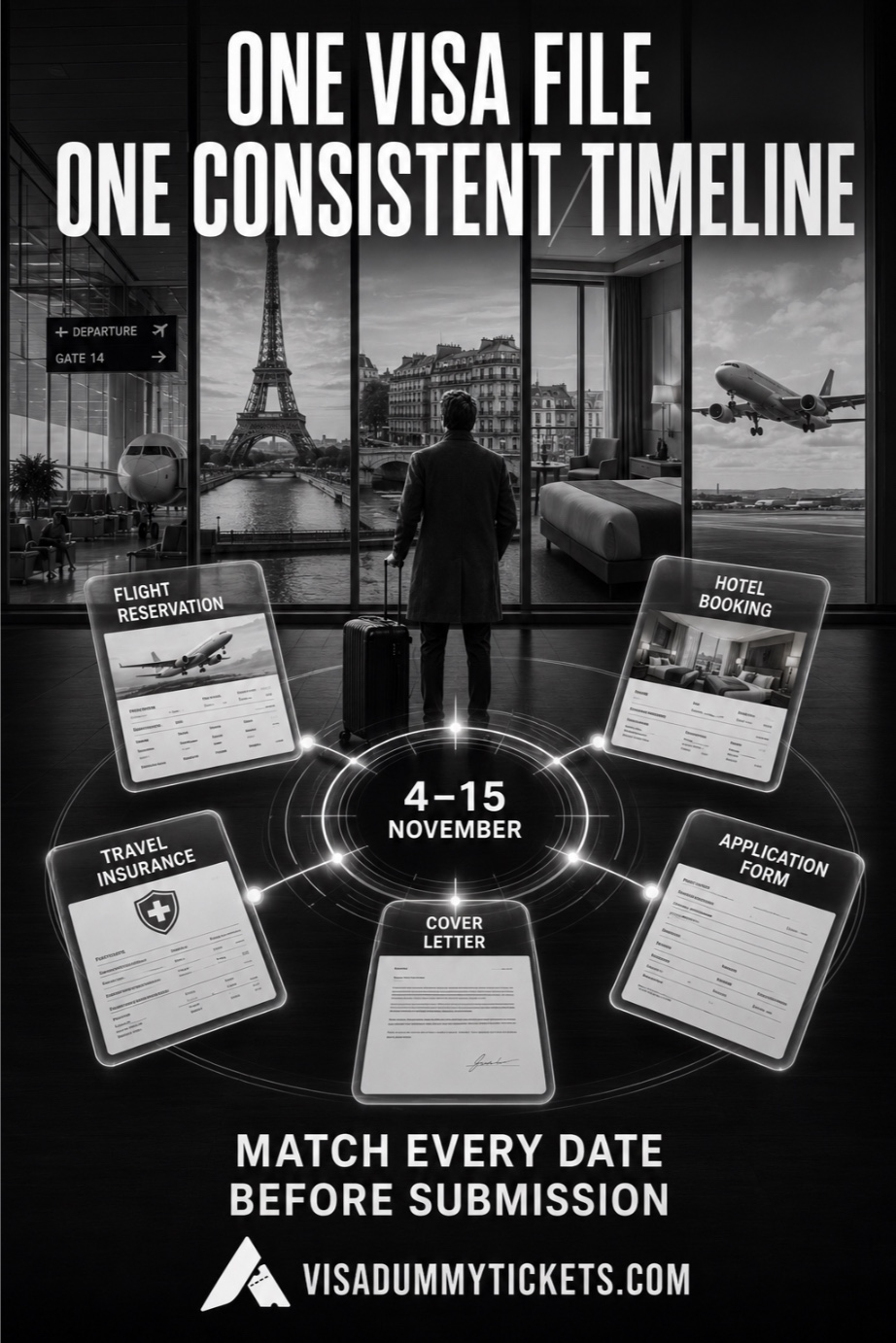
Suppose an applicant requests a 12-day Spanish Schengen visa. The application form says 4–15 November, the cover letter says Madrid and Barcelona, the hotels cover 5–14 November, insurance begins on 6 November, and the flight returns from Paris on 17 November. Every document may look professional, but the combined story is incoherent.
A stronger file would account for the overnight flight, cover the whole insurance period required by the checklist, explain any French portion, show accommodation for each night and request dates that correspond to the itinerary. Officers assess relationships between documents, not isolated PDFs.
PNR verification is useful, not magical
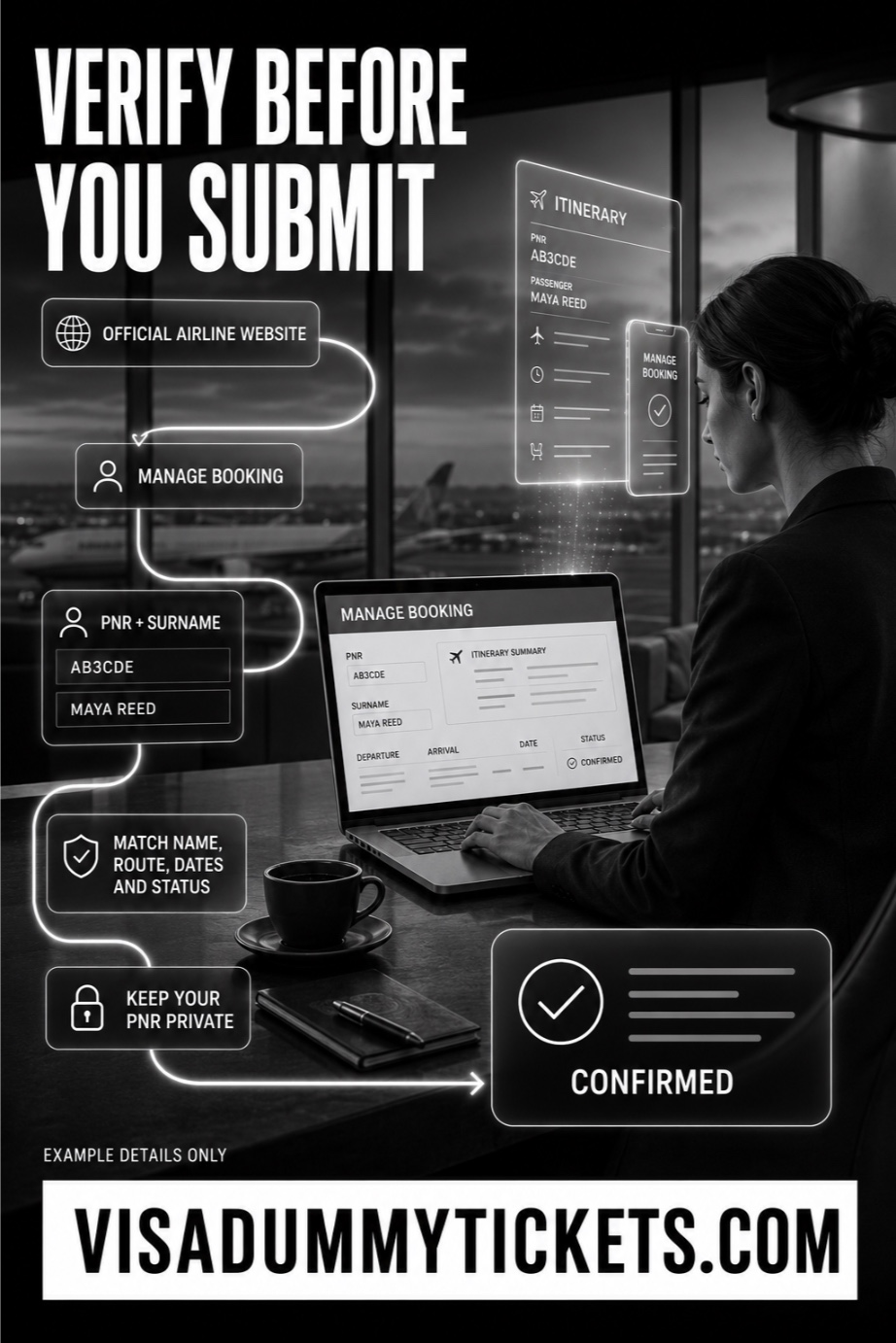
Many airline reservations can be checked on the airline’s official Manage Booking page using a booking reference and surname. However, visibility differs by carrier, codeshare, ticketing arrangement and reservation system. A booking made through one carrier may display only on the operating carrier’s site, or a separate airline reference may be needed. Some records are verifiable through the booking source rather than a public airline page.
Accordingly, the quality question is not merely “Can I type six characters into one website?” Ask the provider:
- Which airline or system should display the reservation?
- What surname format should be used?
- How long is the reservation expected to remain active?
- What happens if the status changes during the promised period?
- Is it a reservation only, or has an e-ticket actually been issued?
Never publish your PNR, passport number or full itinerary in a public forum. Those details can expose personal information and sometimes allow unauthorized access to the booking.
How can an embassy check a dummy ticket?
An officer may simply review the PDF for consistency. The authority may also ask the applicant for clarification, contact a travel provider, check a booking through available systems or request updated transport evidence. It would be misleading to claim that every embassy runs every PNR through the same automated process; verification practices are not globally uniform or fully public.
Before submission, an applicant can perform a responsible self-check:
- Open the airline’s official website manually rather than following an unknown link in the PDF.
- Select Manage Booking, My Trips or the equivalent.
- Enter the booking reference and surname exactly as instructed.
- Compare the displayed name, route, dates, flight numbers and status with the PDF.
- Save the provider’s support details, but do not alter the reservation document yourself.
- Recheck close to submission if the reservation has a limited validity window.
If the reservation cannot be found, do not immediately assume fraud. Check for typographical errors, codeshare references and whether the provider supplied the correct verification channel. If the details still cannot be confirmed, contact the provider before using the document.
When can a dummy ticket cause a visa problem?
The following failures appear repeatedly in weak applications:
- The document was generated, not reserved
A “free dummy ticket generator” may place invented details on an airline-style template without creating any booking. An attractive PDF is not proof. Submitting it can turn a minor itinerary requirement into a false-document issue.
- The reservation expired too early
Temporary reservations have limited lives. If it expires before the appointment, the document may not be verifiable when reviewed. Choose timing that fits the submission process and understand that no reservation remains active forever without ticketing or a provider commitment.
- Passenger details do not match the passport
Missing surnames, reversed names, typing errors and inconsistent transliteration can prevent retrieval and raise doubts. Enter the passport name carefully, especially for compound names and passports without a conventional surname field.
- The itinerary contradicts the visa form
Different dates across flights, hotels, insurance, leave letters, invitations and the form can suggest poor preparation or an unreliable purpose. Align the whole trip before ordering any reservation.
- The wrong country appears to be the main destination
For Schengen travel, a route that points to another main destination can create a jurisdiction problem. Do not manipulate hotel nights or flight sectors to obtain an easier appointment.
- A reservation is described as paid
This is avoidable. If it is not an issued e-ticket, do not call it one. A short cover-letter phrase such as “provisional round-trip flight reservation, to be ticketed after visa issuance” is often clearer where reservations are permitted.
- The journey is commercially or practically implausible
Impossible connections, airport changes without transfer time, an indirect route that costs far more than the applicant can explain, or a one-way trip for a short holiday can create questions. Credibility is logistical as well as documentary.
- The applicant assumes acceptance guarantees approval
An officer can accept the reservation as a document and still refuse the visa for insufficient funds, weak ties, unclear purpose, missing insurance or another reason. “Accepted by embassy” should mean the document format was permitted, not that the authority endorsed the provider or approved the application.
How to get a legal flight reservation for a visa
Step 1: Read the official checklist first
Identify the visa category, competent authority and application location. Note the exact phrase: reservation, itinerary, return booking, onward ticket or paid ticket. Also check whether the authority advises against purchasing travel.
Step 2: Finalize a coherent proposed journey
Choose realistic arrival and departure dates, the correct main destination, plausible connections and accommodation periods. Confirm that leave, invitations, meetings, courses and insurance align.
Step 3: Choose the appropriate booking method
Depending on the requirement, this could be a carrier fare hold, a travel-agent reservation, a refundable issued ticket or a specialist temporary reservation. Avoid template generators and sellers that promise guaranteed approval.
Step 4: Enter passport-matched details
Use the same name order and spelling as the passport. Review every date, airport and passenger before the booking is created.
Step 5: Verify and submit at the right time
Check the booking through the stated channel, retain the original PDF, and submit it within its useful period. Never edit airline or provider fields yourself.
Step 6: Purchase the actual ticket at the appropriate stage
After approval or after a specific instruction from the authority buy an issued ticket that suits the granted visa dates and conditions. The final flight need not always be identical to the proposed itinerary, but it must comply with the visa, border and carrier rules. Reassess connections, insurance and entry conditions before travel.
Using Visa Dummy Tickets for a verifiable reservation
Visa Dummy Tickets prepares application-stage flight reservations for travellers whose current checklist accepts a reservation or itinerary instead of full airfare. The dummy flight reservation service supports one-way, return and multi-city routes and provides a PNR or equivalent booking reference with verification guidance.
The current standard flight plan starts at $9 per traveller. Complete standard orders are generally delivered by email within 1–2 hours. Eligible reservations include monitored validity for up to 14 days under the applicable service terms and up to four reasonable corrections. These are service features, not promises of visa approval or universal embassy acceptance.
The ordering process is straightforward:
- Select the flight reservation option and trip type.
- Enter every traveller’s passport-matched name, route, dates and consulate information.
- Review the emailed itinerary immediately and follow the supplied verification instructions.
If the visa file also requires accommodation, the flight-and-hotel package can align arrival, hotel and departure dates. This reduces preventable discrepancies, but the applicant remains responsible for checking the official requirements and all submitted information. Review the frequently asked questions before ordering if the distinction between a reservation and a paid ticket is unclear.
A final pre-submission checklist
Use this list on the day before an appointment or upload:
- The official checklist currently requests or permits this form of travel evidence.
- I am applying to the correct authority and under the correct visa category.
- The reservation is genuine and has not been manually altered.
- My full name matches my passport.
- The route, dates and trip duration match the application form.
- The itinerary aligns with hotels, insurance, leave, invitations and events.
- The return or onward sector is included where required.
- The reservation can be checked through the stated channel while active.
- I have not described an unpaid reservation as a purchased e-ticket.
- I understand that the reservation cannot be used to board.
- I have not exposed the PNR or passport details publicly.
- I will buy a valid ticket only when appropriate for this visa process.
Frequently asked questions
Is dummy ticket legal to use for a visa application?
A genuine temporary flight reservation is generally legitimate when it is accurate, honestly described and relevant to the official checklist. A fabricated, altered or expired document knowingly represented as current can be treated as false evidence. Legality and immigration consequences depend on the jurisdiction and facts.
Are dummy tickets accepted by embassies?
Some embassies request or accept flight reservations; others do not require them or assign them little value. No provider can guarantee universal acceptance. Check the destination government’s current instructions for the exact visa class and application post.
Is dummy ticket legal for Schengen visa applications?
Yes, a real reservation can be appropriate for a Schengen short-stay application where the checklist requests intended transport. The EU Visa Code recognizes return or round-trip reservations as possible supporting evidence. Fake or misleading documents can cause refusal.
Do all 29 Schengen embassies accept dummy tickets?
All 29 states operate under the common short-stay framework, but local checklists and case requirements vary. It is safer to say that genuine reservations are commonly used where requested—not that every embassy accepts every dummy ticket.
Is dummy ticket legal for a Spanish Schengen visa?
A genuine itinerary may satisfy a Spanish post’s reservation requirement if the current checklist permits it. Apply to Spain only when Spain is the competent main destination, and ensure flights, stays and requested dates agree.
Is dummy ticket legal for French, Italian or German visas?
For short-stay Schengen applications, a truthful reservation is commonly relevant when the responsible French, Italian or German post requests it. National long-stay visas use different checklists. Verify the official instructions for the country where you apply.
Is dummy ticket legal for a UK visitor visa?
A genuine reservation is not inherently a forgery, but UKVI says flight bookings are generally less useful evidence for Standard Visitor applications. Do not obtain one merely to add pages. Transit cases may require confirmed onward-travel evidence.
Is dummy ticket legal for a US B1/B2 visa?
A temporary reservation is not a universal B1/B2 requirement. US guidance tells applicants not to buy tickets or make final travel plans before visa issuance. Provide travel details truthfully if asked; never fabricate a booking.
Is dummy ticket legal for a Canada visa?
IRCC may request an itinerary or provisional arrangements for a visitor visa, depending on the personalized or local document list. A genuine reservation can show proposed flight details, but it does not replace evidence of funds, purpose and ties.
Can I use a dummy ticket for a student visa?
Only if the relevant study-visa or residence checklist requests or permits it. Long-stay applications often prioritize admission, finances, accommodation and sponsorship, and authorities may prefer travel to be booked after approval.
Can a dummy ticket be used at airport check-in?
An unpaid reservation does not confer a right to fly and is not a boarding document. An airline or border authority asking for onward travel may require an issued ticket. Check the entry and carrier rules and purchase valid travel before departure.
How long is a dummy ticket valid?
There is no universal period. Airline holds may last hours or days, while specialist services may offer a defined support window. Confirm the terms before ordering and time the reservation around submission, not around an assumed decision date.
Can an embassy verify a dummy ticket PNR?
It may be able to review or verify booking information, but methods vary. Applicants should assume that every supporting document can be checked. A PNR is useful only while the record is active and its details match the application.
Does a valid PNR guarantee embassy acceptance?
No. A valid PNR can support authenticity, but it does not prove ticket payment, visa eligibility or a genuine purpose. An inconsistent or unnecessary reservation can still be disregarded or questioned.
Can I create a dummy ticket for free?
Some airlines offer short fare holds or cancellable options. A free PDF generator that merely imitates an airline confirmation is unsafe. The issue is not price; it is whether a truthful booking exists and fits the checklist.
Is a refundable ticket better than a dummy ticket?
It can be, especially when the authority requests a paid or confirmed ticket. However, refundable fares can be expensive and subject to fees, refund delays and no-show terms. For a reservation-only requirement, a genuine temporary booking may be more proportionate.
Can a dummy ticket lead to visa refusal?
Yes, if it is false, expired, misleading, unverifiable or inconsistent. A perfectly valid reservation also cannot prevent refusal for unrelated eligibility problems. Treat it as one supporting document, not the foundation of the case.
Should I mention “dummy ticket” in my cover letter?
Clear official language is better. Where accurate, write “provisional round-trip flight reservation” or “proposed flight itinerary to be ticketed after visa issuance.” Do not imply that the fare has been paid.
What should I do if the reservation expires after submission?
Do not send unsolicited replacements unless the authority or procedure calls for them. Retain proof of what was submitted and contact the provider if the reservation changes within its committed support period. If the embassy requests an update, respond promptly with truthful current evidence.
Will changing my flight after visa approval cause a problem?
Travel plans can change, but the final trip must comply with the visa’s validity, duration, entries and genuine destination. A materially different Schengen main destination can create questions at the border. Carry evidence explaining legitimate changes.
The verdict: legal when genuine, accepted only when the rules allow it
So, is dummy ticket legal? A genuine, unaltered and honestly described flight reservation is generally a legitimate application-stage document. It becomes unsafe when there is no underlying booking, its details are manipulated, its status is concealed or it is presented as a paid ticket.
Are dummy tickets accepted by embassies? Reservations are commonly accepted or requested in Schengen short-stay cases, but there is no universal embassy rule. The UK often gives flight bookings little weight for ordinary visitor applications. The US does not generally require a purchased flight for B1/B2 applications. Canada may ask for an itinerary or provisional arrangements. Long-stay and transit routes require their own analysis.
The best document is not the one with the boldest acceptance claim. It is the one that answers the current official checklist, reflects a real proposed journey and remains consistent with every other part of the application. Verify first, describe it truthfully, and purchase the actual ticket at the stage the responsible authority recommends.