



Paid Flight Ticket vs Dummy Ticket: Which Better Supports a Visa Application?
A visa application can create an expensive contradiction. The embassy, consulate or visa application centre may want to understand how an applicant intends to enter and leave the destination, yet the visa decision has not been made. Buying the complete airfare at this stage may demonstrate a settled journey, but it can also expose the traveller to cancellation charges, change penalties or the loss of a non-refundable fare. A dummy ticket for visa purposes addresses this timing problem by documenting the proposed flight plan without requiring the applicant to purchase the complete journey prematurely.
The short answer is that a genuine, verifiable flight reservation is usually the more proportionate option when the official checklist asks for a reservation, itinerary or proposed flight details rather than a fully paid ticket. It performs the limited documentary function the authority has requested while preserving financial flexibility during an uncertain decision period. A paid flight ticket becomes the better option only when the competent authority expressly requires ticketed travel, the applicant already holds an appropriate ticket, or the fare is genuinely refundable and the traveller accepts its conditions.
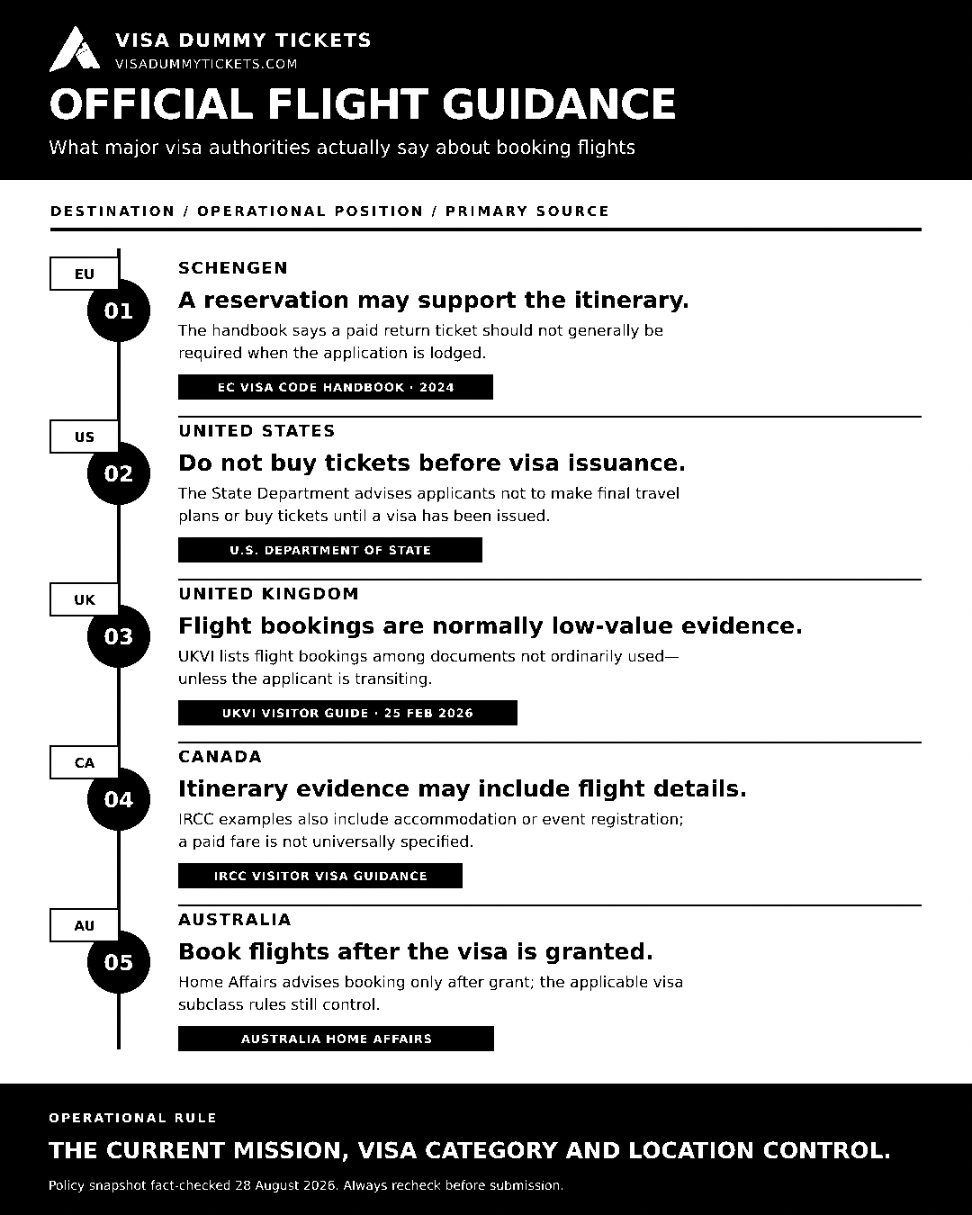
There is an equally important third possibility: sometimes neither a paid ticket nor a dummy reservation is necessary. Requirements differ substantially by destination, visa category and application location. The United Kingdom, for example, currently lists flight bookings among documents that standard visitors should not ordinarily use as evidence, except in transit cases. The United States advises visitor-visa applicants not to make final travel plans or buy tickets until a visa has been issued. Consequently, the best document is not the most expensive one; it is the document that responds precisely to the current official instruction.
This guide examines the paid flight ticket vs dummy ticket for visa question through evidentiary value, financial exposure, verifiability, validity and consular policy. It also explains how to obtain a passenger-specific VDT flight reservation, how to inspect its PNR or booking reference and how to integrate the itinerary into a coherent visa file.
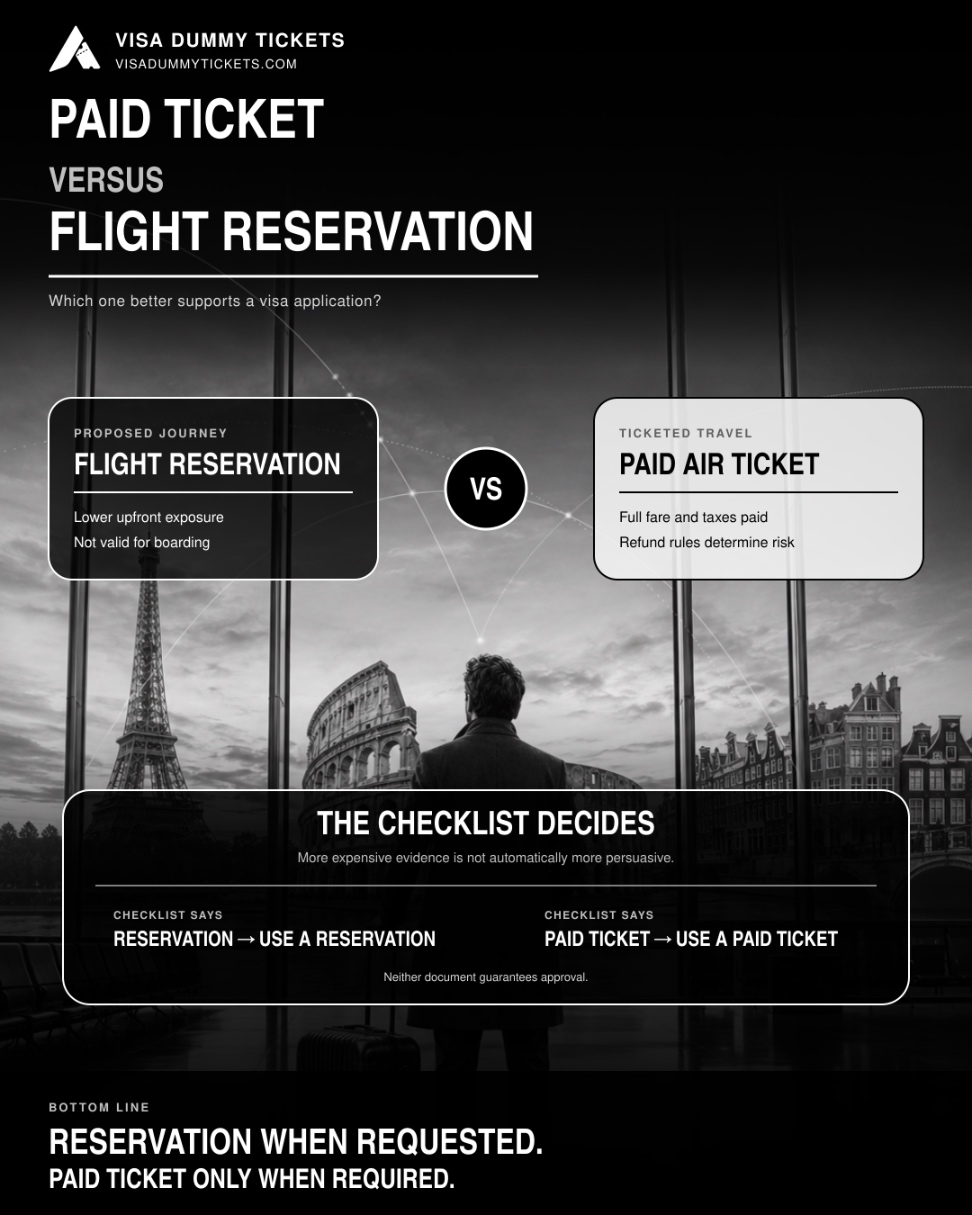
The decisive principle: satisfy the checklist, not an internet myth
Applicants frequently encounter categorical online claims: “every embassy requires a dummy ticket,” “a paid ticket proves seriousness,” or “a confirmed flight guarantees approval.” None is a dependable universal rule.
A visa authority does not decide an application by comparing how much one traveller spent on airfare with how little another spent. The officer examines whether the applicant meets the applicable immigration requirements. Depending on the jurisdiction, that assessment can include the credibility of the visit, financial capacity, accommodation, travel medical insurance, employment or study obligations, family and economic ties, previous travel, invitations, sponsorship and the intention to leave within the authorised period.
A flight document has a narrower role. It can help articulate:
- the proposed departure point and entry airport;
- the intended arrival and departure dates;
- the principal destination or destination sequence;
- connections in a multi-city journey;
- a return or onward movement; and
- whether the transport plan agrees with the rest of the application.
Its probative value comes from accuracy and congruence, not from avoidable expenditure. A costly ticket with the wrong surname, contradictory dates or an implausible destination order may be less useful than an economical reservation that corresponds exactly with the passport, application form, hotel schedule and written itinerary.
The correct sequence is therefore simple: identify the competent authority, open its current checklist, note the exact noun it uses and provide that form of evidence. “Reservation,” “itinerary,” “flight details,” “return booking,” “onward ticket” and “fully paid ticket” should not be treated as interchangeable instructions.
Dummy ticket, flight reservation and paid ticket: the terminology explained
The expression “dummy ticket” is commercially familiar but technically imprecise. In responsible visa-document practice, it means a temporary, application-stage flight reservation prepared around a real traveller and a genuine proposed journey. It must not mean a counterfeit e-ticket, a manually altered airline PDF, an invented PNR or a fabricated boarding pass.
Understanding the documents prevents applicants from accidentally overstating what they possess.
| Document or term | What it ordinarily represents | Common identifying feature | Can it be used to board? |
| Flight reservation for visa | A proposed itinerary held or recorded for application-stage documentation | Passenger name, route, dates, flights and PNR or booking reference where supported | No, not without ticket issuance and fulfilment of airline requirements |
| Dummy ticket for visa | Informal name for a temporary flight reservation; it should be genuine rather than fabricated | The same itinerary fields and retrievable reservation information where available | No |
| Paid airline ticket or e-ticket | Air transportation purchased under an airline or agency fare contract | Reservation reference plus an issued e-ticket number, normally associated with payment | Potentially, after check-in, travel-document and airline conditions are met |
| Boarding pass | A document issued for a particular passenger and flight after the relevant check-in process | Flight, date, gate or sequence information and boarding barcode | Yes, together with the required identity and travel documents |
| PNR or record locator | A reference used to locate a reservation record | Often a short alphanumeric code; format depends on the system | Not by itself |
A PNR does not prove that airfare has been paid. It identifies reservation data. Conversely, a paid ticket may have both a PNR and an e-ticket number. This distinction is particularly important when an applicant searches for a dummy flight ticket with PNR: successful retrieval can establish that booking information exists, but it does not convert the reservation into a ticketed right to travel.
What do official visa authorities say about buying flights before approval?
No worldwide policy governs every visa. Nevertheless, several authoritative sources demonstrate why “buy the ticket first” is poor generic advice.
| Destination or system | Current official position relevant to flight evidence | Practical implication |
| Schengen short-stay visa | The European Commission’s Visa Code Handbook identifies a reservation of a return or round ticket among possible transport evidence and states that a paid return ticket should not be required when the application is lodged; it may be requested exceptionally after visa issuance. | Where the mission’s local checklist requests a flight reservation, an authentic application-stage itinerary is ordinarily more proportionate than a non-refundable paid ticket. |
| United States visitor visa | The U.S. Department of State states that there is no guarantee of visa issuance and tells applicants not to make final travel plans or buy tickets until they have a visa. | A paid flight should not be purchased merely to make a B1/B2 application look stronger. Provide intended travel information and only the evidence requested. |
| United Kingdom Standard Visitor | UK Visas and Immigration lists hotel and flight bookings among documents applicants should not use as evidence, with an exception for flight bookings in transit cases. Applicants must instead show genuine-visitor circumstances and capacity to pay for the return or onward journey. | For an ordinary UK visit, neither a paid ticket nor a dummy ticket should be submitted by default. Follow the category-specific instructions. |
| Canada visitor visa | Immigration, Refugees and Citizenship Canada says itinerary evidence may include flight details, proof of accommodation or event registration. The instruction asks for information showing the intended stay; it does not say that every applicant must buy non-refundable airfare. | Proposed flight details or a reservation may be relevant when requested, but the personal document list and application instructions control. |
| Australia | The Department of Home Affairs advises applicants to lodge early and suggests booking a flight after the visa is granted. Individual subclass requirements still apply. | Do not assume that advance ticket purchase improves the visa case. Submit the specified documents and defer travel commitment where instructed. |
The European Commission’s 2024 operational Visa Code Handbook supplies the clearest Schengen formulation, but applicants must still consult the responsible mission’s local checklist. Its policy is not permission to submit any file labelled “dummy”; it is an instruction to use proportionate transport evidence within an individually assessed application.
The U.S. visitor-visa guidance, UK visitor supporting-document guide and Canadian visitor-visa guidance demonstrate why destination-specific reading matters. Avoiding a paid ticket does not automatically create a need for a commercial reservation, while a request for “flight details” does not inherently require irreversible payment. The authority’s precise requirement is superior to both a universal dummy-ticket rule and the assumption that a paid ticket carries greater consular prestige.
Facts and figures: why premature airfare is a material risk
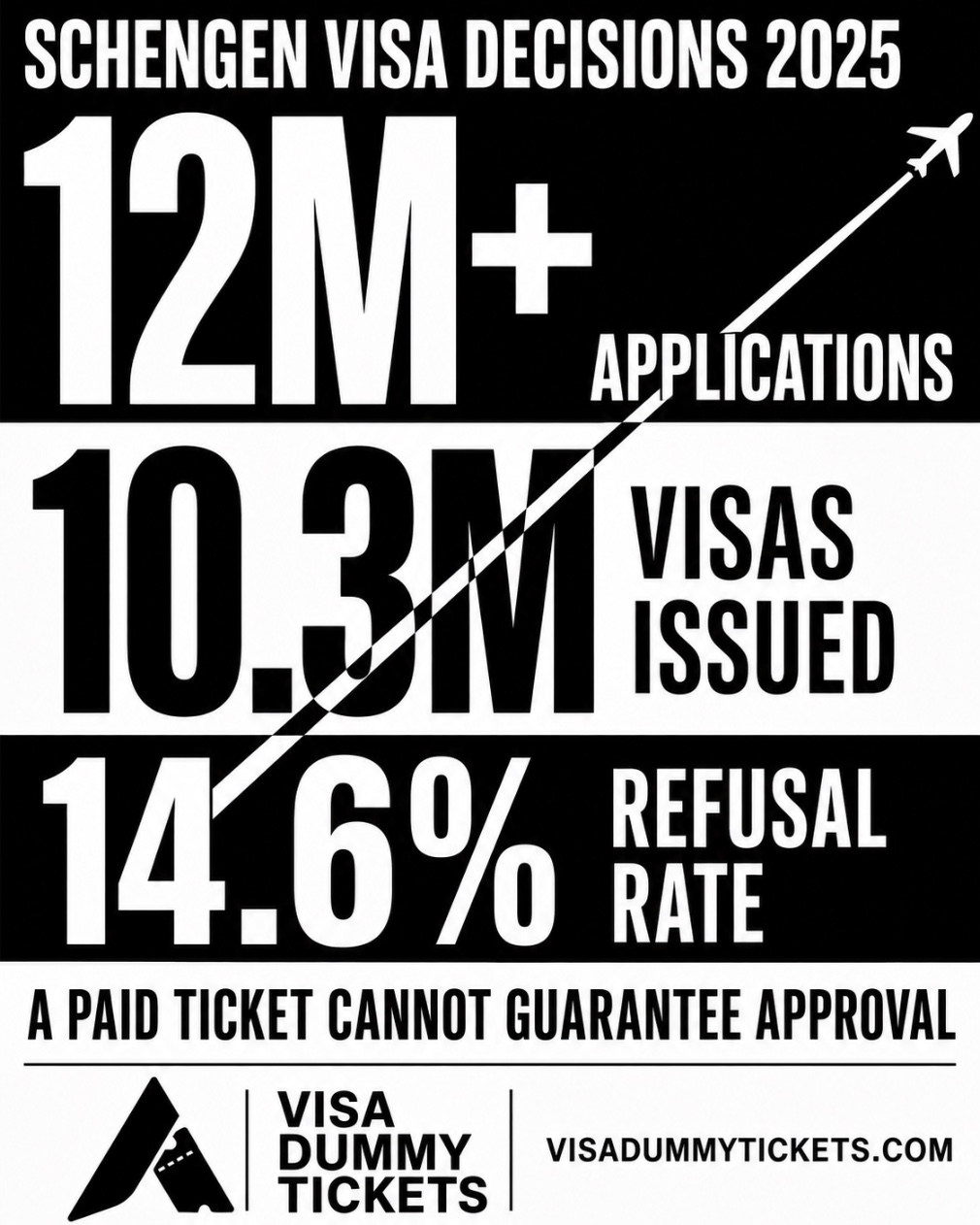
The scale of visa decision-making illustrates why applicants should not treat approval as inevitable. According to the European Commission’s 2025 Schengen visa statistics release, EU and Schengen-associated consulates received more than 12 million short-stay visa applications in 2025. Almost 10.3 million visas were issued, while the global refusal rate was 14.6%. Of the visas issued, 51.7%, or approximately 5.3 million, permitted multiple entries.
These aggregate figures do not predict any individual result; nationality, destination, purpose, documentation and personal circumstances vary. They do establish that a pending decision is a genuine contingency. Paying a non-refundable international fare before the outcome can therefore create material pecuniary exposure. A reservation reduces that exposure when a reservation is the evidence requested, but it cannot reduce the legal or evidential burden of proving the rest of the application.
Paid flight ticket vs dummy ticket for visa: a substantive comparison
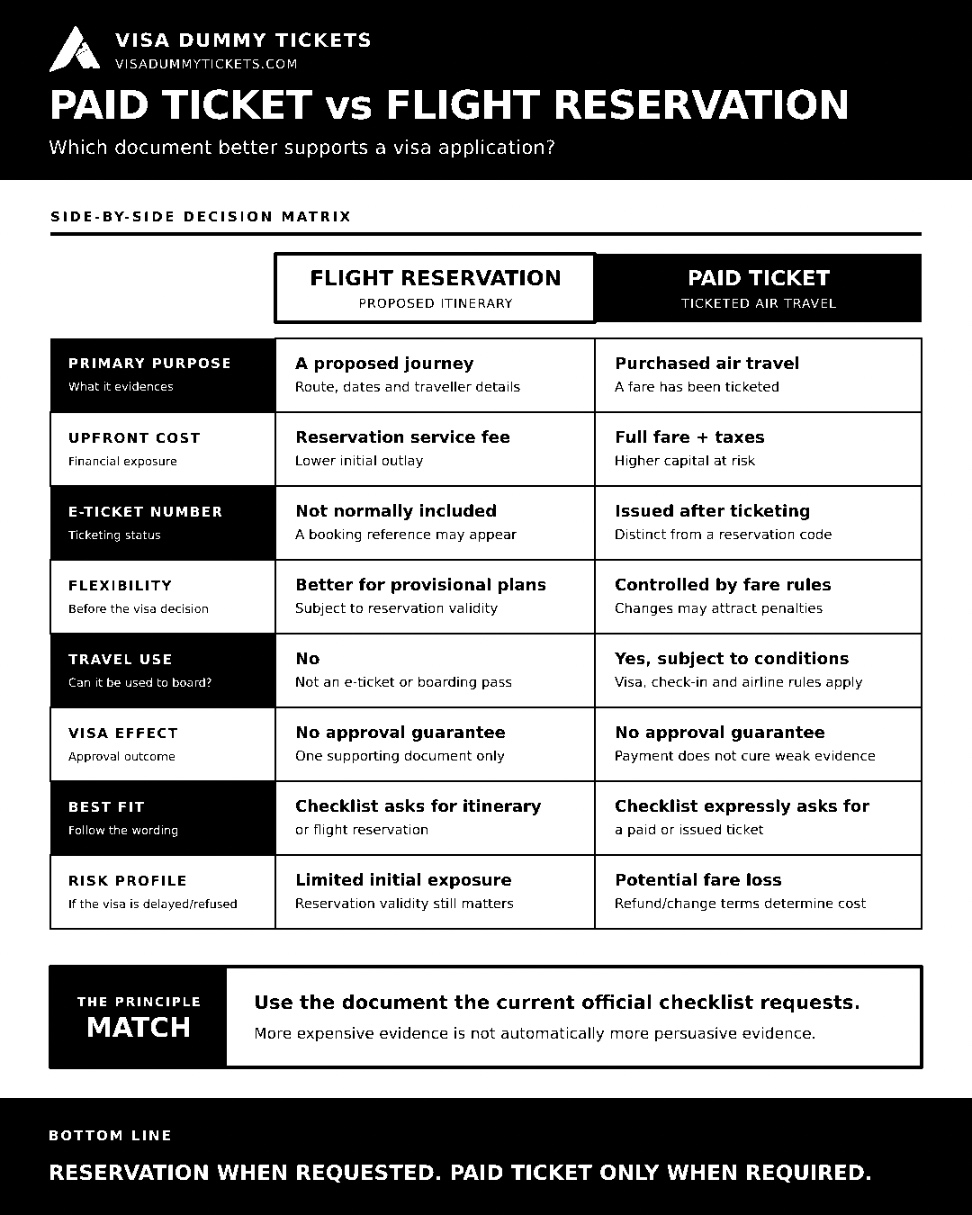
The following comparison separates appearance from actual function.
| Evaluation factor | Verifiable dummy ticket or flight reservation | Fully paid flight ticket |
| Primary purpose | Documents a proposed journey during the application stage | Purchases air transportation for travel |
| Initial financial commitment | VDT’s standard flight-reservation plan currently begins at $9 per traveller; additional or complex routing may affect the price | Full fare, taxes and any agency charges are paid |
| Documentary relevance | Strongly aligned where the checklist asks for a reservation, itinerary or proposed flight information | Appropriate where ticketing is expressly required or the traveller already possesses a suitable ticket |
| Reservation evidence | Can include passenger, airline, flight, airport, date, time and a PNR or equivalent reference | Includes itinerary and booking reference; ticketed travel ordinarily also carries an e-ticket number |
| Online review | VDT reservations can be checked through the airline’s Manage Booking channel or the retrieval method supplied, depending on carrier and reservation system | Normally reviewable through the airline or issuing agency, subject to system and codeshare arrangements |
| Validity | Temporary; VDT monitors eligible reservations for up to 14 days under its service terms | Governed by ticket and fare conditions; flight schedules can still change |
| Delivery and corrections | Complete standard VDT orders are ordinarily emailed within 1–2 hours; eligible plans include up to four reasonable corrections | Changes depend on fare rules and may incur a fare difference or penalty |
| Right to travel | None; the reservation is not a boarding document | Exists subject to visa, passport, entry, check-in, airline and ticket conditions |
| Exposure if the visa is delayed or refused | Limited mainly to the reservation-service charge | Can range from a manageable refundable cancellation to substantial loss under restrictive fares |
| Effect on visa approval | No guarantee and no special entitlement | No guarantee; spending more does not compel approval |
- Financial proportionality
The most conspicuous difference is the money placed at risk. A paid ticket commits the airfare and may carry a fare difference, cancellation deduction, service fee or time-restricted credit. A genuinely refundable fare mitigates the risk, but its rules must be read carefully. A flight reservation without paying full airfare confines the initial expense to the reservation service when the authority wants the intended route rather than proof of carrier payment.
- Evidentiary sufficiency
A paid ticket is not automatically more persuasive. If the checklist asks for a reservation, the material question is whether it identifies the traveller, route, dates and return or onward plan. Ticketing becomes necessary when an instruction expressly says “paid,” “issued e-ticket,” “confirmed and paid transport,” or requires a continuation ticket for transit.
- Flexibility before the decision
Appointments move and processing can extend. A restrictive fare may turn a date amendment into a financial penalty. A temporary reservation offers greater pre-decision flexibility, although it must be ordered at an intelligent time and checked near submission.
- Verification and authenticity
The correct comparison is ticketed travel versus a genuine reservation record, not “real versus fake.” A verifiable dummy ticket should contain passenger-specific information and a retrievable reference where supported. PNR retrieval does not confirm payment, preserve inventory or authorise boarding, and an invented PDF has no legitimate place in a visa file.
- Coherence with the complete application
Consular evidence is relational. A 12 October flight conflicts with a cover letter stating 13 October; a Paris arrival two days before the first hotel leaves a gap; a return after insurance expiry creates another discrepancy. A paid ticket cures none of them. The better document lets all materials describe one credible journey.
When is a dummy flight reservation the better choice?
A verifiable dummy ticket for visa is usually the more rational application-stage option when:
- the checklist requests a reservation, itinerary, flight details or comparable evidence;
- the decision is pending and full-fare exposure is unnecessary;
- the route and dates are stable and truthful;
- the record can be reviewed and remains useful through submission; and
- the applicant will not misrepresent it as a paid e-ticket.
This is particularly practical for a dummy ticket for Schengen visa, multi-city tourism and family applications when the responsible authority requests proposed transport evidence. Destination marketing must never replace checklist analysis.
When can a paid flight ticket be the better choice?
A fully paid ticket may be appropriate in narrower circumstances:
- the competent authority expressly requires a paid or issued ticket;
- the visa has already been granted and the traveller is proceeding to final travel arrangements;
- the applicant already possesses a ticket purchased for legitimate reasons and its itinerary remains accurate;
- an onward or transit requirement specifically calls for ticketed continuation;
- the fare is fully refundable, its conditions have been read carefully and the applicant deliberately accepts the temporary financial commitment; or
- an employer, sponsor or organised-tour arrangement has already ticketed the journey under reliable change and cancellation provisions.
Even then, the ticket should not be portrayed as proof of eligibility. It documents transport, not financial solvency, home-country ties, lawful purpose or compliance with every visa condition.
When should an applicant submit neither document?
Do not order a reservation merely to make the file thicker. If the guide says flight bookings are unnecessary or asks only for intended dates, provide that information and prioritise relevant evidence. The U.S. warning against buying tickets does not automatically require a dummy reservation, while standard UK visitor guidance ordinarily discourages flight bookings. Documentary restraint can be as important as documentary abundance.
What makes a dummy ticket credible rather than merely decorative?
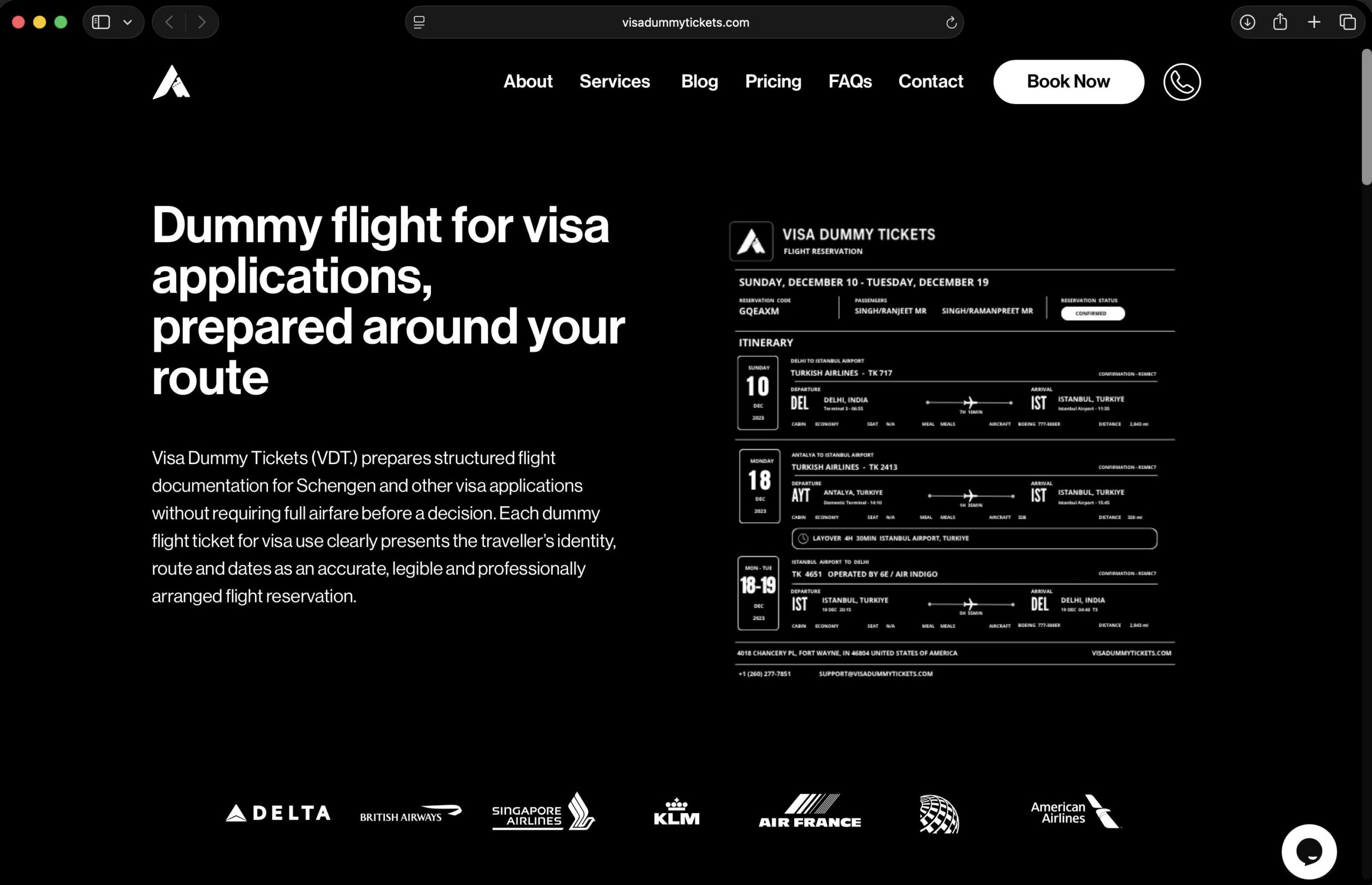
A useful flight itinerary for visa application should contain enough information to identify both the traveller and the intended movement. Depending on the airline and reservation channel, the document may display:
- the passenger’s name as entered from the passport;
- airline and operating-carrier information;
- flight number and booking class where available;
- departure and arrival airports with IATA airport codes;
- each flight sector or connection;
- local departure and arrival dates and times;
- reservation status;
- a PNR, record locator or equivalent booking reference; and
- contact or retrieval instructions where supplied.
The route must possess substantive logic. For Schengen travel, it should support the principal destination and genuine country sequence. An applicant staying eight nights in Spain and two in France should not manufacture a predominantly French itinerary merely to obtain an appointment.
Timing is equally important. Ordering weeks early may exhaust the useful validity, while ordering at the final minute leaves no interval for review. Plan VDT’s monitored period of up to 14 days backwards from the appointment or upload date.
Applicants who want to understand the normal information hierarchy can review VDT’s dummy flight reservation samples. A sample illustrates fields and layout only; it is not a reusable booking and must never be edited with another traveller’s particulars.
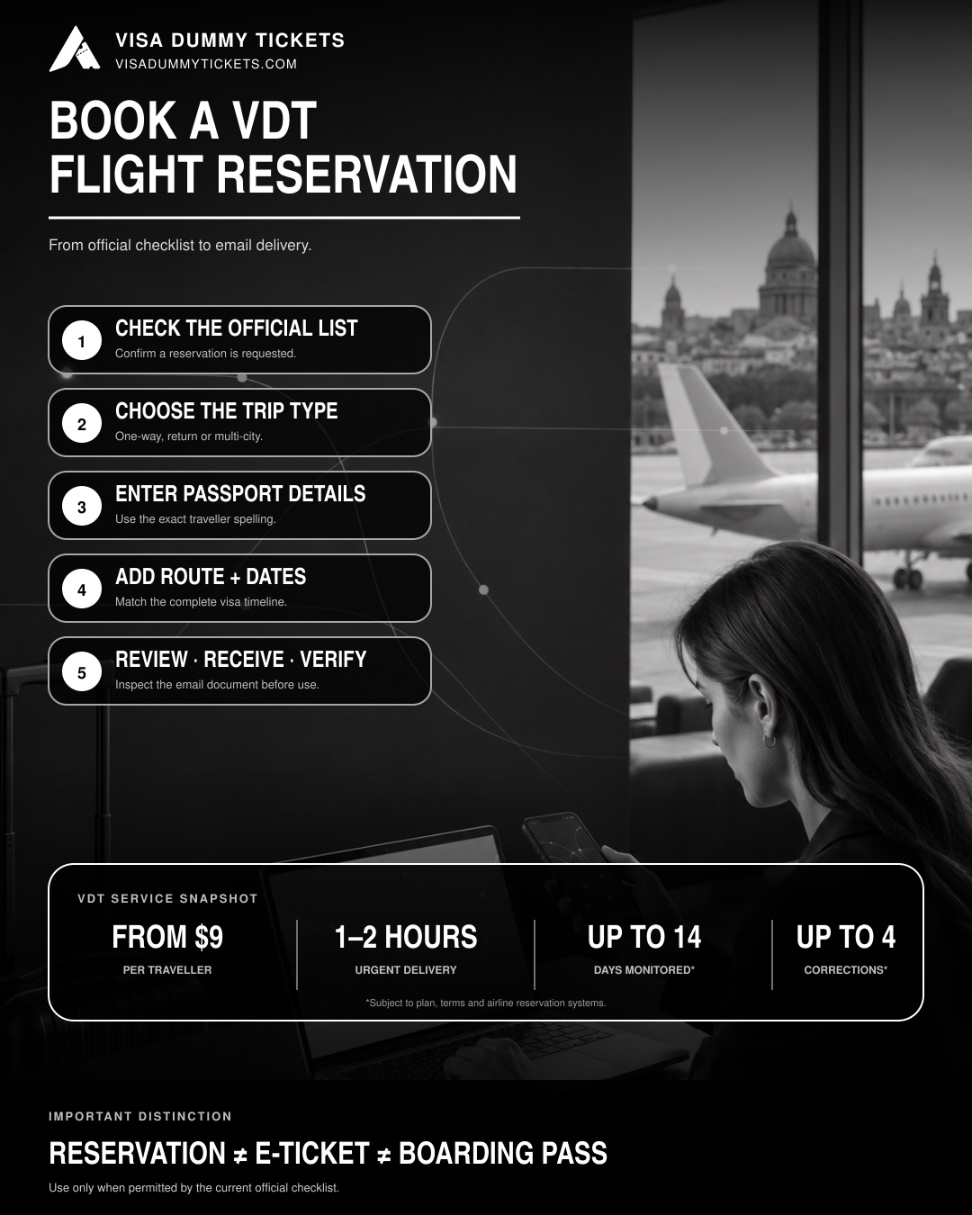
How to book a flight reservation from Visa Dummy Tickets
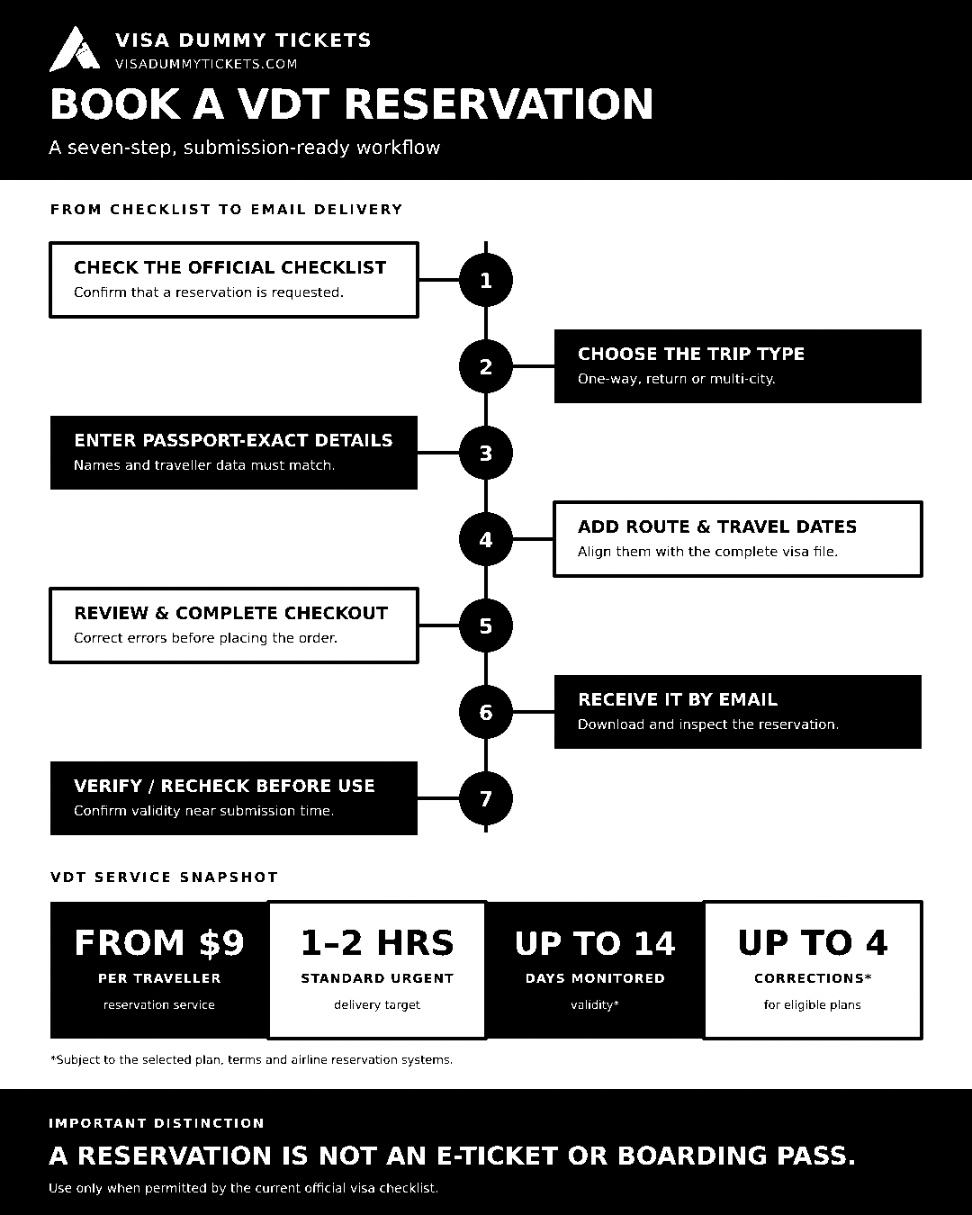
VDT offers an online process for one-way, return and multi-city reservations. The following method combines the website’s ordering steps with the checks an applicant should complete before and after purchase.
Step 1: Read the official checklist for the exact application
Begin with the embassy, consulate, government portal or authorised visa-centre checklist for the destination, visa category and country of application. Confirm whether it requests a flight reservation, itinerary, return booking, onward ticket or paid ticket. For Schengen travel, confirm the competent country from the genuine principal destination and journey structure.
Do this before choosing a service. The most accurate reservation cannot correct an application built for the wrong authority.
Step 2: Stabilise the proposed journey
Set realistic departure, arrival and return dates. Compare them with annual leave, invitation dates, conference or course schedules, hotel stays, travel insurance and the duration stated in the application form. Account for overnight flights: a traveller may depart Riyadh on 5 November but arrive in Paris on 6 November, so the first hotel night and written programme must reflect the arrival calendar.
Choose the simplest route that truthfully serves the trip. Additional connections do not make a visa application more sophisticated; they create more fields that can conflict.
Step 3: Select the VDT dummy-flight plan
Open the VDT dummy flight ticket order page. The standard plan currently begins at $9 per traveller. Select the flight-reservation service rather than the hotel-only or combined flight-and-hotel option. If the checklist requires both transport and accommodation, the combined package may reduce date discrepancies by arranging the two documents around one timeline.
Select the intended journey type:
- one-way for a legitimate one-direction or onward-travel requirement;
- round trip for departure and return travel; or
- multi-city for open-jaw travel, several flight sectors or entry through one city and departure from another.
Step 4: Enter passport-exact traveller information
Choose the number of passengers and enter the email address and phone number requested by the form. Copy each title, first name, last name and passport number from the relevant passport. Do not use a nickname, omit a component because it seems inconvenient or copy one family member’s passport number into another record.
Airline systems may format names differently on the finished itinerary, but the information supplied at ordering must be accurate. Review every traveller separately, even when the family shares a surname.
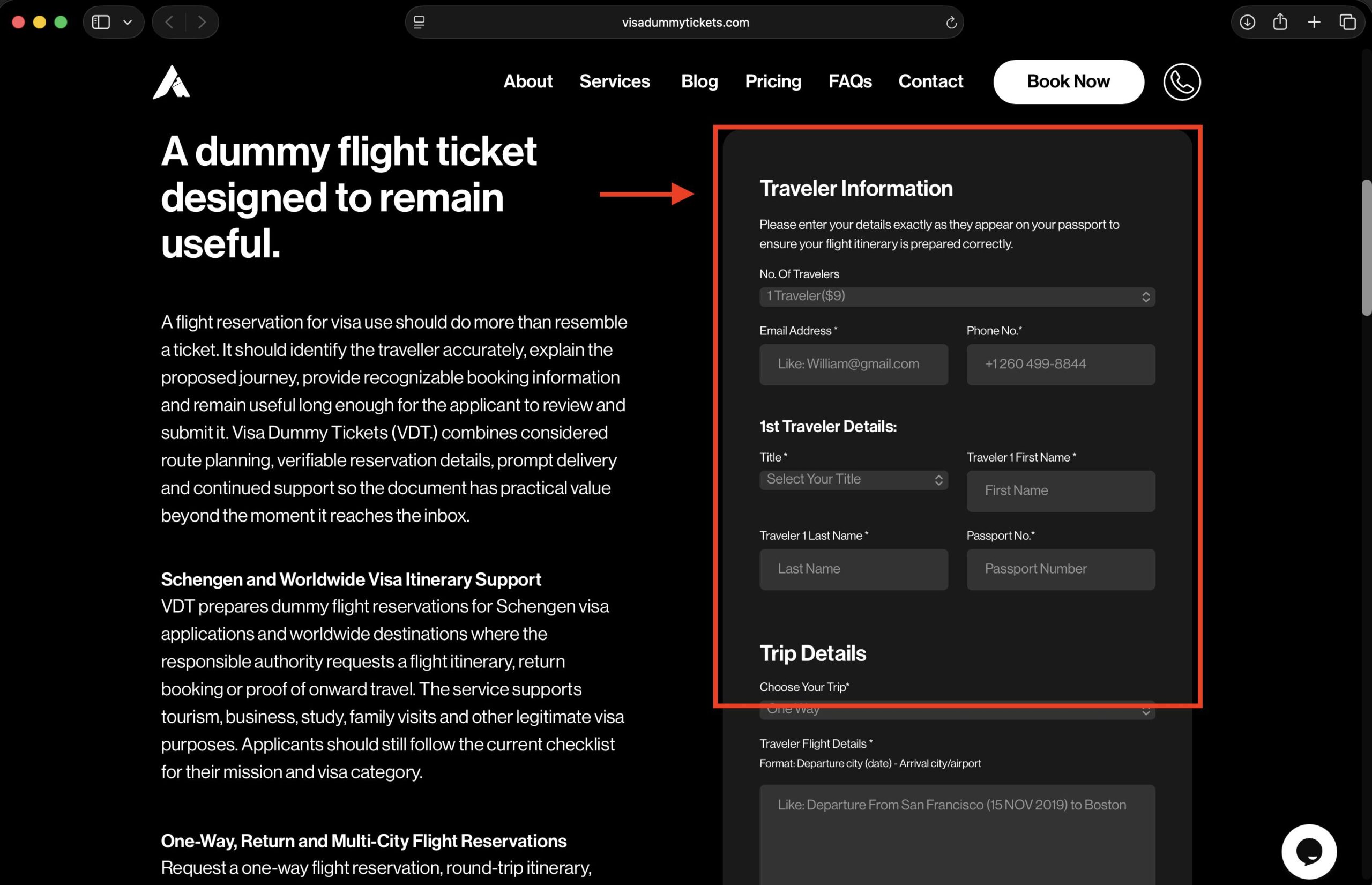
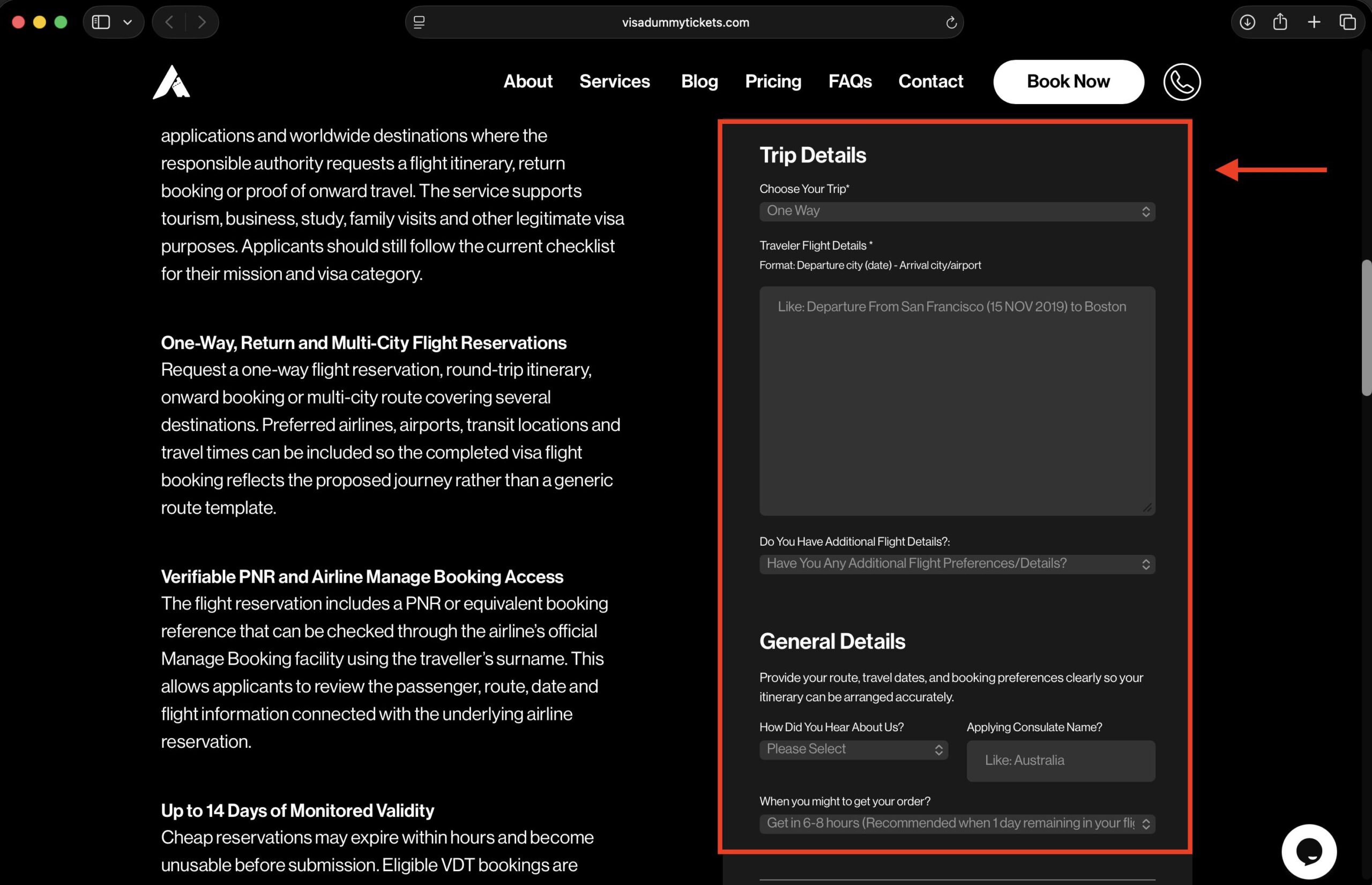
Step 5: Provide complete flight and application details
Enter the genuine departure city, destination, outbound date, return or onward date and any additional sectors. For a multi-country itinerary, write the sequence chronologically. State essential airport or airline preferences, but recognise that operating schedules and reservation availability can affect the final selection.
The VDT form also requests general information such as the applying consulate, required delivery timing, visa interview date and relevant time zone. Accurate appointment information helps position the temporary reservation around the submission window.
Step 6: Review the order before checkout
Before payment, verify:
- the spelling and order of every name;
- passport numbers entered in the form;
- departure and destination cities;
- outbound, return and intermediate dates;
- one-way, return or multi-city selection;
- preferred airline or airport instructions;
- applying consulate and appointment timing; and
- the email address that will receive the document.
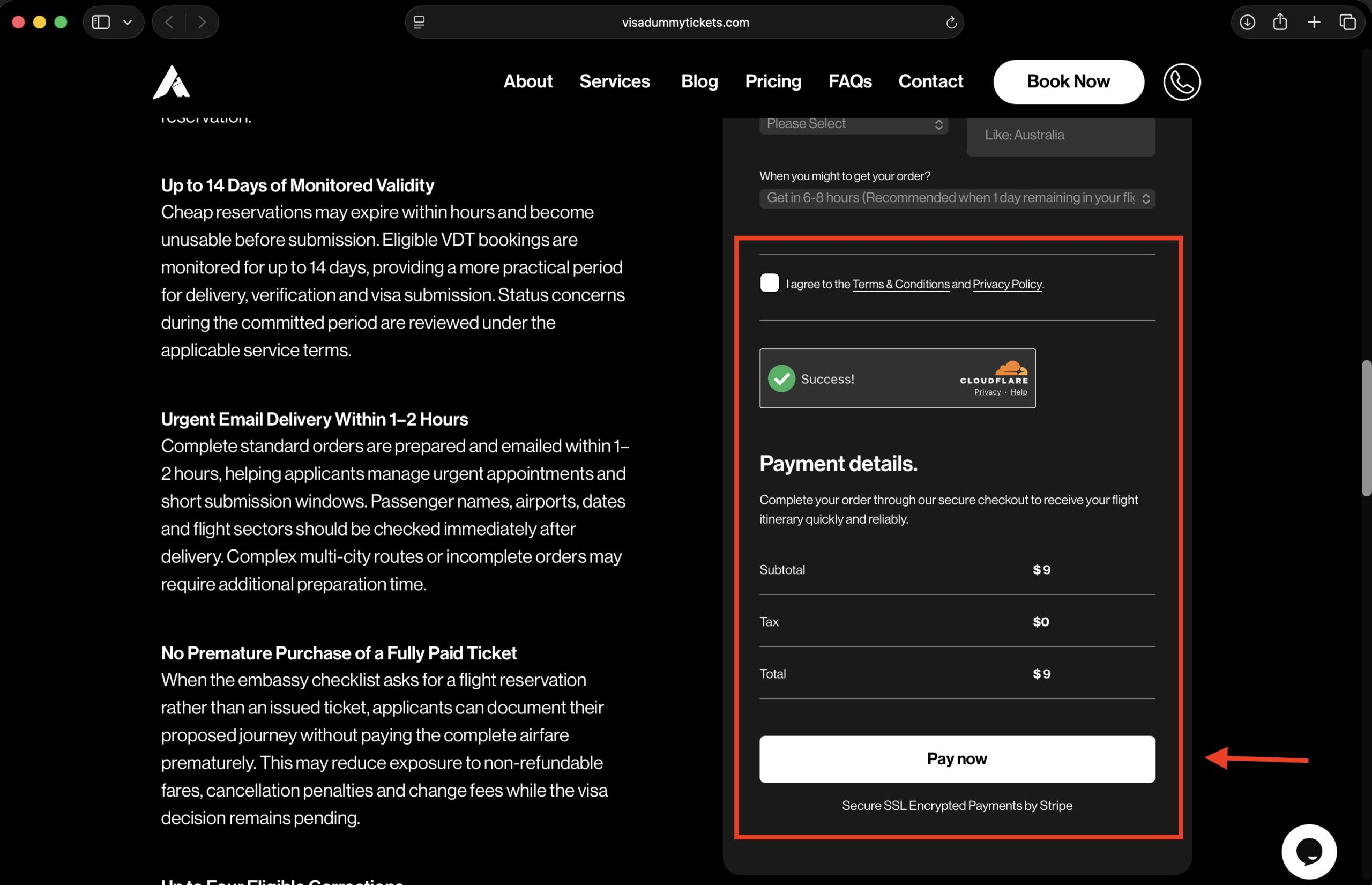
Read the service terms and understand that the payment purchases reservation preparation and support, not the airfare itself. Complete the order through the checkout presented on the VDT website.
Step 7: Receive the reservation by email
VDT ordinarily delivers complete standard urgent orders within one to two hours. Complex multi-city requests or incomplete information may require longer. Open the email promptly, download the itinerary and inspect it on a full screen before printing, uploading or forwarding it to a visa agent.
Check the passenger name, route, flight numbers, airport codes, dates, local times and booking reference. Pay particular attention to airports serving the same metropolitan area and to next-day arrival times.
Step 8: Verify the PNR or booking reference
Use the supplied booking reference and traveller’s surname in the airline’s official Manage Booking facility or follow the retrieval method delivered with the reservation. Some carrier, codeshare or reservation-system arrangements may display information differently, so compare the essential identity, sectors and dates rather than expecting the airline screen to reproduce the PDF design.
Verification shows that reservation information can be retrieved through the relevant channel. It does not show that the fare has been paid and must not be represented as such.
Step 9: Compare the reservation with the complete visa file
Conduct a cross-document audit. The flight arrival should agree with the first hotel check-in, and the final hotel check-out should correspond with the return or onward flight. The visa form, cover letter, day-by-day itinerary, invitation, employer leave and insurance dates should describe the same period.
VDT includes up to four reasonable corrections with eligible flight plans. Contact support promptly if a minor name, date, airport or route-entry error requires attention. A new traveller or complete itinerary reconstruction may constitute a new reservation rather than a correction.
Step 10: Recheck shortly before submission
Eligible VDT reservations are monitored for up to 14 days, subject to the applicable terms and airline or reservation-system conditions. Recheck the record close to the appointment or upload date. If the application is rescheduled beyond the useful window or the status changes, contact VDT support; never manually alter the PDF, PNR, airline, date or flight number. Submit the reservation only if it remains consistent with the final application and the authority requests this type of evidence.
Mistakes that can weaken either a paid ticket or a reservation
Treating “dummy” as a synonym for fabricated
A self-edited template, invented booking code or altered airline document is not a legitimate dummy ticket. False evidence can damage the credibility of the entire application. Use accurate information and a genuine reservation process.
Claiming that the reservation is fully paid
Do not describe a reservation-service charge as payment for the airline ticket. If a form or officer asks whether transport has been paid, answer truthfully. Transparency is more defensible than embellishment.
Buying a restrictive fare to signal commitment
An expensive ticket does not neutralise weak finances, an unexplained purpose or inadequate ties. Purchase it only when required or when its travel and refund value independently justifies the commitment.
Ordering too early
Temporary inventory is temporal by nature. Align the reservation’s monitored period with the actual appointment or upload date instead of ordering as soon as the trip idea emerges.
Ignoring cross-document discrepancies
Review names, dates, destinations and duration across every travel-related document. One transposed date can create a chain of contradictions in accommodation, insurance and the cover letter.
Constructing an ostentatiously complex itinerary
Unnecessary sectors, implausible transfers and airports far from the stated destination do not demonstrate travel sophistication. Prefer a lucid route that an officer can understand without reconstruction.
Believing that verification guarantees acceptance
PNR retrieval concerns the reservation record. Visa acceptance concerns the complete application and remains exclusively within the competent authority’s discretion.
Frequently asked questions about paid and dummy tickets for visas
Is a paid flight ticket better than a dummy ticket for a visa application?
Not automatically. When the official checklist asks for a flight reservation or itinerary, a verifiable dummy ticket normally provides the requested proposed-travel evidence with less financial exposure. A paid ticket is better when ticketing is explicitly required, the visa has been granted or the applicant already holds an appropriate refundable ticket. If flight bookings are not requested, neither document should be added merely for appearance.
Do embassies and consulates accept dummy tickets instead of paid airline tickets?
Many visa instructions accept a reservation, itinerary or proposed flight details, but there is no universal embassy-acceptance rule. The European Commission’s Schengen handbook states that a paid return ticket should not generally be required when an application is lodged. Other systems differ: UK standard-visitor guidance ordinarily discourages flight bookings, while U.S. guidance advises against purchasing tickets before visa issuance. Always follow the exact current checklist.
Can a fully paid ticket increase the probability of visa approval?
There is no official basis for assuming that higher airfare expenditure produces a more favourable decision. A paid ticket can document transport, but it cannot establish the entire purpose of travel, financial stability, intention to return or satisfaction of other immigration requirements. Authorities retain discretion, and both the European Commission and U.S. Department of State materials recognise the uncertainty that exists before issuance.
Is a dummy ticket legal for visa use?
Using a genuine and accurate flight reservation where an authority asks for proposed travel evidence is fundamentally different from using a forged document. The term “dummy ticket” does not authorise fabrication. The applicant must not invent a PNR, alter an airline PDF, add a false e-ticket number or claim that the complete fare has been paid. The submitted document must correspond with the real intended journey and official checklist.
How can I get a flight reservation for a visa without paying the full ticket price?
Open VDT’s flight-reservation order page, select a one-way, return or multi-city route, enter passport-exact passenger information and provide the intended airports and travel dates. Review the order, complete the service payment and inspect the reservation delivered by email. The standard VDT flight-reservation plan begins at $9 per traveller, while additional routing requirements may affect the checkout price.
What is the difference between a PNR and an e-ticket number?
A PNR or record locator identifies reservation information in a booking system. An e-ticket number is associated with issued air transportation after ticketing. A verifiable dummy flight ticket can therefore carry a valid booking reference without containing an e-ticket number. PNR retrieval does not prove payment and does not confer a right to board.
How long should a dummy flight ticket remain valid?
The useful period should overlap the appointment, upload or document-review stage for which the reservation is needed. Validity varies by provider, carrier and reservation system. VDT monitors eligible reservations for up to 14 days under its applicable terms. Applicants should order after the route has stabilised but close enough to submission for that period to remain pertinent.
Can I use a free dummy-ticket PDF or online ticket generator?
A downloadable template or ticket generator may create the appearance of an itinerary without an underlying reservation. Such a file is not equivalent to a passenger-specific booking and may introduce fabricated references or inaccurate airline details. For visa evidence, use the form requested by the authority and avoid any document that has been invented, altered or misrepresented.
Is a dummy ticket suitable for every Schengen country?
VDT can prepare routes involving all 29 Schengen countries, but suitability depends on the checklist of the responsible consulate and the applicant’s genuine principal destination. The route, accommodation and duration must support the actual trip. Do not manipulate a dummy flight booking to apply through a country that is not competent for the intended journey.
Should I buy my actual airline ticket immediately after submitting the visa application?
Wait for the competent authority’s instruction and consider the destination’s official guidance. Where the authority advises against final travel purchases before a decision, buy the actual ticket after the visa is issued. Then inspect the visa’s validity dates, entries and permitted stay before finalising the route. The approved visa does not obligate an airline to preserve the fare or schedule shown in a temporary reservation.
Final verdict: the better document is the proportionate one
In the paid flight ticket vs dummy ticket for visa comparison, price is not the decisive measure of credibility. A paid ticket purchases travel; a dummy flight reservation documents proposed travel. When the official checklist asks for the latter, a passenger-specific, verifiable reservation generally supplies the necessary itinerary evidence without exposing the applicant to the complete airfare before the decision. When the authority expressly requires ticketed transport, that instruction prevails. When it says flight bookings are unnecessary, restraint prevails.
The strongest practice is therefore exacting rather than extravagant: consult the current checklist, use passport-accurate information, choose a geographically and chronologically plausible route, verify the PNR through the stated channel, synchronise the reservation with the complete visa file and never describe temporary travel evidence as a paid ticket.
Applicants whose checklist requests a flight reservation can book a VDT dummy ticket online, receive the document by email, inspect the booking information and submit it within the relevant application window. No reservation can guarantee approval, but the right reservation can present the intended journey clearly, economically and truthfully.