


Applying for a Schengen visa can appear complicated when every embassy, consulate and visa centre publishes a slightly different checklist. The process becomes easier once applicants understand the common framework: identify the correct visa category, apply through the correct Schengen country, prepare evidence that matches the declared purpose of travel and present one coherent journey across every supporting document.
A short-stay Schengen visa generally permits an eligible traveller to visit the Schengen Area for no more than 90 days within any 180-day period. It may be issued for tourism, a family visit, business, medical treatment, cultural activities, short academic programmes or another permitted short-term purpose. The visa does not automatically authorise employment or residence, and possession of a visa does not remove the need to satisfy entry requirements at the border.
The application principles are broadly shared across the Schengen Area, but the exact requirements can differ according to the applicant’s nationality, country of residence, destination, occupation, financial circumstances and reason for travelling. The official checklist published by the responsible embassy, consulate or authorised visa application centre must therefore remain the primary source.
This guide explains how to apply for a Schengen visa from almost any country, what documents are commonly required and how to arrange a flight reservation and hotel booking for a Schengen visa without paying the full cost of travel before a decision is made.
What Is a Schengen Visa?
A Schengen visa is a travel authorisation issued under the common visa rules of the Schengen Area. It allows its holder to approach the external border and request entry for the purpose and period stated in the application.
For short visits, the most familiar category is the Uniform Schengen Visa, generally identified as a Type C visa. It can authorise travel throughout the participating Schengen countries, subject to the number of entries, validity period and permitted duration printed on the visa sticker.
A Schengen visa is not the same as European Union citizenship, permanent residence, a work permit or a guarantee of admission. Border authorities may still ask to see evidence of accommodation, financial means, travel insurance, a return or onward itinerary and the purpose of the visit.
Applicants should also distinguish between the following three concepts:
- Visa validity: The date range during which the visa can be used.
- Permitted duration: The maximum number of days the traveller may remain.
- Number of entries: Whether the visa permits one, two or multiple entries.
A visa valid for several months does not necessarily permit the holder to remain continuously for that entire period. The maximum authorised stay and the 90-days-in-180 rule must still be observed.
Which Countries Are in the Schengen Area?
As of 2026, the Schengen Area contains 29 countries. Bulgaria and Romania became its newest full members on 1 January 2025. The current members are:
Austria, Belgium, Bulgaria, Croatia, Czechia, Denmark, Estonia, Finland, France, Germany, Greece, Hungary, Iceland, Italy, Latvia, Liechtenstein, Lithuania, Luxembourg, Malta, the Netherlands, Norway, Poland, Portugal, Romania, Slovakia, Slovenia, Spain, Sweden and Switzerland.
Four members, Iceland, Liechtenstein, Norway and Switzerland, are not members of the European Union but participate in the Schengen Area.
Cyprus and Ireland are European Union countries but are not currently full Schengen members. Travellers should not treat a visa or itinerary for either country as interchangeable with a standard Schengen application. The European Commission’s current Schengen overview should be consulted before planning a journey.
From Which Countries Can Applicants Apply?
A Schengen visa can be requested by visa-required nationals living in countries around the world. An applicant will normally lodge the application in the country where they are legally resident, using the embassy, consulate or authorised visa application centre responsible for their place of residence.
Major countries and regions from which applications are commonly submitted include:
United States, Canada, United Kingdom, Mexico, Brazil, Argentina, Colombia, Peru, Chile, South Africa, Kenya, Ghana, Nigeria, Morocco, Algeria, Tunisia, Egypt, United Arab Emirates, Saudi Arabia, Qatar, Kuwait, Bahrain, Oman, Jordan, Lebanon, Türkiye, Pakistan, India, Bangladesh, Sri Lanka, Nepal, China, Japan, South Korea, Indonesia, Malaysia, Singapore, Thailand, Vietnam, the Philippines, Australia and New Zealand.
This is an illustrative worldwide list, not a limitation on who may apply. Eligibility depends on nationality, residence status and the applicable visa rules.
A person temporarily visiting another country cannot always lodge a Schengen application there. For example, someone residing in India will normally apply within the consular jurisdiction covering their Indian residence rather than travelling to another country simply because it has an earlier appointment. A non-citizen who lawfully resides in Canada, the United Kingdom, the UAE or another country may generally apply there if they can document their valid residence status.
Nationals of countries with visa-free short-stay access do not normally require a Schengen visa for an ordinary visit within the permitted period. However, visa-free status does not authorise employment, remove border-entry conditions or replace a national visa required for long-term study, work or residence.
Types of Schengen Visas
Choosing the correct category is essential. Applicants frequently describe their visa by travel purpose, such as a tourist or business visa, but the legal visa classification may be broader.
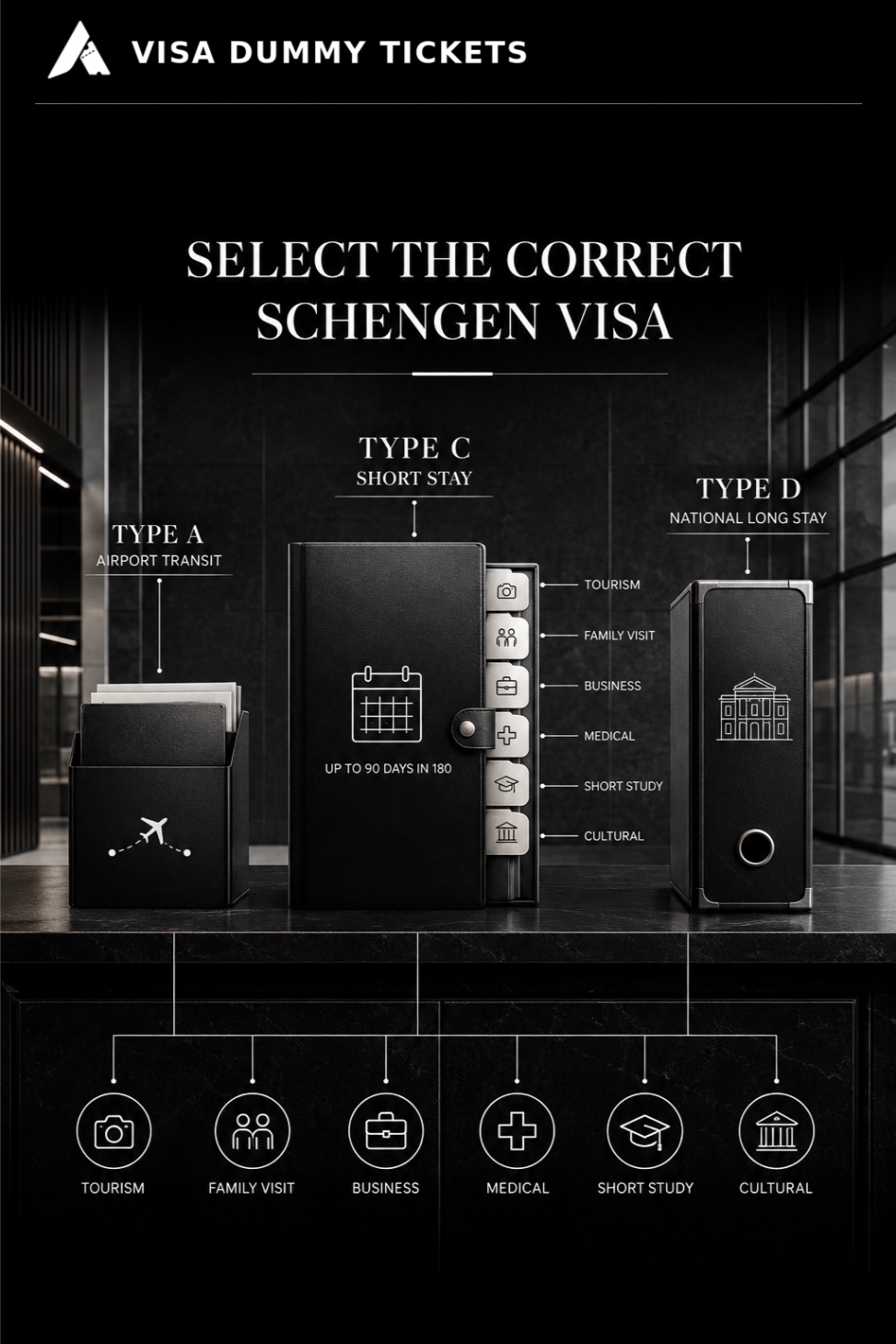
Airport Transit Visa – Type A
An airport transit visa permits certain travellers to pass through the international transit area of a Schengen airport while travelling to a non-Schengen destination. It normally does not permit entry into the Schengen territory.
Whether this visa is required depends on nationality, route, airport and any applicable exemption. Travellers with separate tickets, overnight connections, airport changes or baggage that must be collected should examine the transit rules particularly carefully.
Uniform Short-Stay Schengen Visa – Type C
The Type C visa is used for visits of up to 90 days within a 180-day period. It may be issued for:
- Tourism and holidays
- Visiting relatives or friends
- Business meetings and conferences
- Medical consultations or treatment
- Cultural, artistic or sporting events
- Short courses, training or academic visits
- Official delegations
- Journalism or professional assignments
- Other approved short-term purposes
The visa may permit a single entry, two entries or multiple entries.
Single-Entry Visa
A single-entry visa generally permits one entry into the Schengen Area. Once the holder leaves, the visa ordinarily cannot be used again, even if the printed validity period has not ended.
Moving from one Schengen member to another is not normally treated as leaving the Schengen Area. However, an itinerary that passes through a non-Schengen country may create another external border crossing and should be checked carefully.
Double-Entry Visa
A double-entry visa permits two entries during its validity. This may be relevant where a traveller plans to leave the Schengen Area temporarily and return during the same journey.
Multiple-Entry Visa
A multiple-entry Schengen visa permits repeated visits during its validity, provided the holder does not exceed the authorised duration or the 90-days-in-180 limit.
Applicants should not assume that requesting multiple entry guarantees its issuance. The consulate evaluates the declared need, travel history, reliability and supporting evidence.
Limited Territorial Validity Visa
A Limited Territorial Validity visa authorises travel only within the Schengen state or states identified on the visa. It is issued in specific circumstances and should not be treated as a standard visa valid throughout the entire Schengen Area.
National Long-Stay Visa – Type D
A national Type D visa is used for stays exceeding 90 days, including certain forms of employment, university study, research, residence and family reunification.
Although a Type D holder may receive limited travel rights within other Schengen countries, the application is governed primarily by the national immigration rules of the destination country. A person moving to Germany for work, France for a year of study or Italy for family reunification should follow that country’s national visa process rather than the standard short-stay tourist procedure.
Common Schengen Visa Purposes
The applicant must select a purpose that accurately represents the intended visit. Common purposes include:
Tourism
A tourist application normally explains the destinations, travel dates, sightseeing plans, transportation, accommodation and source of funds. The itinerary should be realistic rather than overloaded with too many distant cities in a short period.
Family or Private Visit
Applicants visiting relatives or friends may need an invitation letter, the host’s identification, address, residence status, relationship evidence and a statement explaining who will pay for the visit.
If the visitor will stay entirely with the host, an unnecessary hotel reservation should not be substituted for the correct host-accommodation documents.
Business
A business application may require an invitation from the receiving organisation, an employer letter, meeting agenda, event registration, commercial relationship evidence and an explanation of expenses.
Business visitors should distinguish meetings, negotiations and conferences from local employment, which may require a different authorisation.
Medical Treatment
A medical visa file may include a hospital or clinic letter, appointment confirmation, treatment plan, cost estimate, proof of payment or available funds and evidence explaining any accompanying person.
Short Study or Training
Academic visits lasting no more than 90 days may fall under the short-stay framework. Applicants generally need admission, registration or invitation evidence, programme dates, accommodation and funding documents.
Longer programmes normally require a national student visa.
Cultural, Sporting or Professional Event
The application may require an organiser’s invitation, event schedule, participant status, sponsorship information and evidence explaining the applicant’s role.
Which Schengen Country Should Receive the Application?
Applicants do not choose a consulate simply because it offers faster appointments or seems more likely to issue a visa.
The correct destination is determined using the following principles:
- One Schengen country: Apply to the country being visited.
- Several countries with one principal purpose: Apply to the country that represents the main purpose.
- Several countries with the same purpose: Apply to the country where the applicant will spend the longest period.
- Equal stays with no other clear main destination: Apply to the country of first entry.
For example, an applicant spending eight nights in Italy and four nights in France should ordinarily apply through Italy. An applicant spending five nights in France and five in Spain, entering through France, would generally apply through France if no other destination represents the principal purpose.
The route, accommodation and written itinerary should support this selection. Creating a longer reservation in one country merely to obtain an appointment there, when the real trip is centred elsewhere, can produce a misleading application.
The EU’s official applicant guidance confirms the principal-destination and first-entry rules and advises lodging an application no later than 15 calendar days before travel while planning up to six months in advance. Official Schengen visa guidance is available through the European External Action Service.
When Should You Apply?
A standard short-stay application may generally be lodged:
- No earlier than six months before the intended visit
- No earlier than nine months for qualifying seafarers
- As a rule, no later than 15 calendar days before departure
These are legal application windows, not recommended last-minute planning targets. Appointments can become unavailable during holiday seasons, summer travel periods, major exhibitions and religious festivals.
A decision is commonly made within 15 calendar days after an admissible application is lodged, but individual cases may require additional examination and can take up to 45 days. Applicants should allow time for an appointment, document preparation, possible requests for further evidence and passport return.
The applicable time limits are summarised in the EU Visa Code.
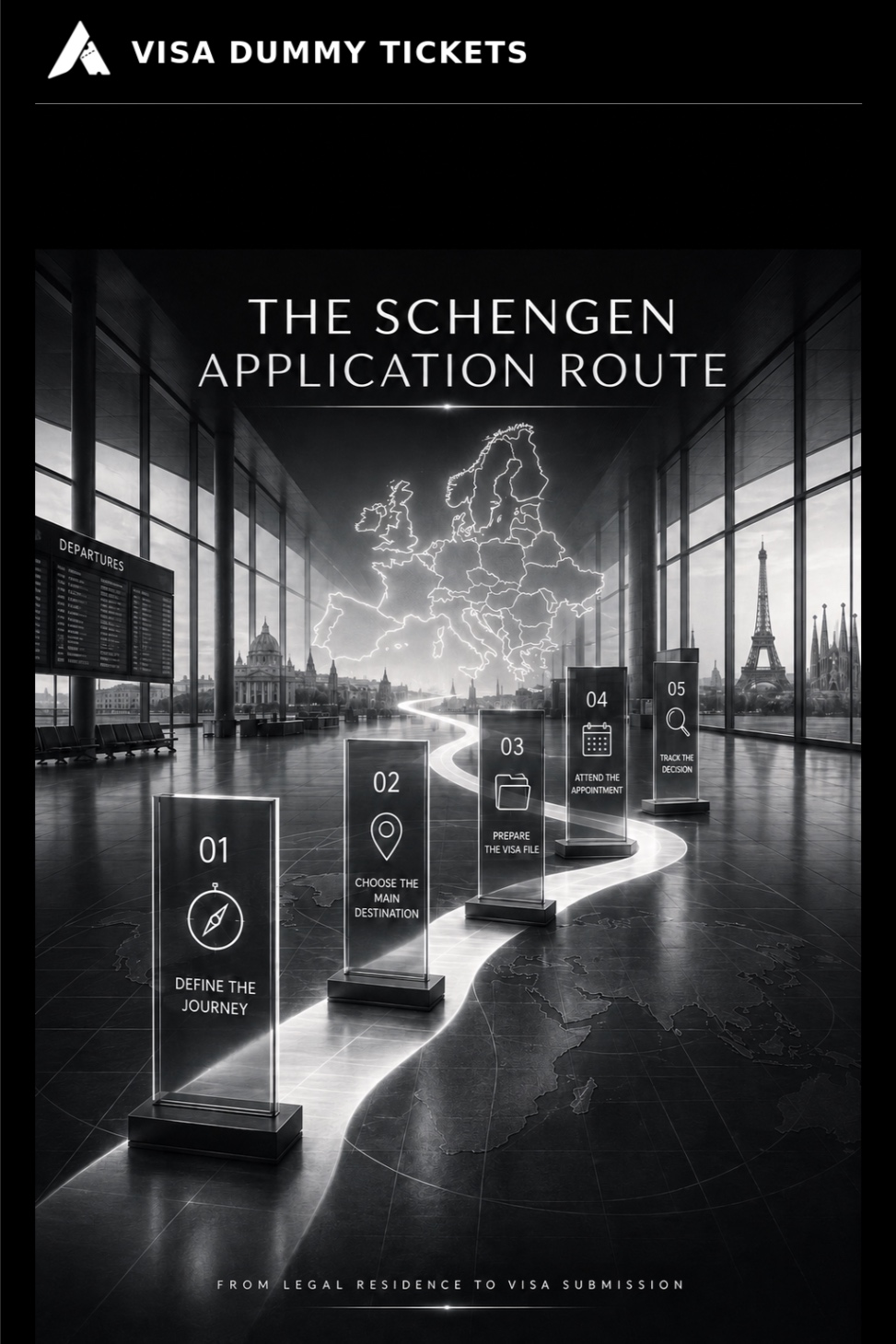
Step-by-Step Schengen Visa Application Process
Step 1: Confirm Whether a Visa Is Required
Check the official website of the destination country’s embassy or consulate. Requirements depend principally on nationality, passport type, residence status, purpose and intended duration.
Do not rely solely on social-media posts, informal forums or another traveller’s experience. A person with a different nationality or residence permit may be subject to different rules.
Step 2: Define the Genuine Journey
Decide:
- The purpose of travel
- Intended departure and return dates
- Countries and cities to be visited
- Principal destination
- Number of nights in each location
- Method of travel between destinations
- Who will finance the trip
- Where the applicant will stay
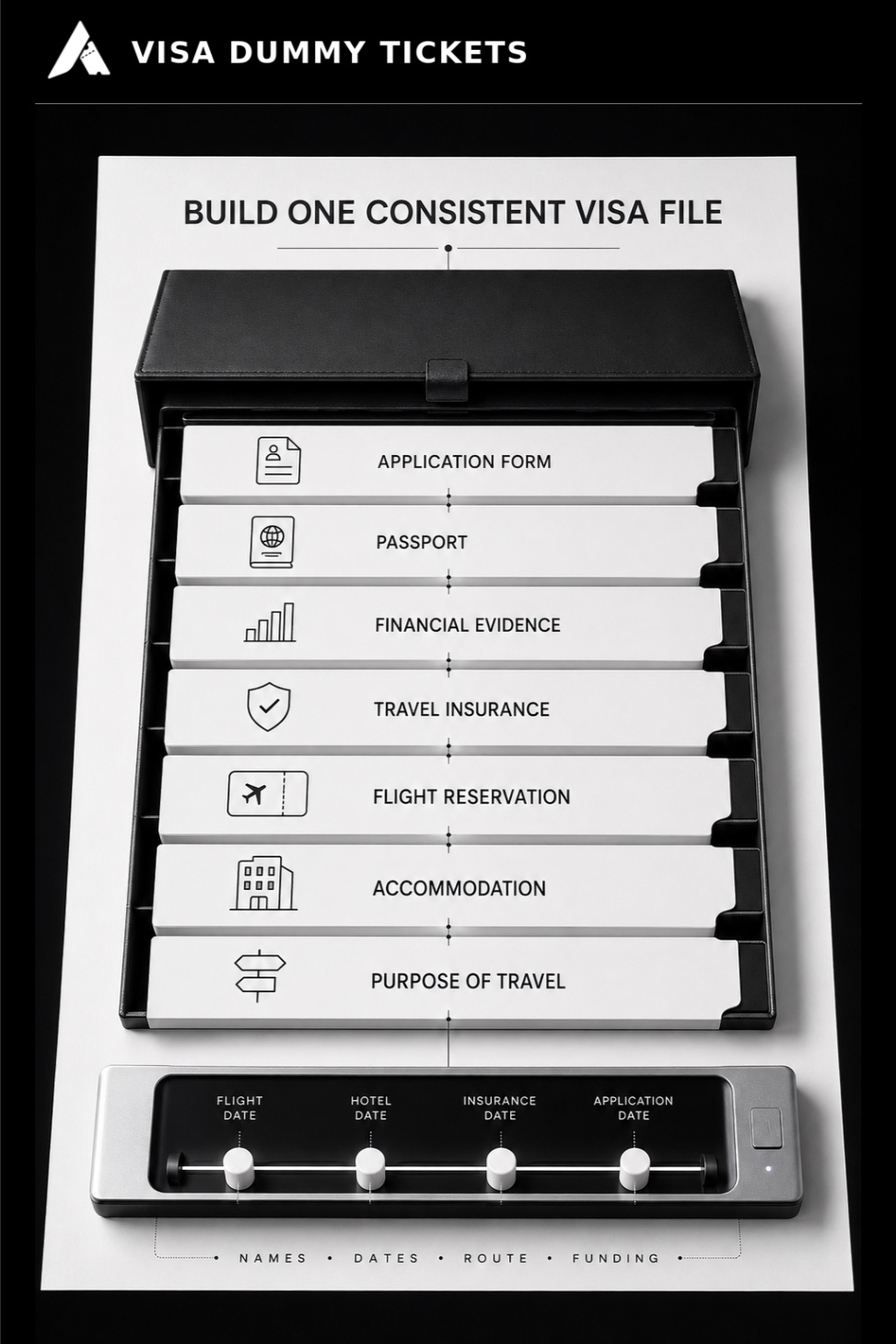
These decisions form the foundation of the application. Flight reservations, hotel bookings, insurance, leave dates, invitations and the application form should describe the same journey.
Step 3: Identify the Competent Consulate
Use the destination and residence rules to determine the correct consular authority. The application may be collected directly by a consulate or by an authorised external service provider.
An appointment booked with a commercial visa centre does not transfer decision-making authority. The competent consulate remains responsible for assessing the application.
Step 4: Select the Correct Visa Purpose
Choose the category matching the real reason for travel. If a trip combines purposes, determine the principal purpose and explain the secondary activity transparently.
For example, an applicant attending a three-day conference and then taking a short holiday may still have business as the primary purpose. The supporting documents should explain the full schedule.
Step 5: Complete the Application Form
Enter personal, passport, travel, employment, host and financial information accurately. Names should match the passport, including spacing and order where required.
Review:
- Passport number
- Issue and expiry dates
- Travel dates
- Destination country
- Number of entries requested
- Previous Schengen visas
- Employer or educational institution
- Host or hotel information
- Person responsible for expenses
Differences between the form and supporting documents should be corrected or explained before submission.
Step 6: Assemble the Required Documents
Create a checklist based on the official requirements of the responsible mission. Arrange documents in the requested order and provide translations where required.
Do not submit altered records, fictional employer letters, false bank statements, counterfeit tickets or accommodation documents that misrepresent the intended journey.
Step 7: Arrange Travel Insurance
Travel medical insurance is normally required for a short-stay Schengen application. Standard EU guidance commonly requires coverage of at least €30,000, valid throughout the Schengen Area and covering the intended stay.
The policy should satisfy the current mission checklist, including any required coverage for emergency medical treatment, hospitalisation and repatriation.
Step 8: Arrange Flight and Accommodation Reservations
If the checklist asks for a proposed flight itinerary and proof of accommodation, applicants can use application-stage reservations instead of purchasing non-refundable travel prematurely.
The details must be consistent with the form, insurance and written itinerary. A reservation supports the proposed journey; it does not guarantee visa approval.
Step 9: Attend the Appointment
Applicants normally submit documents, provide biometrics where required and pay the applicable fee. Fingerprints previously collected for a Schengen visa may remain reusable for a defined period, but the mission can still require personal attendance.
Bring originals and copies according to the checklist. Be prepared to answer direct questions about the trip, employment, finances, host, destination and intention to return.
Step 10: Track the Application and Respond Promptly
Monitor the tracking facility provided by the consulate or visa centre. If additional information is requested, respond within the specified time and ensure that new documents remain consistent with the original application.
Step 11: Check the Issued Visa
After receiving the passport, review:
- Name and passport number
- Valid-from and valid-until dates
- Number of entries
- Permitted duration
- Territorial validity
- Any remarks
Report an apparent printing error to the issuing authority before travelling.
Schengen Visa Document Requirements
The final checklist differs by jurisdiction, but applicants are commonly asked to provide the following categories of evidence.
Core Application Documents
- Completed and signed visa application form
- Valid passport or recognised travel document
- Copies of relevant passport pages
- Recent biometric photographs
- Appointment confirmation
- Proof of payment or applicable visa fee
- Previous passports or visas, where requested
The passport normally must remain valid for at least three months after the intended departure from the Schengen Area, contain sufficient blank pages and satisfy the applicable issue-date requirements.
Proof of Legal Residence
A non-citizen applying outside their country of nationality may need:
- Residence permit
- Work or study visa
- Permanent residence card
- Immigration status document
- Evidence of local address
The residence permission may need to remain valid beyond the proposed return date.
Evidence of Travel Purpose
Depending on the category, this may include:
- Detailed travel plan
- Tourism itinerary
- Invitation letter
- Host identification and address
- Business invitation and meeting agenda
- Conference registration
- Medical appointment and cost estimate
- Admission or training confirmation
- Event participation evidence
- Family relationship records
Financial Evidence
Applicants may be asked to show that they can pay for transportation, accommodation, meals and daily expenses. Evidence can include:
- Recent personal bank statements
- Salary slips
- Employment income
- Tax records
- Savings evidence
- Sponsorship letter
- Sponsor’s bank and income documents
- Business ownership records
- Scholarship or grant documentation
A large unexplained deposit made immediately before applying can raise questions. Financial records should show an understandable and lawful source of funds.
Employment, Business or Study Evidence
Employed applicants may provide:
- Employment confirmation
- Approved leave letter
- Contract
- Salary statements
- Employer contact details
Business owners may provide:
- Company registration
- Tax documents
- Business bank statements
- Partnership or directorship records
- Evidence of active operations
Students may provide:
- Enrolment confirmation
- Approved absence
- Academic schedule
- Student identification
Evidence of Reasons to Return
A consulate assesses the whole application, including whether the traveller is likely to leave within the authorised period. Relevant evidence may include:
- Continuing employment
- Active business responsibilities
- Current studies
- Immediate family responsibilities
- Property or tenancy
- Professional commitments
- A credible travel history
- A scheduled return to work or study
No single document guarantees success. The evidence should collectively explain the applicant’s circumstances.
Travel Medical Insurance
The certificate should clearly identify:
- Insured traveller
- Coverage period
- Geographic validity
- Medical coverage amount
- Relevant emergency benefits
- Insurer details
Flight Reservation for Schengen Visa
A flight reservation may show:
- Passenger’s full name
- Airline
- Flight number
- Departure and arrival airports
- Dates and times
- Connections
- Return or onward journey
- PNR or booking reference
Hotel Booking or Proof of Accommodation
Proof of accommodation may show:
- Guest name
- Property name
- Complete address
- Contact details
- Check-in and check-out dates
- Booking or confirmation reference
- Number of guests
- Stay covering the relevant nights
Other acceptable accommodation evidence can include a host declaration, official invitation, rental agreement or institution-provided housing, depending on the trip.
How to Get a Flight Reservation for a Schengen Visa
Purchasing a fully paid, non-refundable airfare before receiving a visa can create avoidable financial exposure. When the mission requests a proposed itinerary rather than a paid ticket, an applicant can order a dummy flight ticket for Schengen visa use.
Visa Dummy Tickets uses the passenger information, proposed route and intended travel dates supplied in the order to prepare a structured flight reservation. One-way, return and multi-city itineraries can be requested according to the travel plan.
Information Needed for a Flight Reservation
Provide:
- Full passenger name exactly as shown in the passport
- Departure country and airport
- Destination or destinations
- Intended departure date
- Intended return date
- One-way, return or multi-city route
- Preferred airline or schedule, if relevant
- Visa appointment or submission date
What to Check After Delivery
Review:
- Spelling of every passenger name
- Departure and return dates
- Airport codes
- Destination order
- Transit points
- Flight numbers
- Booking reference
- Consistency with insurance and accommodation
The supplied booking reference and traveller’s surname can be entered in the airline’s official Manage Booking facility to review the reservation details. The reservation may also be reviewed using the available itinerary-retrieval information.
A dummy flight ticket for a visa application is a reservation record, not an e-ticket, boarding pass or proof that the full airfare has been paid. Its role is to present the intended travel plan at the application stage.
VDT reservations are prepared for prompt email delivery and supported through a monitored validity period of up to 14 days under the applicable service terms. Because airlines control reservation inventory and status, applicants should review their records close to submission and contact support if assistance is required.
How to Get a Hotel Booking for a Schengen Visa
Proof of accommodation should account for the intended stay. If an applicant plans to spend four nights in Rome, three in Florence and five in Paris, the accommodation evidence should reflect those dates without unexplained gaps or overlapping stays.
A dummy hotel booking for Schengen visa use can be ordered without paying the complete room cost in advance.
Information Needed for a Hotel Reservation
Provide:
- Full guest name
- Destination city or cities
- Check-in and check-out dates
- Number of guests
- Room requirements
- Preferred hotel or area, if applicable
- Flight arrival and departure dates
What a Hotel Confirmation Can Show
The reservation can present:
- Guest name
- Hotel or property name
- Address and contact information
- Check-in and check-out dates
- Number of nights
- Confirmation reference
- Room or occupancy details
The hotel booking can be reviewed through CheckMyTrip using the supplied reservation details.
Applicants should not order a hotel document for nights genuinely being spent with a private host. In that situation, the host invitation, address evidence and any locally required accommodation form should be used.
How to Align Flight and Hotel Reservations
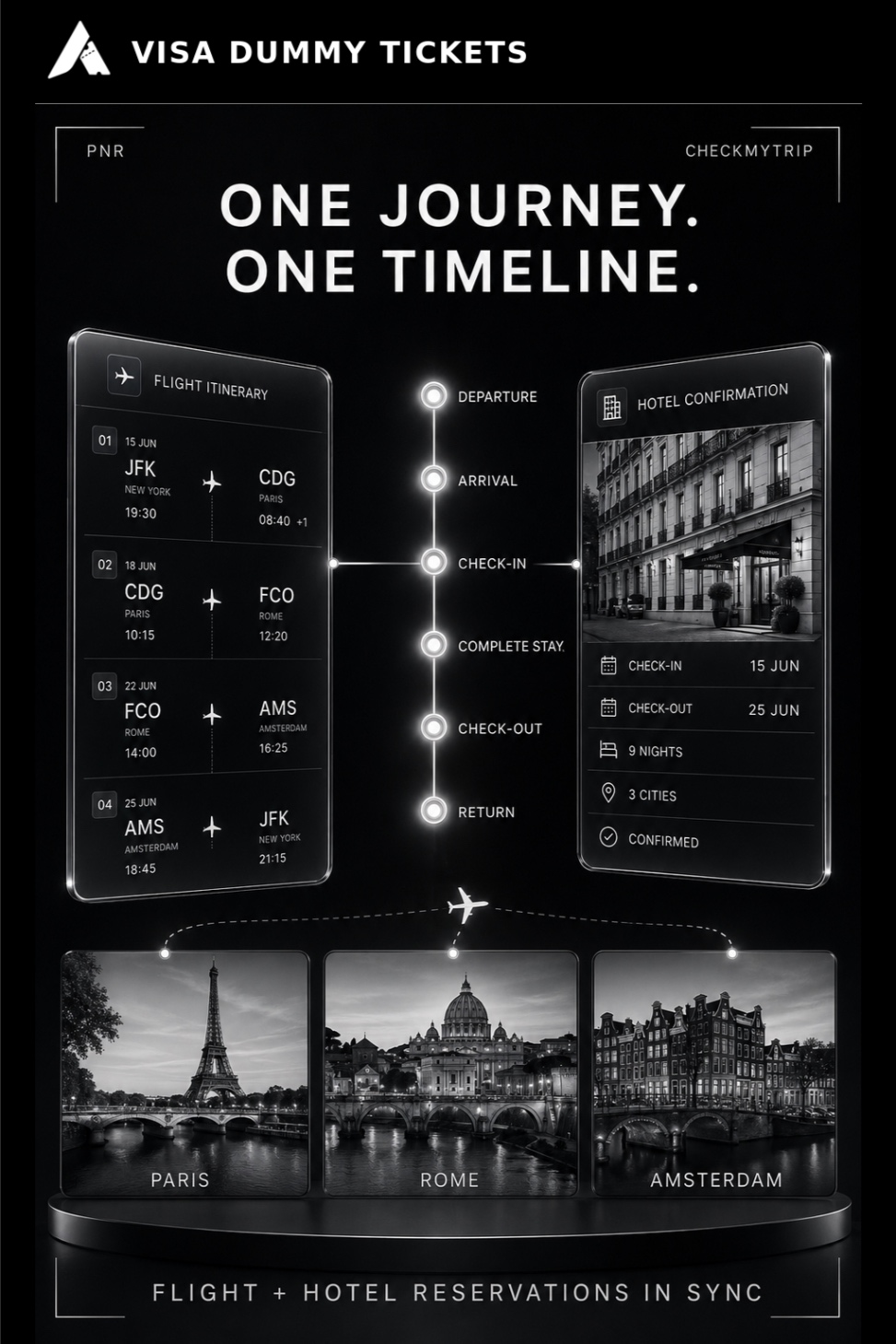
Consistency is more important than adding unnecessary detail. Review the journey as one timeline:
- The outbound flight arrives on the date stated in the application.
- The first accommodation begins on the arrival date.
- Every overnight stay is covered.
- Transfers between cities occur in a logical order.
- The final hotel check-out corresponds with the return or onward departure.
- Insurance covers the entire travel period.
- Employer leave or academic absence includes the relevant dates.
- Invitations and event bookings support the same destinations.
For an overnight flight, the accommodation may begin on the date of arrival rather than the date the aircraft departs. Time zones and overnight connections should therefore be checked carefully.
A multi-country route must also support the consular jurisdiction. If Italy is presented as the main destination, the itinerary should not reveal that the applicant is actually spending most of the visit elsewhere.
Common Reasons an Application File Appears Inconsistent
Applicants should correct the following issues before submission:
- Different spellings of the name
- Hotel dates beginning before arrival
- Missing accommodation nights
- Return flight after insurance expires
- Application submitted to the wrong destination
- Invitation dates that conflict with travel dates
- Unrealistic same-day connections
- Insufficient time between airports
- A business purpose supported only by tourist documents
- Unexplained financial deposits
- Leave approval ending before the return flight
- Contradictory answers in the form and cover letter
- Reservations that have already expired
- A hotel in a city unrelated to the declared route
A longer file is not necessarily a stronger file. Clear, relevant and mutually consistent evidence is generally more useful than a large collection of disconnected documents.
Schengen Visa Fees and Processing
The standard short-stay visa fee is generally €90 for adults and €45 for children aged six to under twelve, with exemptions or different arrangements applying to certain applicants. An authorised external service provider may charge an additional service fee.
Fees, exemptions and exchange rates can change. Always confirm the amount through the responsible mission before attending the appointment.
The application fee pays for assessment and is normally not refunded if the visa is refused.
Does a Reservation Guarantee Visa Approval?
No flight itinerary, hotel booking, invitation, insurance policy or cover letter can guarantee a Schengen visa.
The consulate assesses the application as a whole, including:
- Genuine purpose of travel
- Financial circumstances
- Accuracy of information
- Travel history
- Accommodation
- Insurance
- Intention to leave
- Security and immigration checks
- Compliance with the destination’s requirements
A well-prepared reservation helps communicate the intended journey, but only the competent authority can decide whether the applicant meets the legal requirements.
Final Schengen Visa Application Checklist
Before submission, confirm that:
- The correct consulate has been selected.
- The form is complete and signed.
- Passport details are accurate.
- The declared purpose is supported.
- Flight and hotel dates match.
- Every night is accounted for.
- Insurance covers the journey.
- Financial evidence is understandable.
- Employment, business or study evidence is current.
- Sponsorship documents identify responsibilities clearly.
- Translations and copies meet the checklist.
- The reservation is reviewed close to submission.
- No document has been altered or fabricated.
- The applicant can explain the travel plan confidently.
Frequently Asked Questions
Can I apply for a Schengen visa from any country?
You normally apply in the country where you are legally resident and through the mission responsible for your residential jurisdiction. Applying during a temporary visit elsewhere may be permitted only in justified circumstances accepted by the relevant consulate.
Which nationalities can use VDT flight and hotel reservation services?
VDT can prepare application-stage flight and hotel reservations for travellers residing in major regions worldwide, including the United States, Canada, the United Kingdom, Europe, the UAE, Saudi Arabia, Qatar, India, Pakistan, Bangladesh, China, the Philippines, Indonesia, Nigeria, Ghana, Kenya, South Africa, Morocco, Brazil, Australia and New Zealand.
For which Schengen destinations can reservations be prepared?
Reservations can be arranged for journeys involving Austria, Belgium, Bulgaria, Croatia, Czechia, Denmark, Estonia, Finland, France, Germany, Greece, Hungary, Iceland, Italy, Latvia, Liechtenstein, Lithuania, Luxembourg, Malta, the Netherlands, Norway, Poland, Portugal, Romania, Slovakia, Slovenia, Spain, Sweden and Switzerland.
Do I apply to the country I enter first?
Not automatically. Apply to the country representing the main purpose or longest stay. First entry is used when the main destination cannot otherwise be determined and the stays are equal.
Is a flight reservation the same as a paid ticket?
No. A flight reservation presents the proposed journey and booking information. It is not an e-ticket, boarding document or proof of full payment.
Can a dummy flight ticket be used for a Schengen visa application?
It can be used when the responsible mission requests a flight itinerary or reservation rather than a fully paid ticket. The document must contain accurate traveller and journey information and correspond with the rest of the application.
How long is a VDT reservation valid?
VDT provides reservations with monitored validity of up to 14 days under the applicable service terms. Applicants should order with reference to their appointment and submission schedule and review the reservation before lodging the application.
How can I verify the flight reservation?
Enter the supplied PNR or booking reference and passenger surname through the airline’s official Manage Booking service. Review the traveller name, route, dates and flight details before submission.
How can I verify the hotel booking?
The hotel reservation can be reviewed through CheckMyTrip using the reservation information supplied with the confirmation.
Do I need accommodation for every night?
The accommodation evidence should normally explain where the applicant intends to stay throughout the journey. Private-host stays should be supported using the appropriate invitation and host documents rather than an unnecessary hotel booking.
Should I buy my ticket before the visa decision?
Follow the embassy’s official checklist. Where only a reservation or planned itinerary is requested, purchasing expensive non-refundable airfare before a decision may be unnecessary.
Can I use one Schengen visa to visit several member countries?
A uniform short-stay visa can generally support travel within the Schengen Area, subject to its territorial validity, number of entries, permitted duration and the purpose for which it was issued.
Is a Schengen visa valid for the United Kingdom or Ireland?
No. The United Kingdom and Ireland apply their own immigration and visa rules. A Schengen visa does not automatically authorise entry into either country.
Does a Schengen visa guarantee admission at the border?
No. Border officials can request evidence supporting the visit and make an independent entry decision. Travellers should carry relevant itinerary, accommodation, insurance, funding and purpose documents.
Conclusion
A successful Schengen visa application begins with a truthful and well-defined travel plan. The applicant must select the correct destination, use the appropriate visa category, follow the mission-specific checklist and make every document support the same purpose, dates and route.
A carefully prepared flight reservation for a Schengen visa demonstrates the intended arrival, movement and departure. A matching hotel booking for a Schengen visa explains where the applicant plans to stay. Together, these records can make the proposed journey easier to understand without requiring the applicant to commit prematurely to the complete cost of airfare and accommodation.
Visa Dummy Tickets prepares flight, hotel and combined reservations around the information supplied by the traveller. Applicants remain responsible for providing accurate details, reviewing the delivered records and following the official instructions of the competent embassy or consulate.
Visa rules, fees and procedures can change. Confirm the latest requirements with the responsible mission before submitting any application.